

hydrooctasilsesquioxane (Karstedt’s catalyst, THF, 60 °C) which generated cage
molecules with introduced seven 3,3,3-trifluoropropyl and one propylglycidyl ether
unit. Formation of the expected products was confirmed by IR (bands at 906 and
1255 cm
−1 —symmetric and asymmetric stretching vibrations of C–O–C in epoxide
ring, respectively) and NMR (epoxide ring—
1 H: d = 2.60 and 2.79 ppm, OCH 2 CH
and d = 3.16 ppm, OCH 2 CH,
13 C: d =44.4 ppm, CH 2 , d =51.0 ppm, OCH 2 CH)
spectroscopies. As concluded based on
29
Si NMR spectra, reaction between Si–H
groups of T 8
H and C=C bond of AGE took place mainly as b-addition with only a
small amount of a-addition product (signals at d = −65.2 ppm and d = −67.6 ppm
of high and low intensity, respectively). The synthesized materials were used to
prepare POSS-containing nanocomposites of epoxy resin [86] or poly(ethylene
imine) hybrids [87].
Szubert et al. [88] tested two rhodium siloxide complexes immobilized on SiO 2
as heterogeneous catalysts in the hydrosilylation of AGE, oct-1-ene,
4-allyl-1,2-dimethoxybenzene or allyl 1,1,2,2,3,3,4,4-octafluoropentyl ether with
Q 8 M 8
H which resulted in spherosilicate modified by the relevant groups
(Table 12.3, S1, S2, S3, and S4). One of the catalysts was also applied in the
consecutive hydrosilylation of two compounds: AGE and oct-1-ene or allyl
1,1,2,2,3,3,4,4-octafluoropentyl ether and AGE with Q 8 M 8
H leading to bifunctional
(Table 12.3, S1 and S2 or S4 and S1) spherosilicate molecules. Conversion degrees
of Si–H bonds in the systems were determined by FTIR spectroscopy (ATR
technique with a diamond crystal—monitoring the Si–H band at 903 cm
−1 ).
Chemical structures of the hydrosilylation products were established using
1 H,
13 C,
and
29 Si NMR spectroscopies.
13 C and
29 Si CP/MAS-NMR spectra of the catalysts
allowed concluding that the immobilized Rh complexes were stable after reuse in
ten hydrosilylation cycles.
Bifunctional spherosilicates with incorporated epoxide and methacrylate or
carboxylic acid moieties were prepared by Soh et al. [89] and Kastner et al. [90].
They were obtained by a one-pot process in which Q 8 M 8
H was treated with an
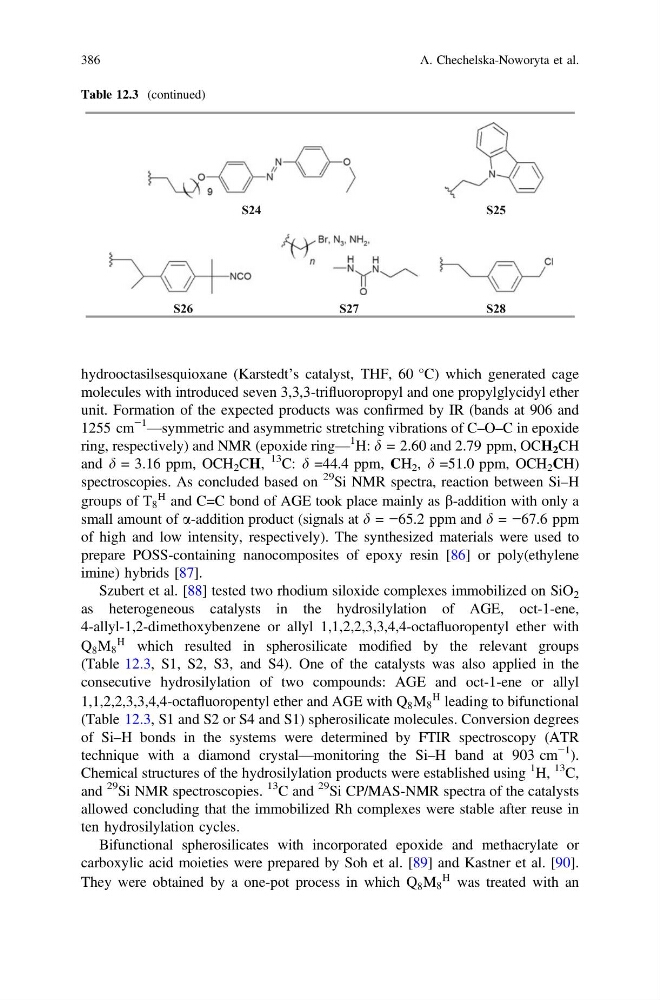
Table 12.3 (continued)
S24
S25
S26
S27
S28
386
A. Chechelska-Noworyta et al.
molecules with introduced seven 3,3,3-trifluoropropyl and one propylglycidyl ether
unit. Formation of the expected products was confirmed by IR (bands at 906 and
1255 cm
−1 —symmetric and asymmetric stretching vibrations of C–O–C in epoxide
ring, respectively) and NMR (epoxide ring—
1 H: d = 2.60 and 2.79 ppm, OCH 2 CH
and d = 3.16 ppm, OCH 2 CH,
13 C: d =44.4 ppm, CH 2 , d =51.0 ppm, OCH 2 CH)
spectroscopies. As concluded based on
29
Si NMR spectra, reaction between Si–H
groups of T 8
H and C=C bond of AGE took place mainly as b-addition with only a
small amount of a-addition product (signals at d = −65.2 ppm and d = −67.6 ppm
of high and low intensity, respectively). The synthesized materials were used to
prepare POSS-containing nanocomposites of epoxy resin [86] or poly(ethylene
imine) hybrids [87].
Szubert et al. [88] tested two rhodium siloxide complexes immobilized on SiO 2
as heterogeneous catalysts in the hydrosilylation of AGE, oct-1-ene,
4-allyl-1,2-dimethoxybenzene or allyl 1,1,2,2,3,3,4,4-octafluoropentyl ether with
Q 8 M 8
H which resulted in spherosilicate modified by the relevant groups
(Table 12.3, S1, S2, S3, and S4). One of the catalysts was also applied in the
consecutive hydrosilylation of two compounds: AGE and oct-1-ene or allyl
1,1,2,2,3,3,4,4-octafluoropentyl ether and AGE with Q 8 M 8
H leading to bifunctional
(Table 12.3, S1 and S2 or S4 and S1) spherosilicate molecules. Conversion degrees
of Si–H bonds in the systems were determined by FTIR spectroscopy (ATR
technique with a diamond crystal—monitoring the Si–H band at 903 cm
−1 ).
Chemical structures of the hydrosilylation products were established using
1 H,
13 C,
and
29 Si NMR spectroscopies.
13 C and
29 Si CP/MAS-NMR spectra of the catalysts
allowed concluding that the immobilized Rh complexes were stable after reuse in
ten hydrosilylation cycles.
Bifunctional spherosilicates with incorporated epoxide and methacrylate or
carboxylic acid moieties were prepared by Soh et al. [89] and Kastner et al. [90].
They were obtained by a one-pot process in which Q 8 M 8
H was treated with an
Table 12.3 (continued)
S24
S25
S26
S27
S28
386
A. Chechelska-Noworyta et al.