

reflux). Products were transformed to octaaldehyde molecules proved to yield imine
moieties-containing ones upon the reaction with an aniline derivative. All the
synthesized compounds were fully characterized by
1 H,
13 C NMR, and FTIR
spectroscopies [84]. Herrero et al. [85], in turn, prepared dendrimers with introduced 16 or 32 ferrocenyl units by hydrosilylation of octavinyloctasilsesquioxane
or octasilsesquioxane containing 16 vinyl groups (synthesized in the work) with bis
(ferrocenyl)methylsilane (Karstedt’s catalyst, toluene, 75 °C).
1 H NMR spectra
evidenced completeness of reactions (no Si-vinyl lines in the d = 5.7–6.1 ppm
region, decrease in the d = 4.92 ppm line of Si–H protons).
1 H and
13 C NMR
spectroscopies demonstrated that only the anti-Markovnikov (b) addition products
were formed. In the
29 Si NMR spectra, all signals could be easily assigned to the
corresponding atoms, and no signals indicating cleavage of the cage structure were
seen. The materials with incorporated ferrocenyl units are electroactive and can be
potentially used as biosensors [85].
In the following parts of this section, studies of octahydrooctasilsesquioxane
(T 8
H ) and octakis(dimethylsiloxy)octasilsesquioxane (Q 8 M 8
H ), i.e., silsesquioxane
and silicate, respectively, containing Si–H groups, modified by organic moieties in
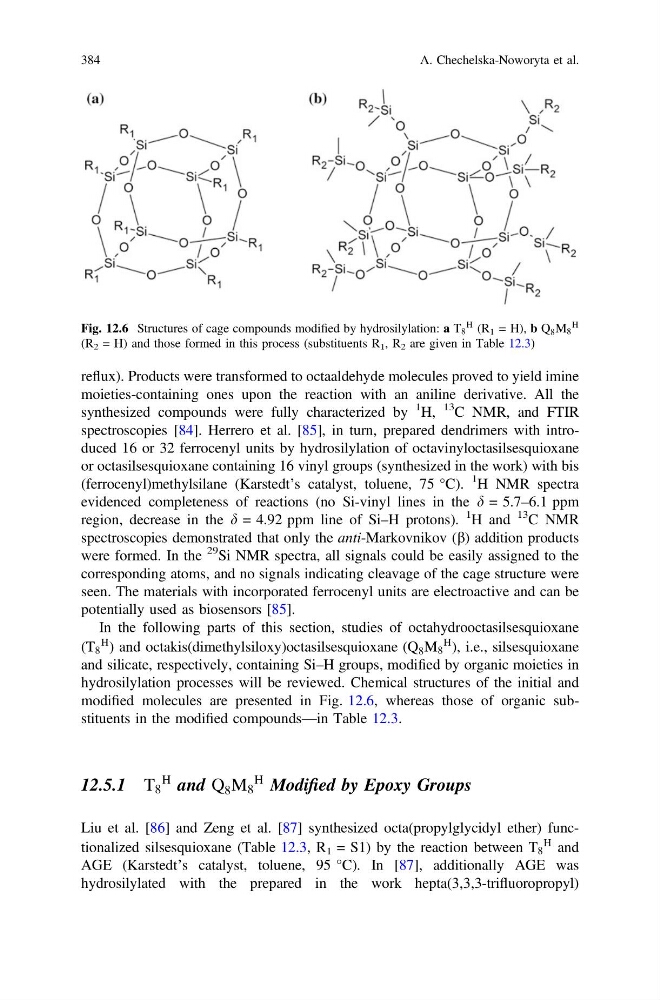
hydrosilylation processes will be reviewed. Chemical structures of the initial and
modified molecules are presented in Fig. 12.6, whereas those of organic substituents in the modified compounds—in Table 12.3.
12.5.1 T 8
H and Q 8 M 8
H Modified by Epoxy Groups
Liu et al. [86] and Zeng et al. [87] synthesized octa(propylglycidyl ether) functionalized silsesquioxane (Table 12.3, R 1 = S1) by the reaction between T 8
H and
AGE (Karstedt’s catalyst, toluene, 95 °C). In [87], additionally AGE was
hydrosilylated with the prepared in the work hepta(3,3,3-trifluoropropyl)
Fig. 12.6 Structures of cage compounds modified by hydrosilylation: a T 8
H (R 1 = H), b Q 8 M 8
H
(R 2 = H) and those formed in this process (substituents R 1 , R 2 are given in Table 12.3)
384
A. Chechelska-Noworyta et al.
moieties-containing ones upon the reaction with an aniline derivative. All the
synthesized compounds were fully characterized by
1 H,
13 C NMR, and FTIR
spectroscopies [84]. Herrero et al. [85], in turn, prepared dendrimers with introduced 16 or 32 ferrocenyl units by hydrosilylation of octavinyloctasilsesquioxane
or octasilsesquioxane containing 16 vinyl groups (synthesized in the work) with bis
(ferrocenyl)methylsilane (Karstedt’s catalyst, toluene, 75 °C).
1 H NMR spectra
evidenced completeness of reactions (no Si-vinyl lines in the d = 5.7–6.1 ppm
region, decrease in the d = 4.92 ppm line of Si–H protons).
1 H and
13 C NMR
spectroscopies demonstrated that only the anti-Markovnikov (b) addition products
were formed. In the
29 Si NMR spectra, all signals could be easily assigned to the
corresponding atoms, and no signals indicating cleavage of the cage structure were
seen. The materials with incorporated ferrocenyl units are electroactive and can be
potentially used as biosensors [85].
In the following parts of this section, studies of octahydrooctasilsesquioxane
(T 8
H ) and octakis(dimethylsiloxy)octasilsesquioxane (Q 8 M 8
H ), i.e., silsesquioxane
and silicate, respectively, containing Si–H groups, modified by organic moieties in
hydrosilylation processes will be reviewed. Chemical structures of the initial and
modified molecules are presented in Fig. 12.6, whereas those of organic substituents in the modified compounds—in Table 12.3.
12.5.1 T 8
H and Q 8 M 8
H Modified by Epoxy Groups
Liu et al. [86] and Zeng et al. [87] synthesized octa(propylglycidyl ether) functionalized silsesquioxane (Table 12.3, R 1 = S1) by the reaction between T 8
H and
AGE (Karstedt’s catalyst, toluene, 95 °C). In [87], additionally AGE was
hydrosilylated with the prepared in the work hepta(3,3,3-trifluoropropyl)
Fig. 12.6 Structures of cage compounds modified by hydrosilylation: a T 8
H (R 1 = H), b Q 8 M 8
H
(R 2 = H) and those formed in this process (substituents R 1 , R 2 are given in Table 12.3)
384
A. Chechelska-Noworyta et al.