

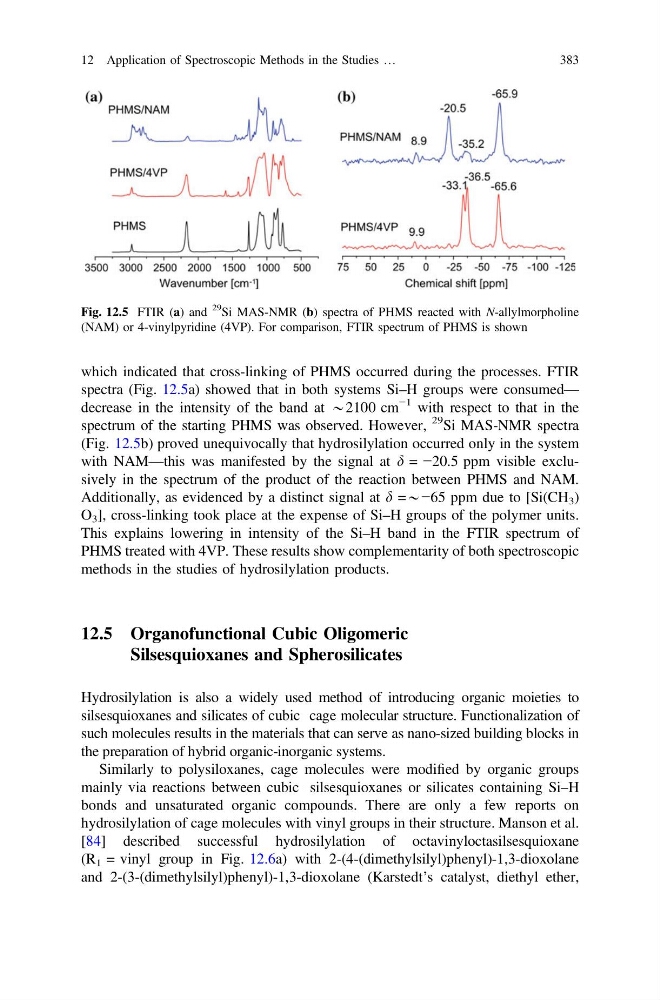
which indicated that cross-linking of PHMS occurred during the processes. FTIR
spectra (Fig. 12.5a) showed that in both systems Si–H groups were consumed—
decrease in the intensity of the band at *2100 cm
−1 with respect to that in the
spectrum of the starting PHMS was observed. However,
29 Si MAS-NMR spectra
(Fig. 12.5b) proved unequivocally that hydrosilylation occurred only in the system
with NAM—this was manifested by the signal at d = −20.5 ppm visible exclusively in the spectrum of the product of the reaction between PHMS and NAM.
Additionally, as evidenced by a distinct signal at d =*−65 ppm due to [Si(CH 3 )
O 3 ], cross-linking took place at the expense of Si–H groups of the polymer units.
This explains lowering in intensity of the Si–H band in the FTIR spectrum of
PHMS treated with 4VP. These results show complementarity of both spectroscopic
methods in the studies of hydrosilylation products.
12.5 Organofunctional Cubic Oligomeric
Silsesquioxanes and Spherosilicates
Hydrosilylation is also a widely used method of introducing organic moieties to
silsesquioxanes and silicates of cubic cage molecular structure. Functionalization of
such molecules results in the materials that can serve as nano-sized building blocks in
the preparation of hybrid organic-inorganic systems.
Similarly to polysiloxanes, cage molecules were modified by organic groups
mainly via reactions between cubic silsesquioxanes or silicates containing Si–H
bonds and unsaturated organic compounds. There are only a few reports on
hydrosilylation of cage molecules with vinyl groups in their structure. Manson et al.
[84] described successful hydrosilylation of octavinyloctasilsesquioxane
(R 1 = vinyl group in Fig. 12.6a) with 2-(4-(dimethylsilyl)phenyl)-1,3-dioxolane
and 2-(3-(dimethylsilyl)phenyl)-1,3-dioxolane (Karstedt’s catalyst, diethyl ether,
Fig. 12.5 FTIR (a) and
29
Si MAS-NMR (b) spectra of PHMS reacted with N-allylmorpholine
(NAM) or 4-vinylpyridine (4VP). For comparison, FTIR spectrum of PHMS is shown
12 Application of Spectroscopic Methods in the Studies …
383
spectra (Fig. 12.5a) showed that in both systems Si–H groups were consumed—
decrease in the intensity of the band at *2100 cm
−1 with respect to that in the
spectrum of the starting PHMS was observed. However,
29 Si MAS-NMR spectra
(Fig. 12.5b) proved unequivocally that hydrosilylation occurred only in the system
with NAM—this was manifested by the signal at d = −20.5 ppm visible exclusively in the spectrum of the product of the reaction between PHMS and NAM.
Additionally, as evidenced by a distinct signal at d =*−65 ppm due to [Si(CH 3 )
O 3 ], cross-linking took place at the expense of Si–H groups of the polymer units.
This explains lowering in intensity of the Si–H band in the FTIR spectrum of
PHMS treated with 4VP. These results show complementarity of both spectroscopic
methods in the studies of hydrosilylation products.
12.5 Organofunctional Cubic Oligomeric
Silsesquioxanes and Spherosilicates
Hydrosilylation is also a widely used method of introducing organic moieties to
silsesquioxanes and silicates of cubic cage molecular structure. Functionalization of
such molecules results in the materials that can serve as nano-sized building blocks in
the preparation of hybrid organic-inorganic systems.
Similarly to polysiloxanes, cage molecules were modified by organic groups
mainly via reactions between cubic silsesquioxanes or silicates containing Si–H
bonds and unsaturated organic compounds. There are only a few reports on
hydrosilylation of cage molecules with vinyl groups in their structure. Manson et al.
[84] described successful hydrosilylation of octavinyloctasilsesquioxane
(R 1 = vinyl group in Fig. 12.6a) with 2-(4-(dimethylsilyl)phenyl)-1,3-dioxolane
and 2-(3-(dimethylsilyl)phenyl)-1,3-dioxolane (Karstedt’s catalyst, diethyl ether,
Fig. 12.5 FTIR (a) and
29
Si MAS-NMR (b) spectra of PHMS reacted with N-allylmorpholine
(NAM) or 4-vinylpyridine (4VP). For comparison, FTIR spectrum of PHMS is shown
12 Application of Spectroscopic Methods in the Studies …
383