

which was explained by the presence of strongly electronegative fluorine atoms in
the substituents. Integration of the
1 H NMR signals, in turn, made it possible to
estimate that about 15% of the Si-vinyl groups in polymer II remained unreacted,
independently of the fluorosilane applied in the modification process. For
3,3,3-trifluoropropyldimethylsilane, this was confirmed by IR spectroscopy: The
spectrum of the hydrosilylation product showed the band at 1597 cm
−1 corresponding to the vibrations of C=C bonds.
In another work [29], a block copolymer obtained by sequential anionic ROP of
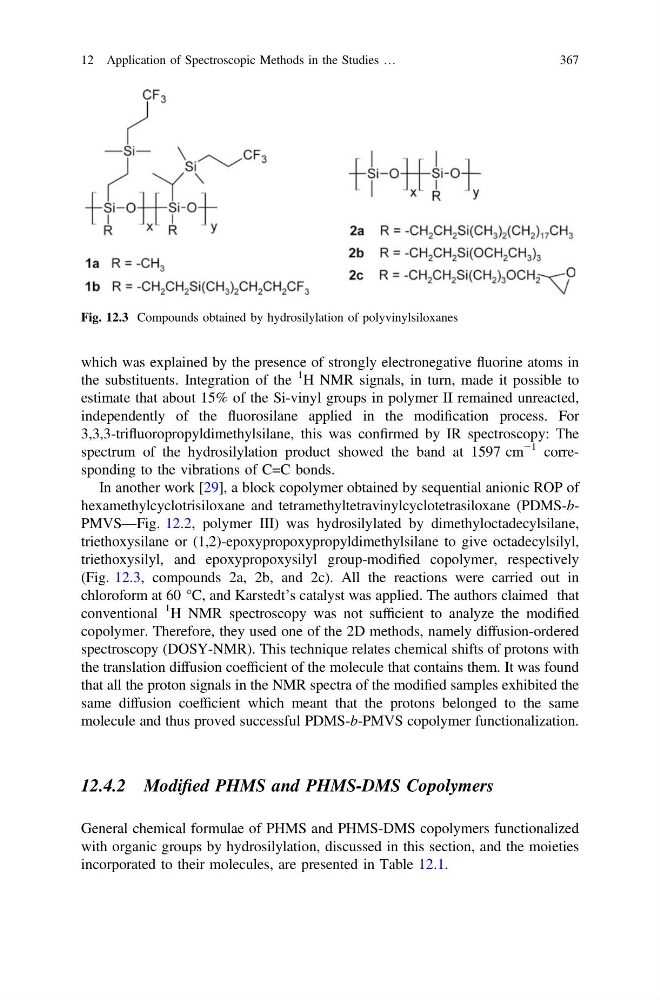
hexamethylcyclotrisiloxane and tetramethyltetravinylcyclotetrasiloxane (PDMS-bPMVS—Fig. 12.2, polymer III) was hydrosilylated by dimethyloctadecylsilane,
triethoxysilane or (1,2)-epoxypropoxypropyldimethylsilane to give octadecylsilyl,
triethoxysilyl, and epoxypropoxysilyl group-modified copolymer, respectively
(Fig. 12.3, compounds 2a, 2b, and 2c). All the reactions were carried out in
chloroform at 60 °C, and Karstedt’s catalyst was applied. The authors claimed that
conventional
1 H NMR spectroscopy was not sufficient to analyze the modified
copolymer. Therefore, they used one of the 2D methods, namely diffusion-ordered
spectroscopy (DOSY-NMR). This technique relates chemical shifts of protons with
the translation diffusion coefficient of the molecule that contains them. It was found
that all the proton signals in the NMR spectra of the modified samples exhibited the
same diffusion coefficient which meant that the protons belonged to the same
molecule and thus proved successful PDMS-b-PMVS copolymer functionalization.
12.4.2 Modified PHMS and PHMS-DMS Copolymers
General chemical formulae of PHMS and PHMS-DMS copolymers functionalized
with organic groups by hydrosilylation, discussed in this section, and the moieties
incorporated to their molecules, are presented in Table 12.1.
Fig. 12.3 Compounds obtained by hydrosilylation of polyvinylsiloxanes
12 Application of Spectroscopic Methods in the Studies …
367
the substituents. Integration of the
1 H NMR signals, in turn, made it possible to
estimate that about 15% of the Si-vinyl groups in polymer II remained unreacted,
independently of the fluorosilane applied in the modification process. For
3,3,3-trifluoropropyldimethylsilane, this was confirmed by IR spectroscopy: The
spectrum of the hydrosilylation product showed the band at 1597 cm
−1 corresponding to the vibrations of C=C bonds.
In another work [29], a block copolymer obtained by sequential anionic ROP of
hexamethylcyclotrisiloxane and tetramethyltetravinylcyclotetrasiloxane (PDMS-bPMVS—Fig. 12.2, polymer III) was hydrosilylated by dimethyloctadecylsilane,
triethoxysilane or (1,2)-epoxypropoxypropyldimethylsilane to give octadecylsilyl,
triethoxysilyl, and epoxypropoxysilyl group-modified copolymer, respectively
(Fig. 12.3, compounds 2a, 2b, and 2c). All the reactions were carried out in
chloroform at 60 °C, and Karstedt’s catalyst was applied. The authors claimed that
conventional
1 H NMR spectroscopy was not sufficient to analyze the modified
copolymer. Therefore, they used one of the 2D methods, namely diffusion-ordered
spectroscopy (DOSY-NMR). This technique relates chemical shifts of protons with
the translation diffusion coefficient of the molecule that contains them. It was found
that all the proton signals in the NMR spectra of the modified samples exhibited the
same diffusion coefficient which meant that the protons belonged to the same
molecule and thus proved successful PDMS-b-PMVS copolymer functionalization.
12.4.2 Modified PHMS and PHMS-DMS Copolymers
General chemical formulae of PHMS and PHMS-DMS copolymers functionalized
with organic groups by hydrosilylation, discussed in this section, and the moieties
incorporated to their molecules, are presented in Table 12.1.
Fig. 12.3 Compounds obtained by hydrosilylation of polyvinylsiloxanes
12 Application of Spectroscopic Methods in the Studies …
367