

The other two classes contain terminal functional groups located either at one or at
both chain ends. Due to limited space, only the first class of modified polysiloxanes
will be considered in this review.
Organic moieties incorporated into polysiloxanes can modify physical, chemical,
or both types of properties inherent to the parent polymers. Epoxy and other
oxygen-containing groups, amine and other nitrogen-containing groups, and
fluoroalkyl groups are the most important substituents that have been introduced to
polysiloxanes by hydrosilylation.
In principle, functionalization by hydrosilylation can be performed using the
polymers that contain either unsaturated hydrocarbon, such as vinyl groups, or H
atoms linked to Si atoms in the siloxane backbone. Survey of the literature shows,
however, that there are just a few examples of polyvinylsiloxanes subjected to this
process [28, 29]. The majority of work is devoted to functionalization of polyhydromethylsiloxane (PHMS) or its copolymers with various fractions of dimethylsiloxane units in the chain (PHMS-DMS). This is most probably due commercial
availability and relatively low cost of PHMS and the copolymers, whereas
polyvinylsiloxanes are not commercial products and have to be synthesized.
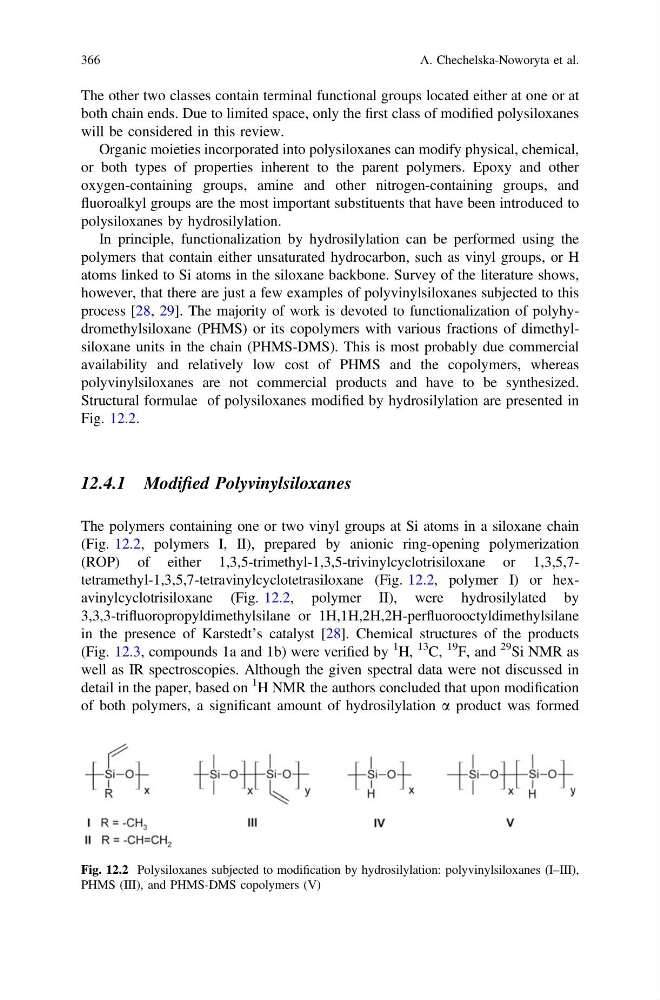
Structural formulae of polysiloxanes modified by hydrosilylation are presented in
Fig. 12.2.
12.4.1 Modified Polyvinylsiloxanes
The polymers containing one or two vinyl groups at Si atoms in a siloxane chain
(Fig. 12.2, polymers I, II), prepared by anionic ring-opening polymerization
(ROP) of either 1,3,5-trimethyl-1,3,5-trivinylcyclotrisiloxane or 1,3,5,7tetramethyl-1,3,5,7-tetravinylcyclotetrasiloxane (Fig. 12.2, polymer I) or hexavinylcyclotrisiloxane (Fig. 12.2, polymer II), were hydrosilylated by
3,3,3-trifluoropropyldimethylsilane or 1H,1H,2H,2H-perfluorooctyldimethylsilane
in the presence of Karstedt’s catalyst [28]. Chemical structures of the products
(Fig. 12.3, compounds 1a and 1b) were verified by
1 H,
13 C,
19 F, and
29 Si NMR as
well as IR spectroscopies. Although the given spectral data were not discussed in
detail in the paper, based on
1 H NMR the authors concluded that upon modification
of both polymers, a significant amount of hydrosilylation a product was formed
Fig. 12.2 Polysiloxanes subjected to modification by hydrosilylation: polyvinylsiloxanes (I–III),
PHMS (III), and PHMS-DMS copolymers (V)
366
A. Chechelska-Noworyta et al.
both chain ends. Due to limited space, only the first class of modified polysiloxanes
will be considered in this review.
Organic moieties incorporated into polysiloxanes can modify physical, chemical,
or both types of properties inherent to the parent polymers. Epoxy and other
oxygen-containing groups, amine and other nitrogen-containing groups, and
fluoroalkyl groups are the most important substituents that have been introduced to
polysiloxanes by hydrosilylation.
In principle, functionalization by hydrosilylation can be performed using the
polymers that contain either unsaturated hydrocarbon, such as vinyl groups, or H
atoms linked to Si atoms in the siloxane backbone. Survey of the literature shows,
however, that there are just a few examples of polyvinylsiloxanes subjected to this
process [28, 29]. The majority of work is devoted to functionalization of polyhydromethylsiloxane (PHMS) or its copolymers with various fractions of dimethylsiloxane units in the chain (PHMS-DMS). This is most probably due commercial
availability and relatively low cost of PHMS and the copolymers, whereas
polyvinylsiloxanes are not commercial products and have to be synthesized.
Structural formulae of polysiloxanes modified by hydrosilylation are presented in
Fig. 12.2.
12.4.1 Modified Polyvinylsiloxanes
The polymers containing one or two vinyl groups at Si atoms in a siloxane chain
(Fig. 12.2, polymers I, II), prepared by anionic ring-opening polymerization
(ROP) of either 1,3,5-trimethyl-1,3,5-trivinylcyclotrisiloxane or 1,3,5,7tetramethyl-1,3,5,7-tetravinylcyclotetrasiloxane (Fig. 12.2, polymer I) or hexavinylcyclotrisiloxane (Fig. 12.2, polymer II), were hydrosilylated by
3,3,3-trifluoropropyldimethylsilane or 1H,1H,2H,2H-perfluorooctyldimethylsilane
in the presence of Karstedt’s catalyst [28]. Chemical structures of the products
(Fig. 12.3, compounds 1a and 1b) were verified by
1 H,
13 C,
19 F, and
29 Si NMR as
well as IR spectroscopies. Although the given spectral data were not discussed in
detail in the paper, based on
1 H NMR the authors concluded that upon modification
of both polymers, a significant amount of hydrosilylation a product was formed
Fig. 12.2 Polysiloxanes subjected to modification by hydrosilylation: polyvinylsiloxanes (I–III),
PHMS (III), and PHMS-DMS copolymers (V)
366
A. Chechelska-Noworyta et al.