

zeolites, an attempt was made to reinterpret the experimental spectra of zeolites
based on calculations carried out for periodic model structures. The theoretical
spectra in this case allow for a much more unambiguous (although for obvious
reasons, non-ideal) assignment of individual bands, among which one can specify
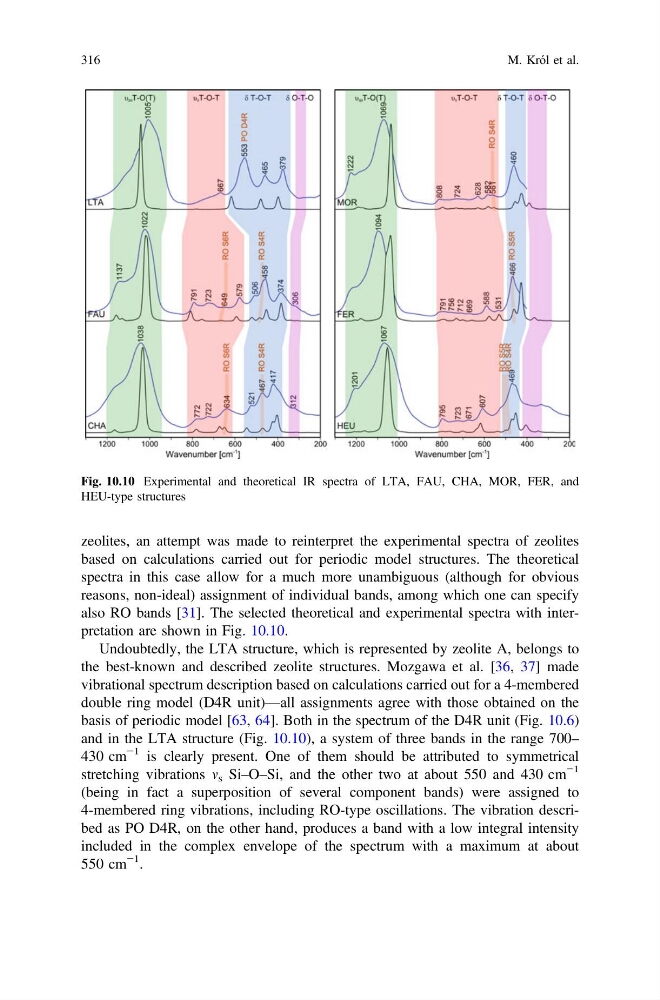
also RO bands [31]. The selected theoretical and experimental spectra with interpretation are shown in Fig. 10.10.
Undoubtedly, the LTA structure, which is represented by zeolite A, belongs to
the best-known and described zeolite structures. Mozgawa et al. [36, 37] made
vibrational spectrum description based on calculations carried out for a 4-membered
double ring model (D4R unit)—all assignments agree with those obtained on the
basis of periodic model [63, 64]. Both in the spectrum of the D4R unit (Fig. 10.6)
and in the LTA structure (Fig. 10.10), a system of three bands in the range 700–
430 cm
−1 is clearly present. One of them should be attributed to symmetrical
stretching vibrations m s Si–O–Si, and the other two at about 550 and 430 cm
−1
(being in fact a superposition of several component bands) were assigned to
4-membered ring vibrations, including RO-type oscillations. The vibration described as PO D4R, on the other hand, produces a band with a low integral intensity
included in the complex envelope of the spectrum with a maximum at about
550 cm
−1 .
Fig. 10.10 Experimental and theoretical IR spectra of LTA, FAU, CHA, MOR, FER, and
HEU-type structures
316
M. Król et al.
based on calculations carried out for periodic model structures. The theoretical
spectra in this case allow for a much more unambiguous (although for obvious
reasons, non-ideal) assignment of individual bands, among which one can specify
also RO bands [31]. The selected theoretical and experimental spectra with interpretation are shown in Fig. 10.10.
Undoubtedly, the LTA structure, which is represented by zeolite A, belongs to
the best-known and described zeolite structures. Mozgawa et al. [36, 37] made
vibrational spectrum description based on calculations carried out for a 4-membered
double ring model (D4R unit)—all assignments agree with those obtained on the
basis of periodic model [63, 64]. Both in the spectrum of the D4R unit (Fig. 10.6)
and in the LTA structure (Fig. 10.10), a system of three bands in the range 700–
430 cm
−1 is clearly present. One of them should be attributed to symmetrical
stretching vibrations m s Si–O–Si, and the other two at about 550 and 430 cm
−1
(being in fact a superposition of several component bands) were assigned to
4-membered ring vibrations, including RO-type oscillations. The vibration described as PO D4R, on the other hand, produces a band with a low integral intensity
included in the complex envelope of the spectrum with a maximum at about
550 cm
−1 .
Fig. 10.10 Experimental and theoretical IR spectra of LTA, FAU, CHA, MOR, FER, and
HEU-type structures
316
M. Król et al.