

and surface systems), BLYP (with Becke exchange [67] and Lee–Yang–Parr correlation [68]) or WC [69].
The next step (meta-GGA approximation) is the addition of consecutive
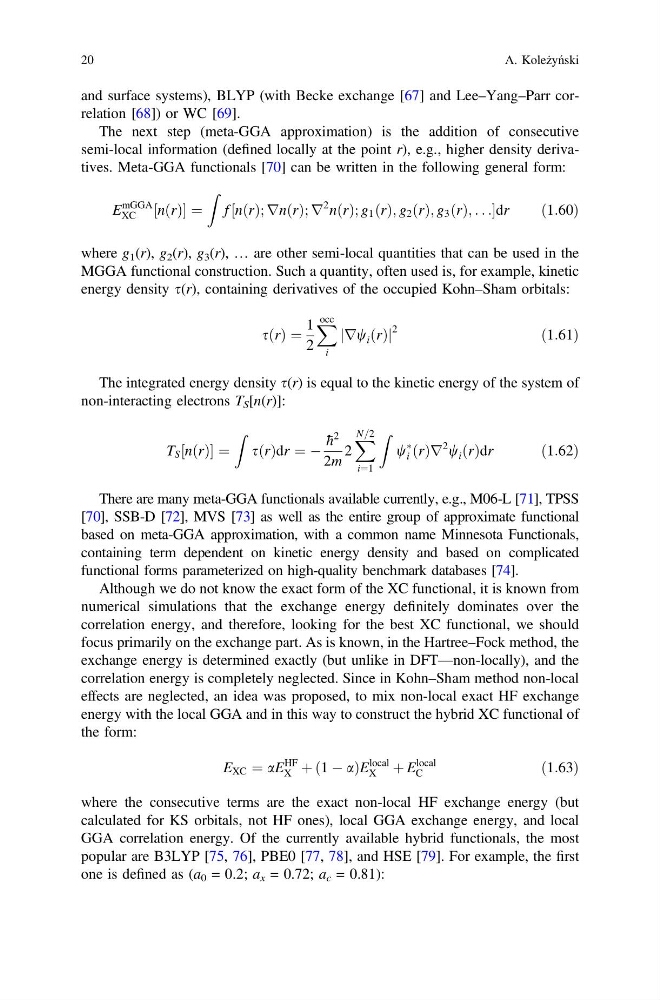
semi-local information (defined locally at the point r), e.g., higher density derivatives. Meta-GGA functionals [70] can be written in the following general form:
E
mGGA
XC
½nðrÞ ¼
Z
f ½nðrÞ; rnðrÞ; r
2 nðrÞ; g 1 ðrÞ; g 2 ðrÞ; g 3 ðrÞ; . . .dr
ð1:60Þ
where g 1 (r), g 2 (r), g 3 (r), … are other semi-local quantities that can be used in the
MGGA functional construction. Such a quantity, often used is, for example, kinetic
energy density s(r), containing derivatives of the occupied Kohn–Sham orbitals:
sðrÞ ¼
1
2
X occ
i
rw i ðrÞ
j
j
2
ð1:61Þ
The integrated energy density s(r) is equal to the kinetic energy of the system of
non-interacting electrons T S [n(r)]:
T S ½nðrÞ ¼
Z
sðrÞdr ¼ À
h
2
2m
2
X N=2
i¼1
Z
w
Ã
i ðrÞr
2 w i ðrÞdr
ð1:62Þ
There are many meta-GGA functionals available currently, e.g., M06-L [71], TPSS
[70], SSB-D [72], MVS [73] as well as the entire group of approximate functional
based on meta-GGA approximation, with a common name Minnesota Functionals,
containing term dependent on kinetic energy density and based on complicated
functional forms parameterized on high-quality benchmark databases [74].
Although we do not know the exact form of the XC functional, it is known from
numerical simulations that the exchange energy definitely dominates over the
correlation energy, and therefore, looking for the best XC functional, we should
focus primarily on the exchange part. As is known, in the Hartree–Fock method, the
exchange energy is determined exactly (but unlike in DFT—non-locally), and the
correlation energy is completely neglected. Since in Kohn–Sham method non-local
effects are neglected, an idea was proposed, to mix non-local exact HF exchange
energy with the local GGA and in this way to construct the hybrid XC functional of
the form:
E XC ¼ aE
HF
X þ ð1 À aÞE
local
X
þ E
local
C
ð1:63Þ
where the consecutive terms are the exact non-local HF exchange energy (but
calculated for KS orbitals, not HF ones), local GGA exchange energy, and local
GGA correlation energy. Of the currently available hybrid functionals, the most
popular are B3LYP [75, 76], PBE0 [77, 78], and HSE [79]. For example, the first
one is defined as (a 0 = 0.2; a x = 0.72; a c = 0.81):
20
A. Koleżyński
The next step (meta-GGA approximation) is the addition of consecutive
semi-local information (defined locally at the point r), e.g., higher density derivatives. Meta-GGA functionals [70] can be written in the following general form:
E
mGGA
XC
½nðrÞ ¼
Z
f ½nðrÞ; rnðrÞ; r
2 nðrÞ; g 1 ðrÞ; g 2 ðrÞ; g 3 ðrÞ; . . .dr
ð1:60Þ
where g 1 (r), g 2 (r), g 3 (r), … are other semi-local quantities that can be used in the
MGGA functional construction. Such a quantity, often used is, for example, kinetic
energy density s(r), containing derivatives of the occupied Kohn–Sham orbitals:
sðrÞ ¼
1
2
X occ
i
rw i ðrÞ
j
j
2
ð1:61Þ
The integrated energy density s(r) is equal to the kinetic energy of the system of
non-interacting electrons T S [n(r)]:
T S ½nðrÞ ¼
Z
sðrÞdr ¼ À
h
2
2m
2
X N=2
i¼1
Z
w
Ã
i ðrÞr
2 w i ðrÞdr
ð1:62Þ
There are many meta-GGA functionals available currently, e.g., M06-L [71], TPSS
[70], SSB-D [72], MVS [73] as well as the entire group of approximate functional
based on meta-GGA approximation, with a common name Minnesota Functionals,
containing term dependent on kinetic energy density and based on complicated
functional forms parameterized on high-quality benchmark databases [74].
Although we do not know the exact form of the XC functional, it is known from
numerical simulations that the exchange energy definitely dominates over the
correlation energy, and therefore, looking for the best XC functional, we should
focus primarily on the exchange part. As is known, in the Hartree–Fock method, the
exchange energy is determined exactly (but unlike in DFT—non-locally), and the
correlation energy is completely neglected. Since in Kohn–Sham method non-local
effects are neglected, an idea was proposed, to mix non-local exact HF exchange
energy with the local GGA and in this way to construct the hybrid XC functional of
the form:
E XC ¼ aE
HF
X þ ð1 À aÞE
local
X
þ E
local
C
ð1:63Þ
where the consecutive terms are the exact non-local HF exchange energy (but
calculated for KS orbitals, not HF ones), local GGA exchange energy, and local
GGA correlation energy. Of the currently available hybrid functionals, the most
popular are B3LYP [75, 76], PBE0 [77, 78], and HSE [79]. For example, the first
one is defined as (a 0 = 0.2; a x = 0.72; a c = 0.81):
20
A. Koleżyński