

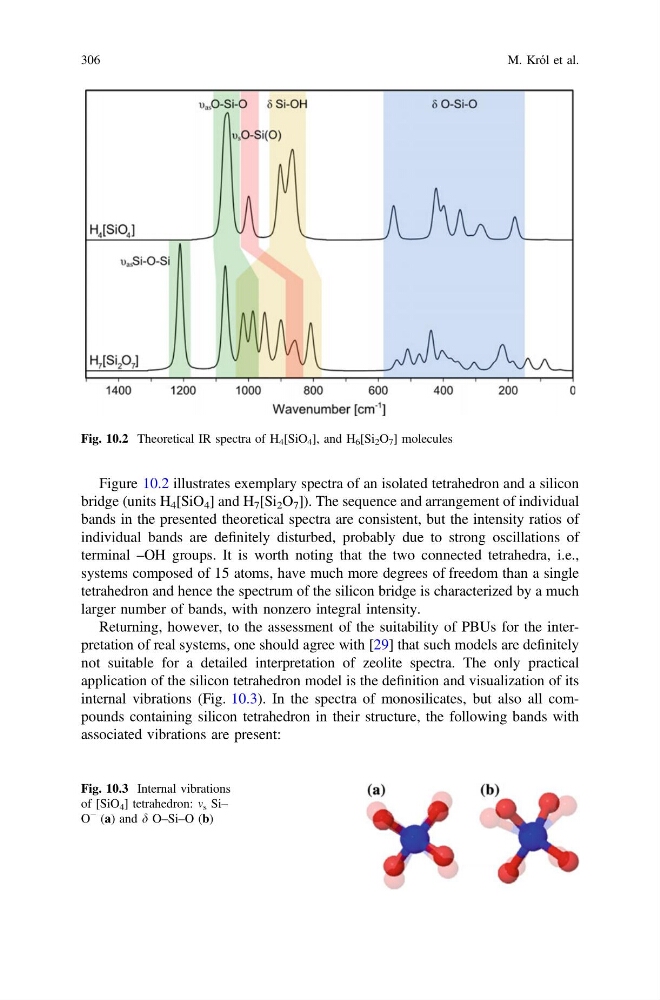
Figure 10.2 illustrates exemplary spectra of an isolated tetrahedron and a silicon
bridge (units H 4 [SiO 4 ] and H 7 [Si 2 O 7 ]). The sequence and arrangement of individual
bands in the presented theoretical spectra are consistent, but the intensity ratios of
individual bands are definitely disturbed, probably due to strong oscillations of
terminal –OH groups. It is worth noting that the two connected tetrahedra, i.e.,
systems composed of 15 atoms, have much more degrees of freedom than a single
tetrahedron and hence the spectrum of the silicon bridge is characterized by a much
larger number of bands, with nonzero integral intensity.
Returning, however, to the assessment of the suitability of PBUs for the interpretation of real systems, one should agree with [29] that such models are definitely
not suitable for a detailed interpretation of zeolite spectra. The only practical
application of the silicon tetrahedron model is the definition and visualization of its
internal vibrations (Fig. 10.3). In the spectra of monosilicates, but also all compounds containing silicon tetrahedron in their structure, the following bands with
associated vibrations are present:
Fig. 10.2 Theoretical IR spectra of H 4 [SiO 4 ], and H 6 [Si 2 O 7 ] molecules
Fig. 10.3 Internal vibrations
of [SiO 4 ] tetrahedron: m s Si–
O
− (a) and d O–Si–O (b)
306
M. Król et al.
bridge (units H 4 [SiO 4 ] and H 7 [Si 2 O 7 ]). The sequence and arrangement of individual
bands in the presented theoretical spectra are consistent, but the intensity ratios of
individual bands are definitely disturbed, probably due to strong oscillations of
terminal –OH groups. It is worth noting that the two connected tetrahedra, i.e.,
systems composed of 15 atoms, have much more degrees of freedom than a single
tetrahedron and hence the spectrum of the silicon bridge is characterized by a much
larger number of bands, with nonzero integral intensity.
Returning, however, to the assessment of the suitability of PBUs for the interpretation of real systems, one should agree with [29] that such models are definitely
not suitable for a detailed interpretation of zeolite spectra. The only practical
application of the silicon tetrahedron model is the definition and visualization of its
internal vibrations (Fig. 10.3). In the spectra of monosilicates, but also all compounds containing silicon tetrahedron in their structure, the following bands with
associated vibrations are present:
Fig. 10.2 Theoretical IR spectra of H 4 [SiO 4 ], and H 6 [Si 2 O 7 ] molecules
Fig. 10.3 Internal vibrations
of [SiO 4 ] tetrahedron: m s Si–
O
− (a) and d O–Si–O (b)
306
M. Król et al.