

Looking at the Mössbauer spectrum at 77 K of the discussed magnetoelectric
(Fig. 9.5a), one can see that the spectrum is Zeeman splitted and all iron cations are
in a magnetically ordered state. The component line widths are narrow, and the
magnetic hyperfine fields are high (Table 9.2). This means that at the liquid
nitrogen, the sample is a magnetic saturation. The value of the fields about 50 T is
quite characteristic for oxides and ferric iron in octahedral coordination. Magnetic
hyperfine field depends on a number of Fe–O–Fe linkages due to strong exchange
interaction. It is known that the number of the linkages determines magnetic
properties of oxides [32, 58]. The substitution of Fe/Nb leads to decrease the
number of the linkages and increase the number Fe–O–Nb, and therefore, one can
expect that a magnetic moment at iron should also be reduced. In oxides, it can be
assumed that the magnetic moment at iron nucleus is proportional to the magnetic
hyperfine field [2]. According to the data summarized in Table 9.2, it can be seen
that increasing the number of niobium atoms in iron surrounding decreases the
magnetic hyperfine field, due to increasing the number of Fe–O–Nb linkages. Based
on the ab initio results, the calculated mean iron magnetic moment is approx. 4.0 µ B
[12] and mean measured B hf = 52.4 T. Assuming proportionality between these
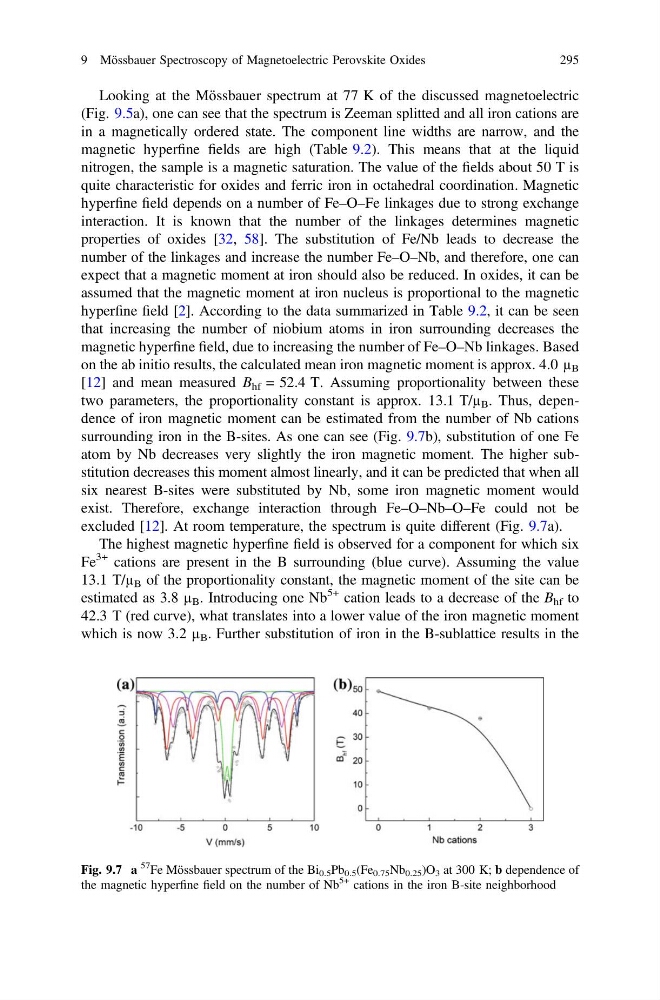
two parameters, the proportionality constant is approx. 13.1 T/µ B . Thus, dependence of iron magnetic moment can be estimated from the number of Nb cations
surrounding iron in the B-sites. As one can see (Fig. 9.7b), substitution of one Fe
atom by Nb decreases very slightly the iron magnetic moment. The higher substitution decreases this moment almost linearly, and it can be predicted that when all
six nearest B-sites were substituted by Nb, some iron magnetic moment would
exist. Therefore, exchange interaction through Fe–O–Nb–O–Fe could not be
excluded [12]. At room temperature, the spectrum is quite different (Fig. 9.7a).
The highest magnetic hyperfine field is observed for a component for which six
Fe
3+ cations are present in the B surrounding (blue curve). Assuming the value
13.1 T/µ B of the proportionality constant, the magnetic moment of the site can be
estimated as 3.8 µ B . Introducing one Nb
5+ cation leads to a decrease of the B hf to
42.3 T (red curve), what translates into a lower value of the iron magnetic moment
which is now 3.2 µ B . Further substitution of iron in the B-sublattice results in the
Fig. 9.7 a
57
Fe Mössbauer spectrum of the Bi 0.5 Pb 0.5 (Fe 0.75 Nb 0.25 )O 3 at 300 K; b dependence of
the magnetic hyperfine field on the number of Nb
5+ cations in the iron B-site neighborhood
9 Mössbauer Spectroscopy of Magnetoelectric Perovskite Oxides
295
(Fig. 9.5a), one can see that the spectrum is Zeeman splitted and all iron cations are
in a magnetically ordered state. The component line widths are narrow, and the
magnetic hyperfine fields are high (Table 9.2). This means that at the liquid
nitrogen, the sample is a magnetic saturation. The value of the fields about 50 T is
quite characteristic for oxides and ferric iron in octahedral coordination. Magnetic
hyperfine field depends on a number of Fe–O–Fe linkages due to strong exchange
interaction. It is known that the number of the linkages determines magnetic
properties of oxides [32, 58]. The substitution of Fe/Nb leads to decrease the
number of the linkages and increase the number Fe–O–Nb, and therefore, one can
expect that a magnetic moment at iron should also be reduced. In oxides, it can be
assumed that the magnetic moment at iron nucleus is proportional to the magnetic
hyperfine field [2]. According to the data summarized in Table 9.2, it can be seen
that increasing the number of niobium atoms in iron surrounding decreases the
magnetic hyperfine field, due to increasing the number of Fe–O–Nb linkages. Based
on the ab initio results, the calculated mean iron magnetic moment is approx. 4.0 µ B
[12] and mean measured B hf = 52.4 T. Assuming proportionality between these
two parameters, the proportionality constant is approx. 13.1 T/µ B . Thus, dependence of iron magnetic moment can be estimated from the number of Nb cations
surrounding iron in the B-sites. As one can see (Fig. 9.7b), substitution of one Fe
atom by Nb decreases very slightly the iron magnetic moment. The higher substitution decreases this moment almost linearly, and it can be predicted that when all
six nearest B-sites were substituted by Nb, some iron magnetic moment would
exist. Therefore, exchange interaction through Fe–O–Nb–O–Fe could not be
excluded [12]. At room temperature, the spectrum is quite different (Fig. 9.7a).
The highest magnetic hyperfine field is observed for a component for which six
Fe
3+ cations are present in the B surrounding (blue curve). Assuming the value
13.1 T/µ B of the proportionality constant, the magnetic moment of the site can be
estimated as 3.8 µ B . Introducing one Nb
5+ cation leads to a decrease of the B hf to
42.3 T (red curve), what translates into a lower value of the iron magnetic moment
which is now 3.2 µ B . Further substitution of iron in the B-sublattice results in the
Fig. 9.7 a
57
Fe Mössbauer spectrum of the Bi 0.5 Pb 0.5 (Fe 0.75 Nb 0.25 )O 3 at 300 K; b dependence of
the magnetic hyperfine field on the number of Nb
5+ cations in the iron B-site neighborhood
9 Mössbauer Spectroscopy of Magnetoelectric Perovskite Oxides
295