

temperature will be probably lower than BiFeO 3 . An interesting observation was
done by Zachariasz et al. [71] that magnetic ordering temperature in multiferroic
solid solutions is linearly correlated with the magnetic hyperfine field in magnetic
saturation. This gives the possibility of rough estimation of the temperatures. Next,
the Mössbauer effect should be measured at temperatures higher and lower than the
magnetic ordering temperature. At temperatures above the magnetic ordering point,
the magnetic hyperfine field is zero and the characteristic Zeeman sextets transform
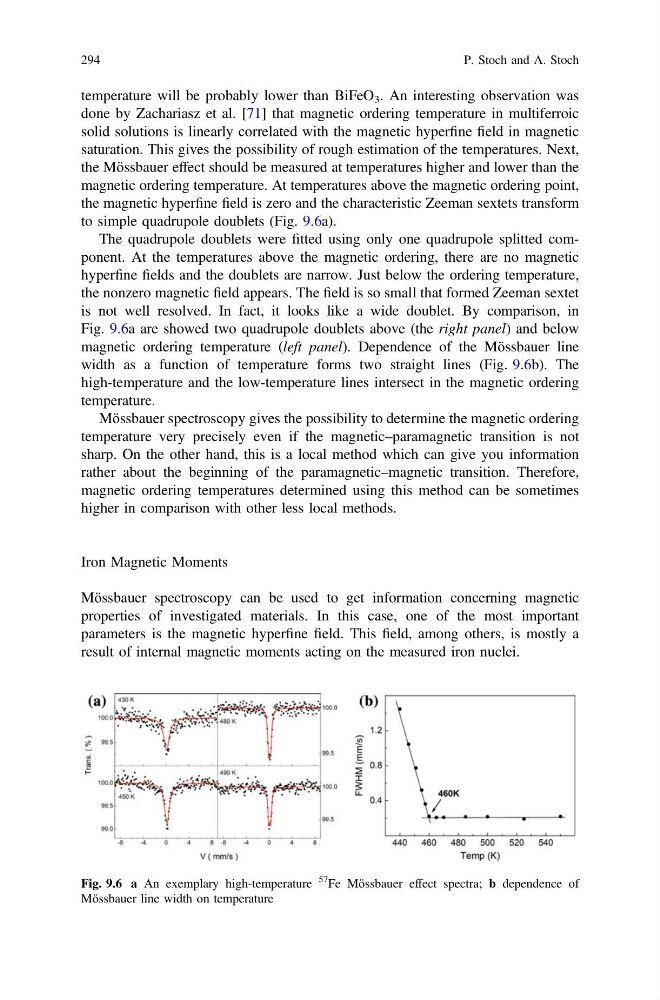
to simple quadrupole doublets (Fig. 9.6a).
The quadrupole doublets were fitted using only one quadrupole splitted component. At the temperatures above the magnetic ordering, there are no magnetic
hyperfine fields and the doublets are narrow. Just below the ordering temperature,
the nonzero magnetic field appears. The field is so small that formed Zeeman sextet
is not well resolved. In fact, it looks like a wide doublet. By comparison, in
Fig. 9.6a are showed two quadrupole doublets above (the right panel) and below
magnetic ordering temperature (left panel). Dependence of the Mössbauer line
width as a function of temperature forms two straight lines (Fig. 9.6b). The
high-temperature and the low-temperature lines intersect in the magnetic ordering
temperature.
Mössbauer spectroscopy gives the possibility to determine the magnetic ordering
temperature very precisely even if the magnetic–paramagnetic transition is not
sharp. On the other hand, this is a local method which can give you information
rather about the beginning of the paramagnetic–magnetic transition. Therefore,
magnetic ordering temperatures determined using this method can be sometimes
higher in comparison with other less local methods.
Iron Magnetic Moments
Mössbauer spectroscopy can be used to get information concerning magnetic
properties of investigated materials. In this case, one of the most important
parameters is the magnetic hyperfine field. This field, among others, is mostly a
result of internal magnetic moments acting on the measured iron nuclei.
Fig. 9.6 a An exemplary high-temperature
57
Fe Mössbauer effect spectra; b dependence of
Mössbauer line width on temperature
294
P. Stoch and A. Stoch
done by Zachariasz et al. [71] that magnetic ordering temperature in multiferroic
solid solutions is linearly correlated with the magnetic hyperfine field in magnetic
saturation. This gives the possibility of rough estimation of the temperatures. Next,
the Mössbauer effect should be measured at temperatures higher and lower than the
magnetic ordering temperature. At temperatures above the magnetic ordering point,
the magnetic hyperfine field is zero and the characteristic Zeeman sextets transform
to simple quadrupole doublets (Fig. 9.6a).
The quadrupole doublets were fitted using only one quadrupole splitted component. At the temperatures above the magnetic ordering, there are no magnetic
hyperfine fields and the doublets are narrow. Just below the ordering temperature,
the nonzero magnetic field appears. The field is so small that formed Zeeman sextet
is not well resolved. In fact, it looks like a wide doublet. By comparison, in
Fig. 9.6a are showed two quadrupole doublets above (the right panel) and below
magnetic ordering temperature (left panel). Dependence of the Mössbauer line
width as a function of temperature forms two straight lines (Fig. 9.6b). The
high-temperature and the low-temperature lines intersect in the magnetic ordering
temperature.
Mössbauer spectroscopy gives the possibility to determine the magnetic ordering
temperature very precisely even if the magnetic–paramagnetic transition is not
sharp. On the other hand, this is a local method which can give you information
rather about the beginning of the paramagnetic–magnetic transition. Therefore,
magnetic ordering temperatures determined using this method can be sometimes
higher in comparison with other less local methods.
Iron Magnetic Moments
Mössbauer spectroscopy can be used to get information concerning magnetic
properties of investigated materials. In this case, one of the most important
parameters is the magnetic hyperfine field. This field, among others, is mostly a
result of internal magnetic moments acting on the measured iron nuclei.
Fig. 9.6 a An exemplary high-temperature
57
Fe Mössbauer effect spectra; b dependence of
Mössbauer line width on temperature
294
P. Stoch and A. Stoch