

Long-range electrostatic interactions are problematic (due to the slow potential
fall-off) and a number of methods can be used to address this problem, like particle
mesh Ewald (PME) [177] or particle–particle particle–mesh (PPPM) techniques
[178]. An ab initio QM is often used to evaluate molecular charges for MD simulations using a restrained electrostatic potential protocol (RESP) [179]. The exact
form of the potential function, called overall the force field, depends on the particular simulation and is essential to obtain results comparable with the experiment.
The popular force fields used for polymers are AMBER (94 [180], 99SB [181], ff03
[182]), GROMOS (87 [183], 96 53A6 [184]), OPLS-AA [185], CHARMM [186],
PCFF [187]. Water molecules, if used as solvents, are usually described by SPC/E
[188], TIP3P [189] or TIP4P/2005 [190] models. Typical time step (time resolution) is of the single femtoseconds order of magnitude and the accessible timescale
reaches hundreds of nanoseconds for the research-level NPT-ensemble simulation
(only some special dedicated supercomputers offer simulations up to hundreds of
microseconds of the real time). Periodic boundary conditions are commonly used to
minimize the effect of the finite size of a simulation box and emulate the infinite
sample. Popular MD software packages are e.g. GROMACS, LAMMPS, AMBER,
CHARMM, NAMD. The MM can be combined with QM to increase the theory
level in a desired region of the simulation space [191].
In dissipative particle dynamics (DPD) [192] (a broad review can be found in
[193]), the simulated objects are composed of molecules described as a set of
soft-like beads that move along the Newton momentum equation and interact in the
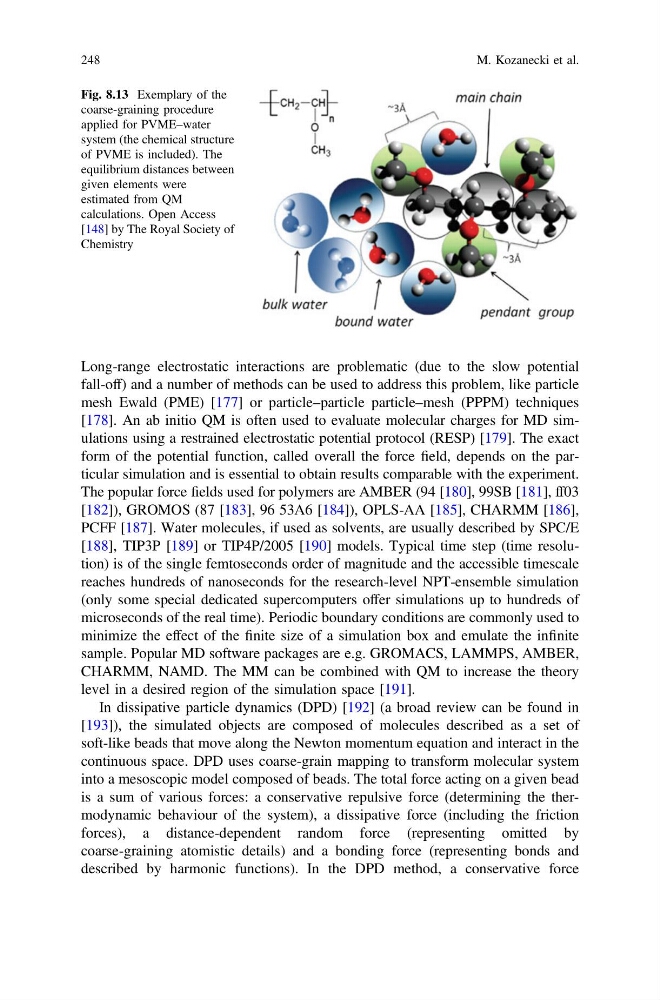
continuous space. DPD uses coarse-grain mapping to transform molecular system
into a mesoscopic model composed of beads. The total force acting on a given bead
is a sum of various forces: a conservative repulsive force (determining the thermodynamic behaviour of the system), a dissipative force (including the friction
forces), a distance-dependent random force (representing omitted by
coarse-graining atomistic details) and a bonding force (representing bonds and
described by harmonic functions). In the DPD method, a conservative force
Fig. 8.13 Exemplary of the
coarse-graining procedure
applied for PVME–water
system (the chemical structure
of PVME is included). The
equilibrium distances between
given elements were
estimated from QM
calculations. Open Access
[148] by The Royal Society of
Chemistry
248
M. Kozanecki et al.
fall-off) and a number of methods can be used to address this problem, like particle
mesh Ewald (PME) [177] or particle–particle particle–mesh (PPPM) techniques
[178]. An ab initio QM is often used to evaluate molecular charges for MD simulations using a restrained electrostatic potential protocol (RESP) [179]. The exact
form of the potential function, called overall the force field, depends on the particular simulation and is essential to obtain results comparable with the experiment.
The popular force fields used for polymers are AMBER (94 [180], 99SB [181], ff03
[182]), GROMOS (87 [183], 96 53A6 [184]), OPLS-AA [185], CHARMM [186],
PCFF [187]. Water molecules, if used as solvents, are usually described by SPC/E
[188], TIP3P [189] or TIP4P/2005 [190] models. Typical time step (time resolution) is of the single femtoseconds order of magnitude and the accessible timescale
reaches hundreds of nanoseconds for the research-level NPT-ensemble simulation
(only some special dedicated supercomputers offer simulations up to hundreds of
microseconds of the real time). Periodic boundary conditions are commonly used to
minimize the effect of the finite size of a simulation box and emulate the infinite
sample. Popular MD software packages are e.g. GROMACS, LAMMPS, AMBER,
CHARMM, NAMD. The MM can be combined with QM to increase the theory
level in a desired region of the simulation space [191].
In dissipative particle dynamics (DPD) [192] (a broad review can be found in
[193]), the simulated objects are composed of molecules described as a set of
soft-like beads that move along the Newton momentum equation and interact in the
continuous space. DPD uses coarse-grain mapping to transform molecular system
into a mesoscopic model composed of beads. The total force acting on a given bead
is a sum of various forces: a conservative repulsive force (determining the thermodynamic behaviour of the system), a dissipative force (including the friction
forces), a distance-dependent random force (representing omitted by
coarse-graining atomistic details) and a bonding force (representing bonds and
described by harmonic functions). In the DPD method, a conservative force
Fig. 8.13 Exemplary of the
coarse-graining procedure
applied for PVME–water
system (the chemical structure
of PVME is included). The
equilibrium distances between
given elements were
estimated from QM
calculations. Open Access
[148] by The Royal Society of
Chemistry
248
M. Kozanecki et al.