

In Raman spectroscopy studies on crosslinked polyacrylic acid hydrogel,
Tsukida et al. [110] studied changes in the structure of water in the course of
pH-induced transition of polyacid chains. Walczak et al. [114], with the use of the
polarized Raman spectroscopy, analysed the dependence of the polyacrylic acid
chain conformation on the degree of polymer neutralization and the results correlated well with earlier SAXS and NMR studies of the subject.
The important issue related to pH-responsive polymers is an influence of the
counterion on the polymer chain conformation, hydration and stability of ionomers
in water. Interestingly, the effect of ‘salting out’ and ‘salting in’ of proteins in water
and related Hofmeister series has been known for many years. Franz Hofmeister
published between 1888 and 1898 [115–117] the results of his experiments aimed
to quantify the effect of particular cations and anions on the egg white protein
stability in a solution. Hofmeister observed that for salts having the same cation,
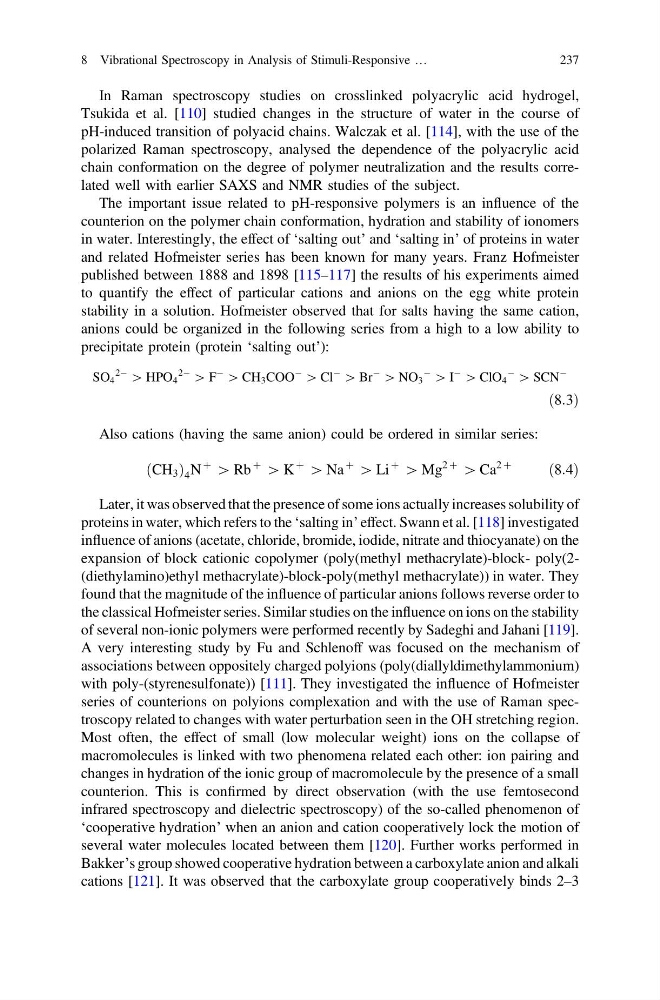
anions could be organized in the following series from a high to a low ability to
precipitate protein (protein ‘salting out’):
SO 4
2À [ HPO 4
2À [ F
À [ CH 3 COO
À [ Cl
À [ Br
À [ NO 3
À [ I
À [ ClO 4
À [ SCN
À
ð8:3Þ
Also cations (having the same anion) could be ordered in similar series:
CH 3
ð
Þ 4 N
þ
[ Rb
þ
[ K
þ
[ Na
þ
[ Li
þ
[ Mg
2 þ
[ Ca
2 þ
ð8:4Þ
Later, it was observed that the presence of some ions actually increases solubility of
proteins in water, which refers to the ‘salting in’ effect. Swann et al. [118] investigated
influence of anions (acetate, chloride, bromide, iodide, nitrate and thiocyanate) on the
expansion of block cationic copolymer (poly(methyl methacrylate)-block- poly(2(diethylamino)ethyl methacrylate)-block-poly(methyl methacrylate)) in water. They
found that the magnitude of the influence of particular anions follows reverse order to
the classical Hofmeister series. Similar studies on the influence on ions on the stability
of several non-ionic polymers were performed recently by Sadeghi and Jahani [119].
A very interesting study by Fu and Schlenoff was focused on the mechanism of
associations between oppositely charged polyions (poly(diallyldimethylammonium)
with poly-(styrenesulfonate)) [111]. They investigated the influence of Hofmeister
series of counterions on polyions complexation and with the use of Raman spectroscopy related to changes with water perturbation seen in the OH stretching region.
Most often, the effect of small (low molecular weight) ions on the collapse of
macromolecules is linked with two phenomena related each other: ion pairing and
changes in hydration of the ionic group of macromolecule by the presence of a small
counterion. This is confirmed by direct observation (with the use femtosecond
infrared spectroscopy and dielectric spectroscopy) of the so-called phenomenon of
‘cooperative hydration’ when an anion and cation cooperatively lock the motion of
several water molecules located between them [120]. Further works performed in
Bakker’s group showed cooperative hydration between a carboxylate anion and alkali
cations [121]. It was observed that the carboxylate group cooperatively binds 2–3
8 Vibrational Spectroscopy in Analysis of Stimuli-Responsive …
237
Tsukida et al. [110] studied changes in the structure of water in the course of
pH-induced transition of polyacid chains. Walczak et al. [114], with the use of the
polarized Raman spectroscopy, analysed the dependence of the polyacrylic acid
chain conformation on the degree of polymer neutralization and the results correlated well with earlier SAXS and NMR studies of the subject.
The important issue related to pH-responsive polymers is an influence of the
counterion on the polymer chain conformation, hydration and stability of ionomers
in water. Interestingly, the effect of ‘salting out’ and ‘salting in’ of proteins in water
and related Hofmeister series has been known for many years. Franz Hofmeister
published between 1888 and 1898 [115–117] the results of his experiments aimed
to quantify the effect of particular cations and anions on the egg white protein
stability in a solution. Hofmeister observed that for salts having the same cation,
anions could be organized in the following series from a high to a low ability to
precipitate protein (protein ‘salting out’):
SO 4
2À [ HPO 4
2À [ F
À [ CH 3 COO
À [ Cl
À [ Br
À [ NO 3
À [ I
À [ ClO 4
À [ SCN
À
ð8:3Þ
Also cations (having the same anion) could be ordered in similar series:
CH 3
ð
Þ 4 N
þ
[ Rb
þ
[ K
þ
[ Na
þ
[ Li
þ
[ Mg
2 þ
[ Ca
2 þ
ð8:4Þ
Later, it was observed that the presence of some ions actually increases solubility of
proteins in water, which refers to the ‘salting in’ effect. Swann et al. [118] investigated
influence of anions (acetate, chloride, bromide, iodide, nitrate and thiocyanate) on the
expansion of block cationic copolymer (poly(methyl methacrylate)-block- poly(2(diethylamino)ethyl methacrylate)-block-poly(methyl methacrylate)) in water. They
found that the magnitude of the influence of particular anions follows reverse order to
the classical Hofmeister series. Similar studies on the influence on ions on the stability
of several non-ionic polymers were performed recently by Sadeghi and Jahani [119].
A very interesting study by Fu and Schlenoff was focused on the mechanism of
associations between oppositely charged polyions (poly(diallyldimethylammonium)
with poly-(styrenesulfonate)) [111]. They investigated the influence of Hofmeister
series of counterions on polyions complexation and with the use of Raman spectroscopy related to changes with water perturbation seen in the OH stretching region.
Most often, the effect of small (low molecular weight) ions on the collapse of
macromolecules is linked with two phenomena related each other: ion pairing and
changes in hydration of the ionic group of macromolecule by the presence of a small
counterion. This is confirmed by direct observation (with the use femtosecond
infrared spectroscopy and dielectric spectroscopy) of the so-called phenomenon of
‘cooperative hydration’ when an anion and cation cooperatively lock the motion of
several water molecules located between them [120]. Further works performed in
Bakker’s group showed cooperative hydration between a carboxylate anion and alkali
cations [121]. It was observed that the carboxylate group cooperatively binds 2–3
8 Vibrational Spectroscopy in Analysis of Stimuli-Responsive …
237