

Given the fact that a structural transition in the pH-responsive polymer system is
practically always related to the degree of ionization of a polymer chain, and the
role of vibrational spectroscopy in studies of these systems is usually limited to
monitoring the fraction of ionized groups on a polymer chain. This is perfectly seen
in studies of the popular pH-responsive systems based on polyacrylic or polymethacrylic acids. A fully ionized (at high pH) polyacid chain is strongly hydrated
and expanded due to repulsive anion–anion interactions. After protonation of a
critical amount of carboxylate groups (at chain neutralization degree a = 0.3 [110]
at acidic pH, hydrophobic chain–chain interactions lead to the collapse of a polymer
chain and eventually to the polymer/water phase separation. Since the carbonyl
band (stretching of C=O, at 1705 cm
−1 ) is well separated from the antisymmetric
stretching of –COO
− anion (around 1566 cm
−1 ), the analysis of intensity of these
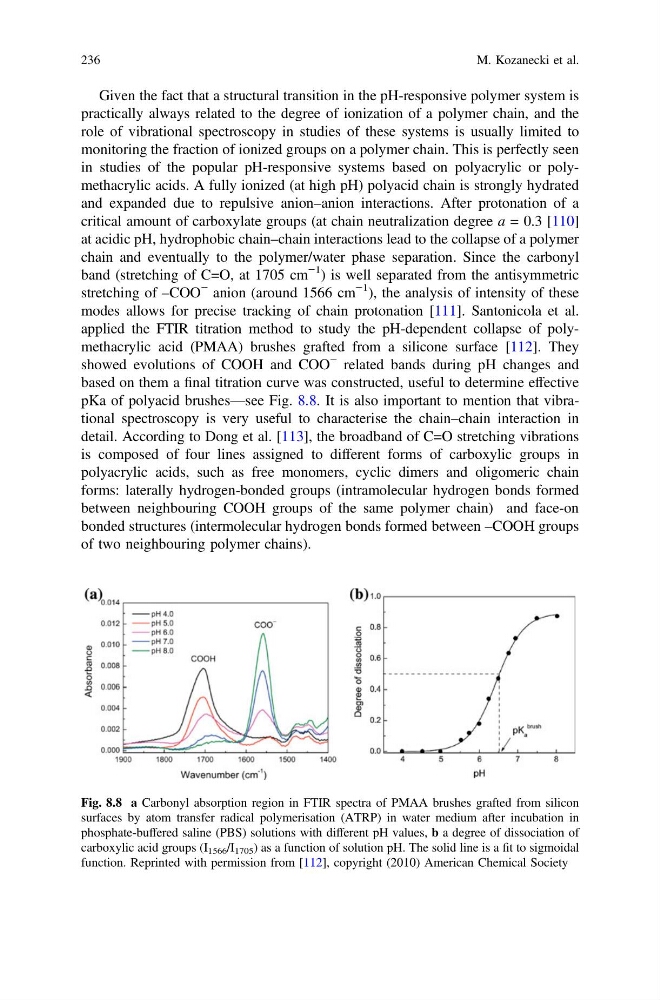
modes allows for precise tracking of chain protonation [111]. Santonicola et al.
applied the FTIR titration method to study the pH-dependent collapse of polymethacrylic acid (PMAA) brushes grafted from a silicone surface [112]. They
showed evolutions of COOH and COO
− related bands during pH changes and
based on them a final titration curve was constructed, useful to determine effective
pKa of polyacid brushes—see Fig. 8.8. It is also important to mention that vibrational spectroscopy is very useful to characterise the chain–chain interaction in
detail. According to Dong et al. [113], the broadband of C=O stretching vibrations
is composed of four lines assigned to different forms of carboxylic groups in
polyacrylic acids, such as free monomers, cyclic dimers and oligomeric chain
forms: laterally hydrogen-bonded groups (intramolecular hydrogen bonds formed
between neighbouring COOH groups of the same polymer chain) and face-on
bonded structures (intermolecular hydrogen bonds formed between –COOH groups
of two neighbouring polymer chains).
Fig. 8.8 a Carbonyl absorption region in FTIR spectra of PMAA brushes grafted from silicon
surfaces by atom transfer radical polymerisation (ATRP) in water medium after incubation in
phosphate-buffered saline (PBS) solutions with different pH values, b a degree of dissociation of
carboxylic acid groups (I 1566 /I 1705 ) as a function of solution pH. The solid line is a fit to sigmoidal
function. Reprinted with permission from [112], copyright (2010) American Chemical Society
236
M. Kozanecki et al.
practically always related to the degree of ionization of a polymer chain, and the
role of vibrational spectroscopy in studies of these systems is usually limited to
monitoring the fraction of ionized groups on a polymer chain. This is perfectly seen
in studies of the popular pH-responsive systems based on polyacrylic or polymethacrylic acids. A fully ionized (at high pH) polyacid chain is strongly hydrated
and expanded due to repulsive anion–anion interactions. After protonation of a
critical amount of carboxylate groups (at chain neutralization degree a = 0.3 [110]
at acidic pH, hydrophobic chain–chain interactions lead to the collapse of a polymer
chain and eventually to the polymer/water phase separation. Since the carbonyl
band (stretching of C=O, at 1705 cm
−1 ) is well separated from the antisymmetric
stretching of –COO
− anion (around 1566 cm
−1 ), the analysis of intensity of these
modes allows for precise tracking of chain protonation [111]. Santonicola et al.
applied the FTIR titration method to study the pH-dependent collapse of polymethacrylic acid (PMAA) brushes grafted from a silicone surface [112]. They
showed evolutions of COOH and COO
− related bands during pH changes and
based on them a final titration curve was constructed, useful to determine effective
pKa of polyacid brushes—see Fig. 8.8. It is also important to mention that vibrational spectroscopy is very useful to characterise the chain–chain interaction in
detail. According to Dong et al. [113], the broadband of C=O stretching vibrations
is composed of four lines assigned to different forms of carboxylic groups in
polyacrylic acids, such as free monomers, cyclic dimers and oligomeric chain
forms: laterally hydrogen-bonded groups (intramolecular hydrogen bonds formed
between neighbouring COOH groups of the same polymer chain) and face-on
bonded structures (intermolecular hydrogen bonds formed between –COOH groups
of two neighbouring polymer chains).
Fig. 8.8 a Carbonyl absorption region in FTIR spectra of PMAA brushes grafted from silicon
surfaces by atom transfer radical polymerisation (ATRP) in water medium after incubation in
phosphate-buffered saline (PBS) solutions with different pH values, b a degree of dissociation of
carboxylic acid groups (I 1566 /I 1705 ) as a function of solution pH. The solid line is a fit to sigmoidal
function. Reprinted with permission from [112], copyright (2010) American Chemical Society
236
M. Kozanecki et al.