

replaced by single bands at nearly the same frequencies in the Raman spectrum of
polymorph I. Ongoing studies will allow us to confirm these predictions.
7.4.2 Hydantoins: Polymorphism in 1MH and 5MH
The study of neat 1MH and 5MH, by combined use of DSC, PLTM, and infrared
and Raman spectroscopies, allowed to identify several new polymorphs of these
compounds, characterize them structurally, and shed light on the energetics and
other relevant features of the observed phase transitions [28–30].
For 1MH, two polymorphs were identified. Polymorph I was obtained by
crystallization of the low-temperature amorphous phase produced from fast condensation of the vapor of the compound, as well as from crystallization of most of
the solvents used during the polymorph screening work. Polymorph II was
obtained by sublimation, and by crystallization from methanol. This last polymorph
converts into polymorph I upon warming, in a low energy solid–solid transition
which takes place from about 110 to 135 °C. The so formed polymorph I then melts
at a temperature of 155.7 ± 0.7 °C with an enthalpy of fusion of
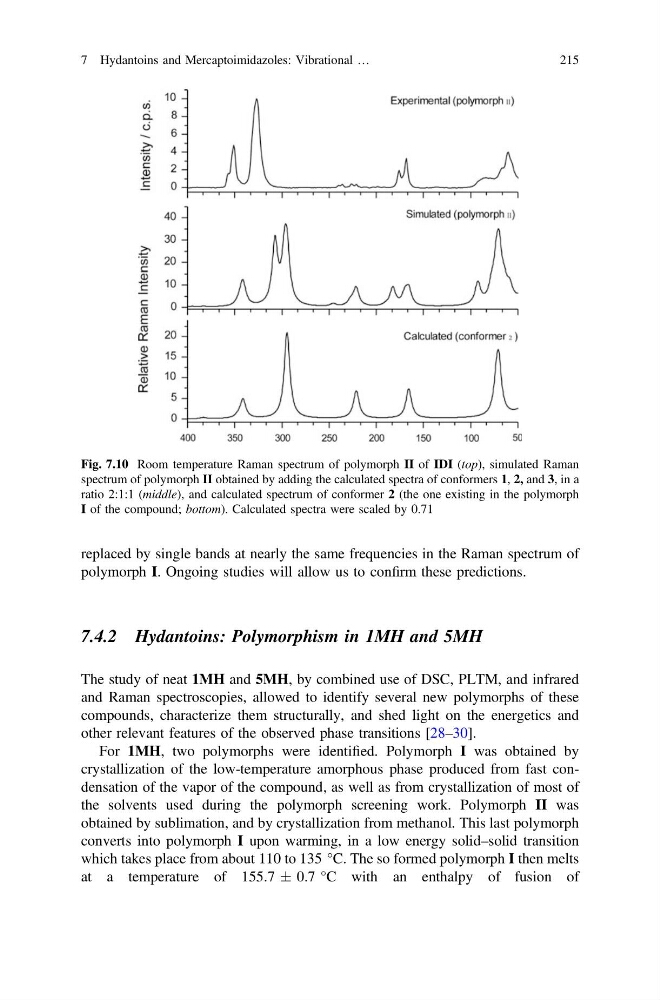
Fig. 7.10 Room temperature Raman spectrum of polymorph II of IDI (top), simulated Raman
spectrum of polymorph II obtained by adding the calculated spectra of conformers 1, 2, and 3, in a
ratio 2:1:1 (middle), and calculated spectrum of conformer 2 (the one existing in the polymorph
I of the compound; bottom). Calculated spectra were scaled by 0.71
7 Hydantoins and Mercaptoimidazoles: Vibrational …
215
polymorph I. Ongoing studies will allow us to confirm these predictions.
7.4.2 Hydantoins: Polymorphism in 1MH and 5MH
The study of neat 1MH and 5MH, by combined use of DSC, PLTM, and infrared
and Raman spectroscopies, allowed to identify several new polymorphs of these
compounds, characterize them structurally, and shed light on the energetics and
other relevant features of the observed phase transitions [28–30].
For 1MH, two polymorphs were identified. Polymorph I was obtained by
crystallization of the low-temperature amorphous phase produced from fast condensation of the vapor of the compound, as well as from crystallization of most of
the solvents used during the polymorph screening work. Polymorph II was
obtained by sublimation, and by crystallization from methanol. This last polymorph
converts into polymorph I upon warming, in a low energy solid–solid transition
which takes place from about 110 to 135 °C. The so formed polymorph I then melts
at a temperature of 155.7 ± 0.7 °C with an enthalpy of fusion of
Fig. 7.10 Room temperature Raman spectrum of polymorph II of IDI (top), simulated Raman
spectrum of polymorph II obtained by adding the calculated spectra of conformers 1, 2, and 3, in a
ratio 2:1:1 (middle), and calculated spectrum of conformer 2 (the one existing in the polymorph
I of the compound; bottom). Calculated spectra were scaled by 0.71
7 Hydantoins and Mercaptoimidazoles: Vibrational …
215