

electrons oscillate coherently at a plane of metal–dielectric interface, producing
huge electromagnetic field and consequently enhancing Raman scattering (electromagnetic mechanism). The oscillation frequency depends on dielectric function
of Ag/Au nanoplasmonic structures and is also associated with their shape and size.
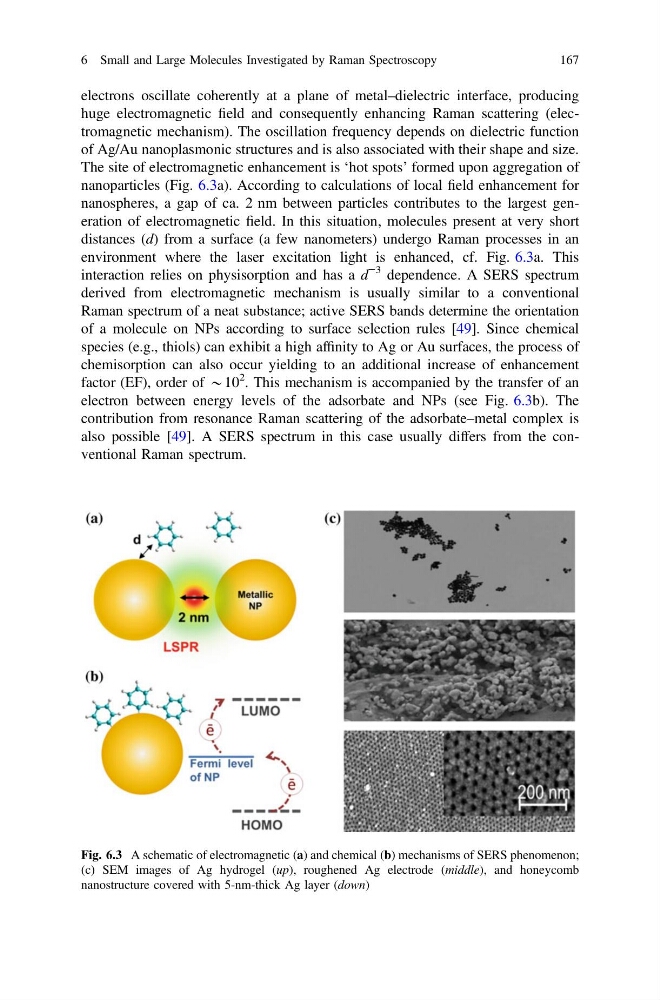
The site of electromagnetic enhancement is ‘hot spots’ formed upon aggregation of
nanoparticles (Fig. 6.3a). According to calculations of local field enhancement for
nanospheres, a gap of ca. 2 nm between particles contributes to the largest generation of electromagnetic field. In this situation, molecules present at very short
distances (d) from a surface (a few nanometers) undergo Raman processes in an
environment where the laser excitation light is enhanced, cf. Fig. 6.3a. This
interaction relies on physisorption and has a d
−3 dependence. A SERS spectrum
derived from electromagnetic mechanism is usually similar to a conventional
Raman spectrum of a neat substance; active SERS bands determine the orientation
of a molecule on NPs according to surface selection rules [49]. Since chemical
species (e.g., thiols) can exhibit a high affinity to Ag or Au surfaces, the process of
chemisorption can also occur yielding to an additional increase of enhancement
factor (EF), order of *10
2 . This mechanism is accompanied by the transfer of an
electron between energy levels of the adsorbate and NPs (see Fig. 6.3b). The
contribution from resonance Raman scattering of the adsorbate–metal complex is
also possible [49]. A SERS spectrum in this case usually differs from the conventional Raman spectrum.
Fig. 6.3 A schematic of electromagnetic (a) and chemical (b) mechanisms of SERS phenomenon;
(c) SEM images of Ag hydrogel (up), roughened Ag electrode (middle), and honeycomb
nanostructure covered with 5-nm-thick Ag layer (down)
6 Small and Large Molecules Investigated by Raman Spectroscopy
167
huge electromagnetic field and consequently enhancing Raman scattering (electromagnetic mechanism). The oscillation frequency depends on dielectric function
of Ag/Au nanoplasmonic structures and is also associated with their shape and size.
The site of electromagnetic enhancement is ‘hot spots’ formed upon aggregation of
nanoparticles (Fig. 6.3a). According to calculations of local field enhancement for
nanospheres, a gap of ca. 2 nm between particles contributes to the largest generation of electromagnetic field. In this situation, molecules present at very short
distances (d) from a surface (a few nanometers) undergo Raman processes in an
environment where the laser excitation light is enhanced, cf. Fig. 6.3a. This
interaction relies on physisorption and has a d
−3 dependence. A SERS spectrum
derived from electromagnetic mechanism is usually similar to a conventional
Raman spectrum of a neat substance; active SERS bands determine the orientation
of a molecule on NPs according to surface selection rules [49]. Since chemical
species (e.g., thiols) can exhibit a high affinity to Ag or Au surfaces, the process of
chemisorption can also occur yielding to an additional increase of enhancement
factor (EF), order of *10
2 . This mechanism is accompanied by the transfer of an
electron between energy levels of the adsorbate and NPs (see Fig. 6.3b). The
contribution from resonance Raman scattering of the adsorbate–metal complex is
also possible [49]. A SERS spectrum in this case usually differs from the conventional Raman spectrum.
Fig. 6.3 A schematic of electromagnetic (a) and chemical (b) mechanisms of SERS phenomenon;
(c) SEM images of Ag hydrogel (up), roughened Ag electrode (middle), and honeycomb
nanostructure covered with 5-nm-thick Ag layer (down)
6 Small and Large Molecules Investigated by Raman Spectroscopy
167