

arrangement of polyene chains from neighboring molecules. This enables to collect
RROA spectra after few-minute acquisition with a relatively low laser power (*10
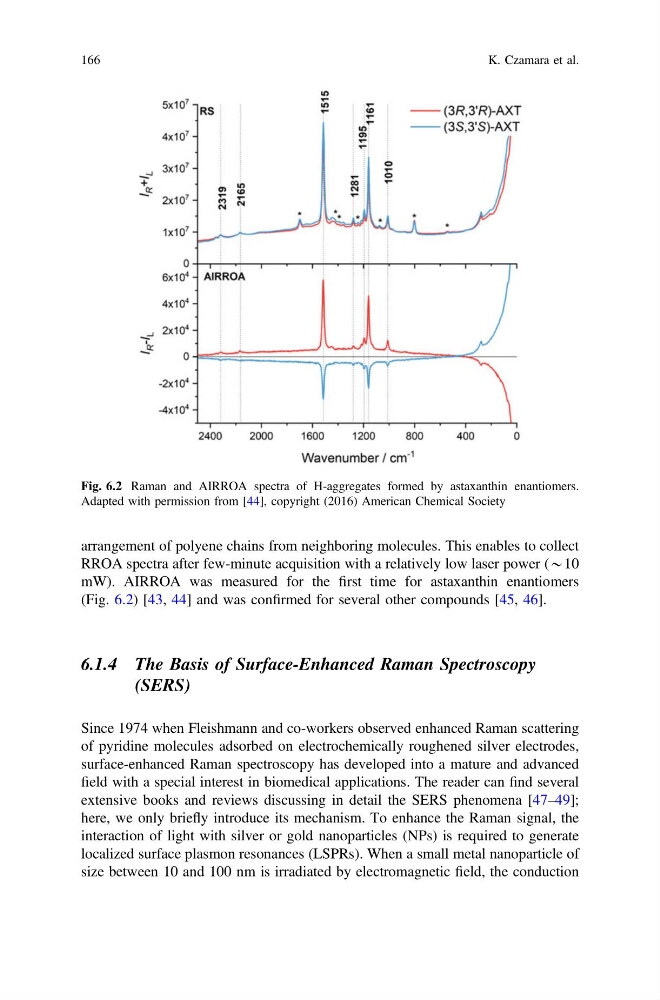
mW). AIRROA was measured for the first time for astaxanthin enantiomers
(Fig. 6.2) [43, 44] and was confirmed for several other compounds [45, 46].
6.1.4 The Basis of Surface-Enhanced Raman Spectroscopy
(SERS)
Since 1974 when Fleishmann and co-workers observed enhanced Raman scattering
of pyridine molecules adsorbed on electrochemically roughened silver electrodes,
surface-enhanced Raman spectroscopy has developed into a mature and advanced
field with a special interest in biomedical applications. The reader can find several
extensive books and reviews discussing in detail the SERS phenomena [47–49];
here, we only briefly introduce its mechanism. To enhance the Raman signal, the
interaction of light with silver or gold nanoparticles (NPs) is required to generate
localized surface plasmon resonances (LSPRs). When a small metal nanoparticle of
size between 10 and 100 nm is irradiated by electromagnetic field, the conduction
Fig. 6.2 Raman and AIRROA spectra of H-aggregates formed by astaxanthin enantiomers.
Adapted with permission from [44], copyright (2016) American Chemical Society
166
K. Czamara et al.
RROA spectra after few-minute acquisition with a relatively low laser power (*10
mW). AIRROA was measured for the first time for astaxanthin enantiomers
(Fig. 6.2) [43, 44] and was confirmed for several other compounds [45, 46].
6.1.4 The Basis of Surface-Enhanced Raman Spectroscopy
(SERS)
Since 1974 when Fleishmann and co-workers observed enhanced Raman scattering
of pyridine molecules adsorbed on electrochemically roughened silver electrodes,
surface-enhanced Raman spectroscopy has developed into a mature and advanced
field with a special interest in biomedical applications. The reader can find several
extensive books and reviews discussing in detail the SERS phenomena [47–49];
here, we only briefly introduce its mechanism. To enhance the Raman signal, the
interaction of light with silver or gold nanoparticles (NPs) is required to generate
localized surface plasmon resonances (LSPRs). When a small metal nanoparticle of
size between 10 and 100 nm is irradiated by electromagnetic field, the conduction
Fig. 6.2 Raman and AIRROA spectra of H-aggregates formed by astaxanthin enantiomers.
Adapted with permission from [44], copyright (2016) American Chemical Society
166
K. Czamara et al.