

their spectra provide an additional insight into molecular structure when compared
to conventional Raman spectroscopy. We also summarize the latest applications of
ROA and SERS for modelling of inter- and intramolecular interactions of selected
biomedical systems.
6.1.1 The Basis of the Raman Optical Activity (ROA)
Raman optical activity (ROA) is one of two fundamental forms of vibrational
optical activity (VOA), complementary to vibrational circular dichroism (VCD),
and the most powerful structural probe of molecular chirality for the study of
various types of molecules in their natural environment. ROA spectroscopy can be
effectively used in a stereochemical analysis and in determining the absolute configuration of molecules. This chiroptical method is based on the small intensity
difference in Raman scattering of right and left circularly polarized light (from
near-infrared to ultraviolet region) by optically active molecules. The primary
scattering mechanism accountable for ROA phenomenon was discovered in 1969
by Atkins and Barron [1], and then, two years later, Barron and Buckingham
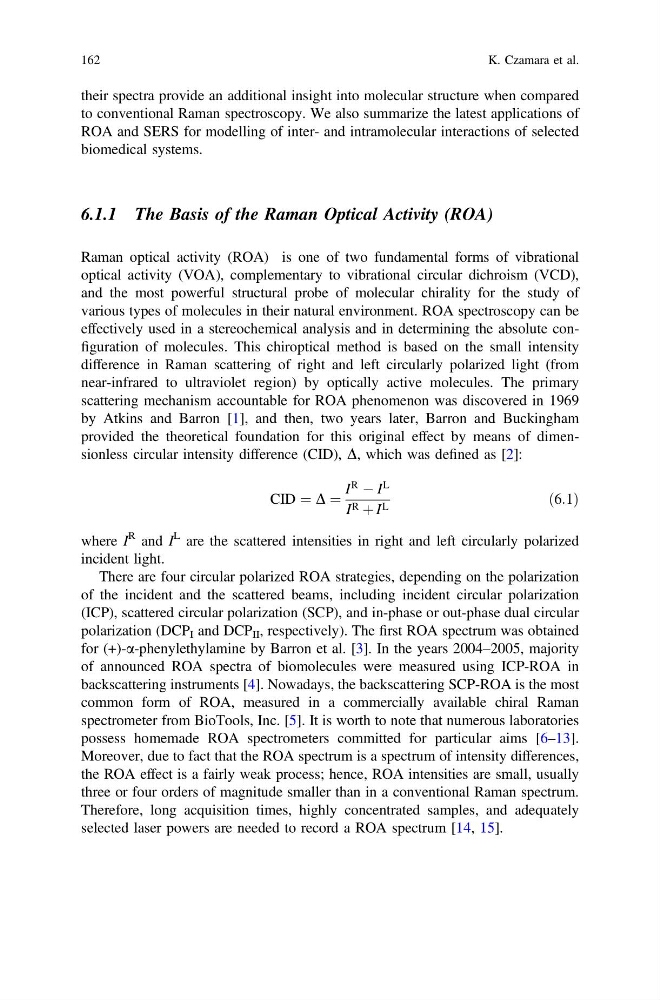
provided the theoretical foundation for this original effect by means of dimensionless circular intensity difference (CID), D, which was defined as [2]:
CID ¼ D ¼
I
R
À I
L
I R þ I L
ð6:1Þ
where I
R and I
L are the scattered intensities in right and left circularly polarized
incident light.
There are four circular polarized ROA strategies, depending on the polarization
of the incident and the scattered beams, including incident circular polarization
(ICP), scattered circular polarization (SCP), and in-phase or out-phase dual circular
polarization (DCP I and DCP II , respectively). The first ROA spectrum was obtained
for (+)-a-phenylethylamine by Barron et al. [3]. In the years 2004–2005, majority
of announced ROA spectra of biomolecules were measured using ICP-ROA in
backscattering instruments [4]. Nowadays, the backscattering SCP-ROA is the most
common form of ROA, measured in a commercially available chiral Raman
spectrometer from BioTools, Inc. [5]. It is worth to note that numerous laboratories
possess homemade ROA spectrometers committed for particular aims [6–13].
Moreover, due to fact that the ROA spectrum is a spectrum of intensity differences,
the ROA effect is a fairly weak process; hence, ROA intensities are small, usually
three or four orders of magnitude smaller than in a conventional Raman spectrum.
Therefore, long acquisition times, highly concentrated samples, and adequately
selected laser powers are needed to record a ROA spectrum [14, 15].
162
K. Czamara et al.
to conventional Raman spectroscopy. We also summarize the latest applications of
ROA and SERS for modelling of inter- and intramolecular interactions of selected
biomedical systems.
6.1.1 The Basis of the Raman Optical Activity (ROA)
Raman optical activity (ROA) is one of two fundamental forms of vibrational
optical activity (VOA), complementary to vibrational circular dichroism (VCD),
and the most powerful structural probe of molecular chirality for the study of
various types of molecules in their natural environment. ROA spectroscopy can be
effectively used in a stereochemical analysis and in determining the absolute configuration of molecules. This chiroptical method is based on the small intensity
difference in Raman scattering of right and left circularly polarized light (from
near-infrared to ultraviolet region) by optically active molecules. The primary
scattering mechanism accountable for ROA phenomenon was discovered in 1969
by Atkins and Barron [1], and then, two years later, Barron and Buckingham
provided the theoretical foundation for this original effect by means of dimensionless circular intensity difference (CID), D, which was defined as [2]:
CID ¼ D ¼
I
R
À I
L
I R þ I L
ð6:1Þ
where I
R and I
L are the scattered intensities in right and left circularly polarized
incident light.
There are four circular polarized ROA strategies, depending on the polarization
of the incident and the scattered beams, including incident circular polarization
(ICP), scattered circular polarization (SCP), and in-phase or out-phase dual circular
polarization (DCP I and DCP II , respectively). The first ROA spectrum was obtained
for (+)-a-phenylethylamine by Barron et al. [3]. In the years 2004–2005, majority
of announced ROA spectra of biomolecules were measured using ICP-ROA in
backscattering instruments [4]. Nowadays, the backscattering SCP-ROA is the most
common form of ROA, measured in a commercially available chiral Raman
spectrometer from BioTools, Inc. [5]. It is worth to note that numerous laboratories
possess homemade ROA spectrometers committed for particular aims [6–13].
Moreover, due to fact that the ROA spectrum is a spectrum of intensity differences,
the ROA effect is a fairly weak process; hence, ROA intensities are small, usually
three or four orders of magnitude smaller than in a conventional Raman spectrum.
Therefore, long acquisition times, highly concentrated samples, and adequately
selected laser powers are needed to record a ROA spectrum [14, 15].
162
K. Czamara et al.