

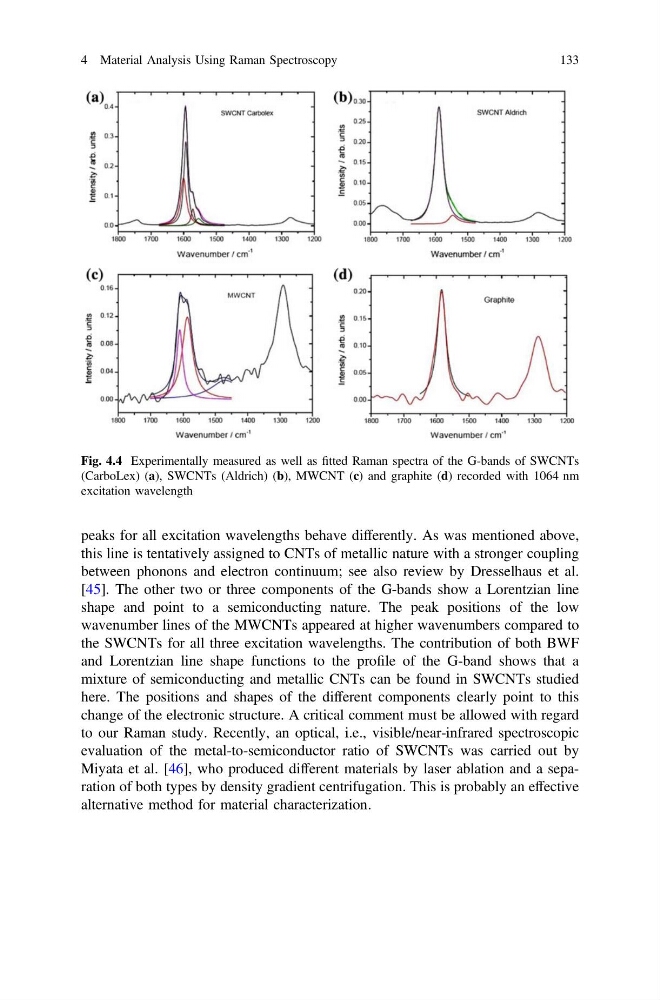
peaks for all excitation wavelengths behave differently. As was mentioned above,
this line is tentatively assigned to CNTs of metallic nature with a stronger coupling
between phonons and electron continuum; see also review by Dresselhaus et al.
[45]. The other two or three components of the G-bands show a Lorentzian line
shape and point to a semiconducting nature. The peak positions of the low
wavenumber lines of the MWCNTs appeared at higher wavenumbers compared to
the SWCNTs for all three excitation wavelengths. The contribution of both BWF
and Lorentzian line shape functions to the profile of the G-band shows that a
mixture of semiconducting and metallic CNTs can be found in SWCNTs studied
here. The positions and shapes of the different components clearly point to this
change of the electronic structure. A critical comment must be allowed with regard
to our Raman study. Recently, an optical, i.e., visible/near-infrared spectroscopic
evaluation of the metal-to-semiconductor ratio of SWCNTs was carried out by
Miyata et al. [46], who produced different materials by laser ablation and a separation of both types by density gradient centrifugation. This is probably an effective
alternative method for material characterization.
Fig. 4.4 Experimentally measured as well as fitted Raman spectra of the G-bands of SWCNTs
(CarboLex) (a), SWCNTs (Aldrich) (b), MWCNT (c) and graphite (d) recorded with 1064 nm
excitation wavelength
4 Material Analysis Using Raman Spectroscopy
133
this line is tentatively assigned to CNTs of metallic nature with a stronger coupling
between phonons and electron continuum; see also review by Dresselhaus et al.
[45]. The other two or three components of the G-bands show a Lorentzian line
shape and point to a semiconducting nature. The peak positions of the low
wavenumber lines of the MWCNTs appeared at higher wavenumbers compared to
the SWCNTs for all three excitation wavelengths. The contribution of both BWF
and Lorentzian line shape functions to the profile of the G-band shows that a
mixture of semiconducting and metallic CNTs can be found in SWCNTs studied
here. The positions and shapes of the different components clearly point to this
change of the electronic structure. A critical comment must be allowed with regard
to our Raman study. Recently, an optical, i.e., visible/near-infrared spectroscopic
evaluation of the metal-to-semiconductor ratio of SWCNTs was carried out by
Miyata et al. [46], who produced different materials by laser ablation and a separation of both types by density gradient centrifugation. This is probably an effective
alternative method for material characterization.
Fig. 4.4 Experimentally measured as well as fitted Raman spectra of the G-bands of SWCNTs
(CarboLex) (a), SWCNTs (Aldrich) (b), MWCNT (c) and graphite (d) recorded with 1064 nm
excitation wavelength
4 Material Analysis Using Raman Spectroscopy
133