

4.1 Proof of Sefficiency Indicators
43
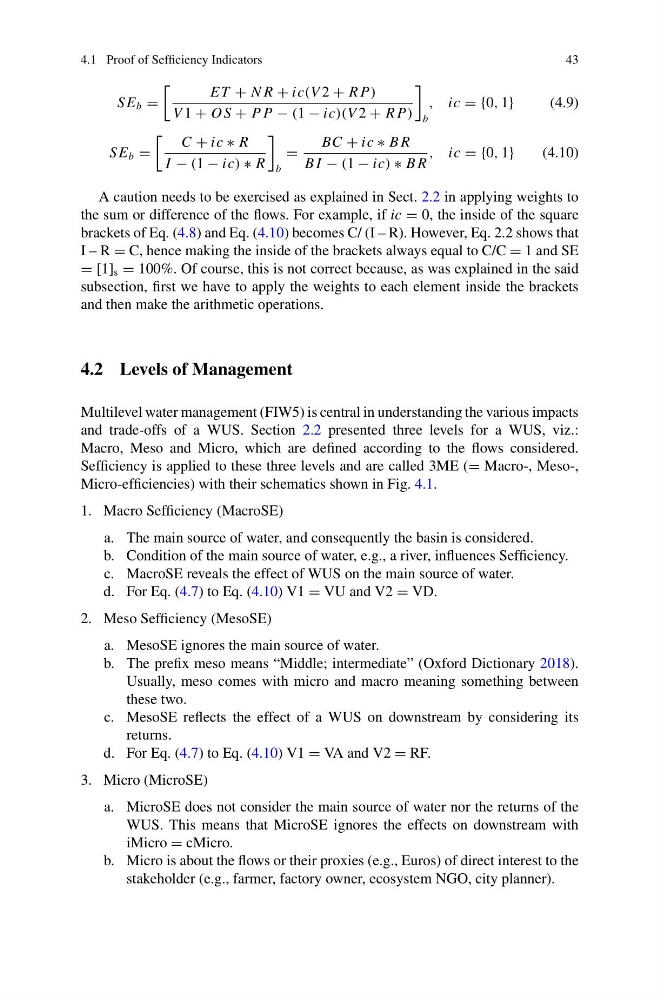
S E b =
E T + N R + ic(V 2 + R P)
V 1 + O S + P P − (1 − ic)(V 2 + R P)
b
, ic = {0, 1}
(4.9)
S E b =
C + ic ∗ R
I − (1 − ic) ∗ R
b
=
BC + ic ∗ B R
B I − (1 − ic) ∗ B R
, ic = {0, 1}
(4.10)
A caution needs to be exercised as explained in Sect. 2.2 in applying weights to
the sum or difference of the flows. For example, if ic = 0, the inside of the square
brackets of Eq. (4.8) and Eq. (4.10) becomes C/ (I – R). However, Eq. 2.2 shows that
I – R = C, hence making the inside of the brackets always equal to C/C = 1 and SE
= [1] s = 100%. Of course, this is not correct because, as was explained in the said
subsection, first we have to apply the weights to each element inside the brackets
and then make the arithmetic operations.
4.2 Levels of Management
Multilevel water management (FIW5) is central in understanding the various impacts
and trade-offs of a WUS. Section 2.2 presented three levels for a WUS, viz.:
Macro, Meso and Micro, which are defined according to the flows considered.
Sefficiency is applied to these three levels and are called 3ME (= Macro-, Meso-,
Micro-efficiencies) with their schematics shown in Fig. 4.1.
1. Macro Sefficiency (MacroSE)
a. The main source of water, and consequently the basin is considered.
b. Condition of the main source of water, e.g., a river, influences Sefficiency.
c. MacroSE reveals the effect of WUS on the main source of water.
d. For Eq. (4.7) to Eq. (4.10) V1 = VU and V2 = VD.
2. Meso Sefficiency (MesoSE)
a. MesoSE ignores the main source of water.
b. The prefix meso means “Middle; intermediate” (Oxford Dictionary 2018).
Usually, meso comes with micro and macro meaning something between
these two.
c. MesoSE reflects the effect of a WUS on downstream by considering its
returns.
d. For Eq. (4.7) to Eq. (4.10) V1 = VA and V2 = RF.
3. Micro (MicroSE)
a. MicroSE does not consider the main source of water nor the returns of the
WUS. This means that MicroSE ignores the effects on downstream with
iMicro = cMicro.
b. Micro is about the flows or their proxies (e.g., Euros) of direct interest to the
stakeholder (e.g., farmer, factory owner, ecosystem NGO, city planner).
43
S E b =
E T + N R + ic(V 2 + R P)
V 1 + O S + P P − (1 − ic)(V 2 + R P)
b
, ic = {0, 1}
(4.9)
S E b =
C + ic ∗ R
I − (1 − ic) ∗ R
b
=
BC + ic ∗ B R
B I − (1 − ic) ∗ B R
, ic = {0, 1}
(4.10)
A caution needs to be exercised as explained in Sect. 2.2 in applying weights to
the sum or difference of the flows. For example, if ic = 0, the inside of the square
brackets of Eq. (4.8) and Eq. (4.10) becomes C/ (I – R). However, Eq. 2.2 shows that
I – R = C, hence making the inside of the brackets always equal to C/C = 1 and SE
= [1] s = 100%. Of course, this is not correct because, as was explained in the said
subsection, first we have to apply the weights to each element inside the brackets
and then make the arithmetic operations.
4.2 Levels of Management
Multilevel water management (FIW5) is central in understanding the various impacts
and trade-offs of a WUS. Section 2.2 presented three levels for a WUS, viz.:
Macro, Meso and Micro, which are defined according to the flows considered.
Sefficiency is applied to these three levels and are called 3ME (= Macro-, Meso-,
Micro-efficiencies) with their schematics shown in Fig. 4.1.
1. Macro Sefficiency (MacroSE)
a. The main source of water, and consequently the basin is considered.
b. Condition of the main source of water, e.g., a river, influences Sefficiency.
c. MacroSE reveals the effect of WUS on the main source of water.
d. For Eq. (4.7) to Eq. (4.10) V1 = VU and V2 = VD.
2. Meso Sefficiency (MesoSE)
a. MesoSE ignores the main source of water.
b. The prefix meso means “Middle; intermediate” (Oxford Dictionary 2018).
Usually, meso comes with micro and macro meaning something between
these two.
c. MesoSE reflects the effect of a WUS on downstream by considering its
returns.
d. For Eq. (4.7) to Eq. (4.10) V1 = VA and V2 = RF.
3. Micro (MicroSE)
a. MicroSE does not consider the main source of water nor the returns of the
WUS. This means that MicroSE ignores the effects on downstream with
iMicro = cMicro.
b. Micro is about the flows or their proxies (e.g., Euros) of direct interest to the
stakeholder (e.g., farmer, factory owner, ecosystem NGO, city planner).