

42
4 Sefficiency (Sustainable Efficiency)
real WUS, these conditions never happen but the idea of good water management is
to maximize W bX and W qX . This is to get the highest benefit with lowest pollution
possible in a learning environment specific to the WUS under analysis, which in turn
minimizes the undesirables. In other words, the basic idea is to [Min ()], which can
be written as Eq. (4.5):
Min
[(V 1 + O S + P P) − (1 − ic)(V 2 + R P)]−
−[(E T + N R) + ic(V 2 + R P)]
s
, ic = {0, 1}
(4.5)
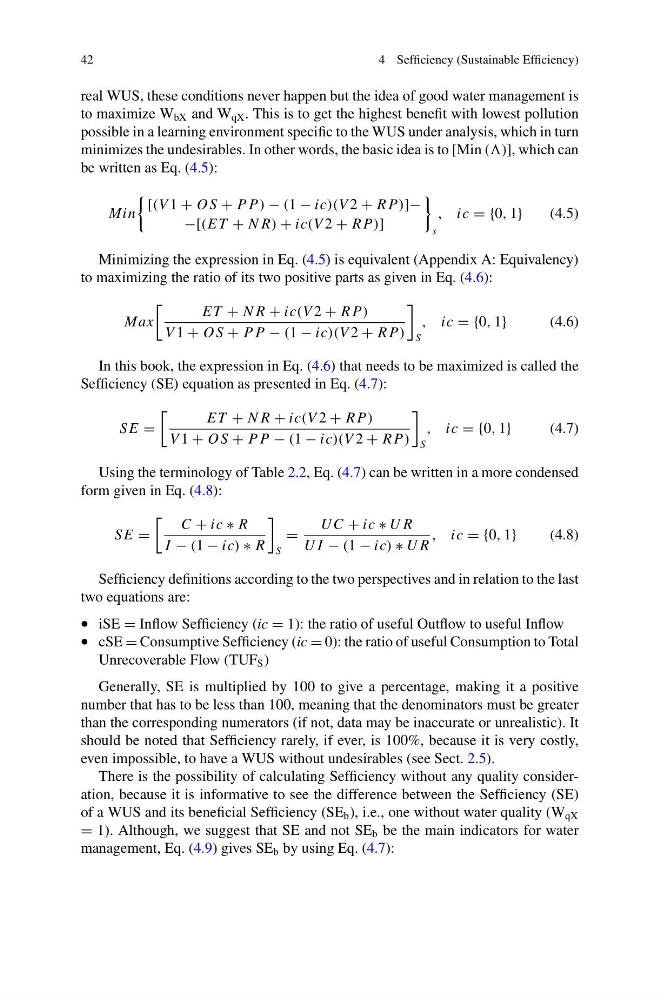
Minimizing the expression in Eq. (4.5) is equivalent (Appendix A: Equivalency)
to maximizing the ratio of its two positive parts as given in Eq. (4.6):
Max
E T + N R + ic(V 2 + R P)
V 1 + O S + P P − (1 − ic)(V 2 + R P)
S
, ic = {0, 1}
(4.6)
In this book, the expression in Eq. (4.6) that needs to be maximized is called the
Sefficiency (SE) equation as presented in Eq. (4.7):
S E =
E T + N R + ic(V 2 + R P)
V 1 + O S + P P − (1 − ic)(V 2 + R P)
S
, ic = {0, 1}
(4.7)
Using the terminology of Table 2.2, Eq. (4.7) can be written in a more condensed
form given in Eq. (4.8):
S E =
C + ic ∗ R
I − (1 − ic) ∗ R
S
=
UC + ic ∗ U R
U I − (1 − ic) ∗ U R
, ic = {0, 1}
(4.8)
Sefficiency definitions according to the two perspectives and in relation to the last
two equations are:
• iSE = Inflow Sefficiency (ic = 1): the ratio of useful Outflow to useful Inflow
• cSE = Consumptive Sefficiency (ic = 0): the ratio of useful Consumption to Total
Unrecoverable Flow (TUF S )
Generally, SE is multiplied by 100 to give a percentage, making it a positive
number that has to be less than 100, meaning that the denominators must be greater
than the corresponding numerators (if not, data may be inaccurate or unrealistic). It
should be noted that Sefficiency rarely, if ever, is 100%, because it is very costly,
even impossible, to have a WUS without undesirables (see Sect. 2.5).
There is the possibility of calculating Sefficiency without any quality consideration, because it is informative to see the difference between the Sefficiency (SE)
of a WUS and its beneficial Sefficiency (SE b ), i.e., one without water quality (W qX
= 1). Although, we suggest that SE and not SE b be the main indicators for water
management, Eq. (4.9) gives SE b by using Eq. (4.7):
4 Sefficiency (Sustainable Efficiency)
real WUS, these conditions never happen but the idea of good water management is
to maximize W bX and W qX . This is to get the highest benefit with lowest pollution
possible in a learning environment specific to the WUS under analysis, which in turn
minimizes the undesirables. In other words, the basic idea is to [Min ()], which can
be written as Eq. (4.5):
Min
[(V 1 + O S + P P) − (1 − ic)(V 2 + R P)]−
−[(E T + N R) + ic(V 2 + R P)]
s
, ic = {0, 1}
(4.5)
Minimizing the expression in Eq. (4.5) is equivalent (Appendix A: Equivalency)
to maximizing the ratio of its two positive parts as given in Eq. (4.6):
Max
E T + N R + ic(V 2 + R P)
V 1 + O S + P P − (1 − ic)(V 2 + R P)
S
, ic = {0, 1}
(4.6)
In this book, the expression in Eq. (4.6) that needs to be maximized is called the
Sefficiency (SE) equation as presented in Eq. (4.7):
S E =
E T + N R + ic(V 2 + R P)
V 1 + O S + P P − (1 − ic)(V 2 + R P)
S
, ic = {0, 1}
(4.7)
Using the terminology of Table 2.2, Eq. (4.7) can be written in a more condensed
form given in Eq. (4.8):
S E =
C + ic ∗ R
I − (1 − ic) ∗ R
S
=
UC + ic ∗ U R
U I − (1 − ic) ∗ U R
, ic = {0, 1}
(4.8)
Sefficiency definitions according to the two perspectives and in relation to the last
two equations are:
• iSE = Inflow Sefficiency (ic = 1): the ratio of useful Outflow to useful Inflow
• cSE = Consumptive Sefficiency (ic = 0): the ratio of useful Consumption to Total
Unrecoverable Flow (TUF S )
Generally, SE is multiplied by 100 to give a percentage, making it a positive
number that has to be less than 100, meaning that the denominators must be greater
than the corresponding numerators (if not, data may be inaccurate or unrealistic). It
should be noted that Sefficiency rarely, if ever, is 100%, because it is very costly,
even impossible, to have a WUS without undesirables (see Sect. 2.5).
There is the possibility of calculating Sefficiency without any quality consideration, because it is informative to see the difference between the Sefficiency (SE)
of a WUS and its beneficial Sefficiency (SE b ), i.e., one without water quality (W qX
= 1). Although, we suggest that SE and not SE b be the main indicators for water
management, Eq. (4.9) gives SE b by using Eq. (4.7):