

6.2 Urban
95
The Micro Sefficiencies are very low because they are of the Classical Efficiency
type. In this example, Eq. 4.16 gives a very low CE value of 36% illustrating what
we wrote in showing that it is flawed (Sect. 4.5). However, some experts use only
water quantities to arrive at a meso level efficiency, which in this case is about 68%
(= (I − RP wsl − RP wwl )/I). Such calculation ignores the Usefulness Criterion and is
a fraction with very limited meaning, at least in relation to the full performance of the
system. Furthermore, it implicitly assumes that the beneficial and quality weights of
all the involved flows are practically the same (e.g., W sX = 1), which is, of course, a
wrong assumption and, consequently such a calculation that is based only on water
quantity should not be used.
6.3 Equity
Equity in urban areas is one of the critical issues that the world faces. As stated in
Sect. 5.5, any system during a time interval is defined by a point on one of the 15
segments shown in Fig. 5.1. One important fact about this figure worth repeating is
that local managers in consultation with stakeholders can largely set the thresholds
(Sect. 5.1). There is also a necessity to have some water in river after abstraction (i.e.,
after VA) and after return (VD) due to ecological needs, legal contracts, and ethics
(national or international). Such a downstream required value is shown as DS req and
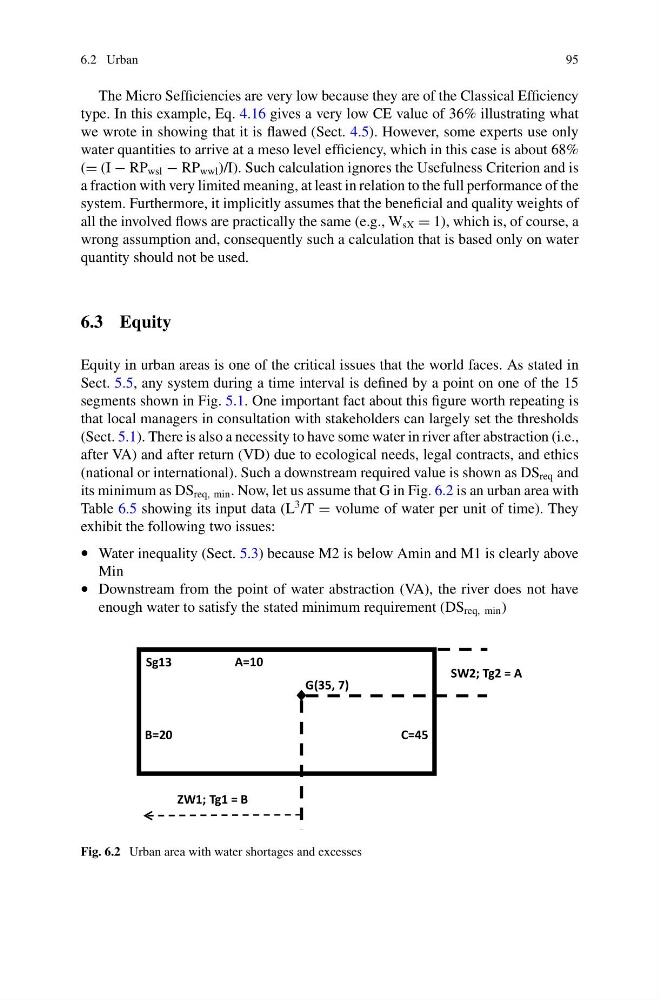
its minimum as DS req, min . Now, let us assume that G in Fig. 6.2 is an urban area with
Table 6.5 showing its input data (L
3 /T = volume of water per unit of time). They
exhibit the following two issues:
• Water inequality (Sect. 5.3) because M2 is below Amin and M1 is clearly above
Min
• Downstream from the point of water abstraction (VA), the river does not have
enough water to satisfy the stated minimum requirement (DS req, min )
G(35, 7)
Sg13
SW2; Tg2 = A
ZW1; Tg1 = B
A=10
C=45
B=20
Fig. 6.2 Urban area with water shortages and excesses
95
The Micro Sefficiencies are very low because they are of the Classical Efficiency
type. In this example, Eq. 4.16 gives a very low CE value of 36% illustrating what
we wrote in showing that it is flawed (Sect. 4.5). However, some experts use only
water quantities to arrive at a meso level efficiency, which in this case is about 68%
(= (I − RP wsl − RP wwl )/I). Such calculation ignores the Usefulness Criterion and is
a fraction with very limited meaning, at least in relation to the full performance of the
system. Furthermore, it implicitly assumes that the beneficial and quality weights of
all the involved flows are practically the same (e.g., W sX = 1), which is, of course, a
wrong assumption and, consequently such a calculation that is based only on water
quantity should not be used.
6.3 Equity
Equity in urban areas is one of the critical issues that the world faces. As stated in
Sect. 5.5, any system during a time interval is defined by a point on one of the 15
segments shown in Fig. 5.1. One important fact about this figure worth repeating is
that local managers in consultation with stakeholders can largely set the thresholds
(Sect. 5.1). There is also a necessity to have some water in river after abstraction (i.e.,
after VA) and after return (VD) due to ecological needs, legal contracts, and ethics
(national or international). Such a downstream required value is shown as DS req and
its minimum as DS req, min . Now, let us assume that G in Fig. 6.2 is an urban area with
Table 6.5 showing its input data (L
3 /T = volume of water per unit of time). They
exhibit the following two issues:
• Water inequality (Sect. 5.3) because M2 is below Amin and M1 is clearly above
Min
• Downstream from the point of water abstraction (VA), the river does not have
enough water to satisfy the stated minimum requirement (DS req, min )
G(35, 7)
Sg13
SW2; Tg2 = A
ZW1; Tg1 = B
A=10
C=45
B=20
Fig. 6.2 Urban area with water shortages and excesses