

5 Gods, Spirits and Natural Hazards …
87
Kiribati
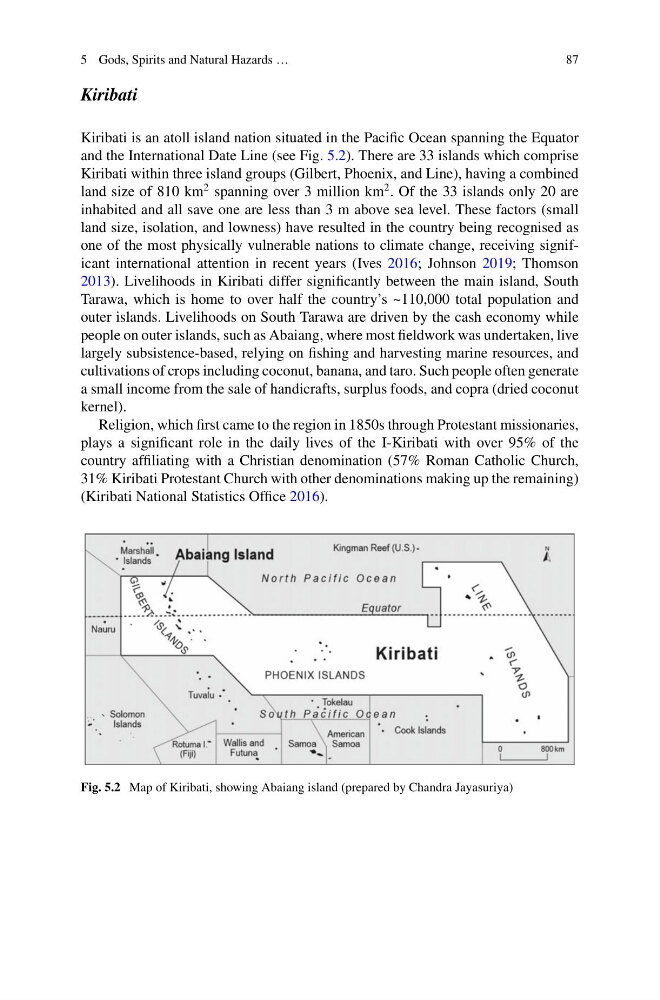
Kiribati is an atoll island nation situated in the Pacific Ocean spanning the Equator
and the International Date Line (see Fig. 5.2). There are 33 islands which comprise
Kiribati within three island groups (Gilbert, Phoenix, and Line), having a combined
land size of 810 km
2 spanning over 3 million km
2 . Of the 33 islands only 20 are
inhabited and all save one are less than 3 m above sea level. These factors (small
land size, isolation, and lowness) have resulted in the country being recognised as
one of the most physically vulnerable nations to climate change, receiving significant international attention in recent years (Ives 2016; Johnson 2019; Thomson
2013). Livelihoods in Kiribati differ significantly between the main island, South
Tarawa, which is home to over half the country’s ~110,000 total population and
outer islands. Livelihoods on South Tarawa are driven by the cash economy while
people on outer islands, such as Abaiang, where most fieldwork was undertaken, live
largely subsistence-based, relying on fishing and harvesting marine resources, and
cultivations of crops including coconut, banana, and taro. Such people often generate
a small income from the sale of handicrafts, surplus foods, and copra (dried coconut
kernel).
Religion, which first came to the region in 1850s through Protestant missionaries,
plays a significant role in the daily lives of the I-Kiribati with over 95% of the
country affiliating with a Christian denomination (57% Roman Catholic Church,
31% Kiribati Protestant Church with other denominations making up the remaining)
(Kiribati National Statistics Office 2016).
Fig. 5.2 Map of Kiribati, showing Abaiang island (prepared by Chandra Jayasuriya)
87
Kiribati
Kiribati is an atoll island nation situated in the Pacific Ocean spanning the Equator
and the International Date Line (see Fig. 5.2). There are 33 islands which comprise
Kiribati within three island groups (Gilbert, Phoenix, and Line), having a combined
land size of 810 km
2 spanning over 3 million km
2 . Of the 33 islands only 20 are
inhabited and all save one are less than 3 m above sea level. These factors (small
land size, isolation, and lowness) have resulted in the country being recognised as
one of the most physically vulnerable nations to climate change, receiving significant international attention in recent years (Ives 2016; Johnson 2019; Thomson
2013). Livelihoods in Kiribati differ significantly between the main island, South
Tarawa, which is home to over half the country’s ~110,000 total population and
outer islands. Livelihoods on South Tarawa are driven by the cash economy while
people on outer islands, such as Abaiang, where most fieldwork was undertaken, live
largely subsistence-based, relying on fishing and harvesting marine resources, and
cultivations of crops including coconut, banana, and taro. Such people often generate
a small income from the sale of handicrafts, surplus foods, and copra (dried coconut
kernel).
Religion, which first came to the region in 1850s through Protestant missionaries,
plays a significant role in the daily lives of the I-Kiribati with over 95% of the
country affiliating with a Christian denomination (57% Roman Catholic Church,
31% Kiribati Protestant Church with other denominations making up the remaining)
(Kiribati National Statistics Office 2016).
Fig. 5.2 Map of Kiribati, showing Abaiang island (prepared by Chandra Jayasuriya)