

86
G. Jackson and A. Piggott-McKellar
Bedamuni, Western Province, Papua New Guinea
The Bedamuni occupy dissected foothills in the very remote and economically
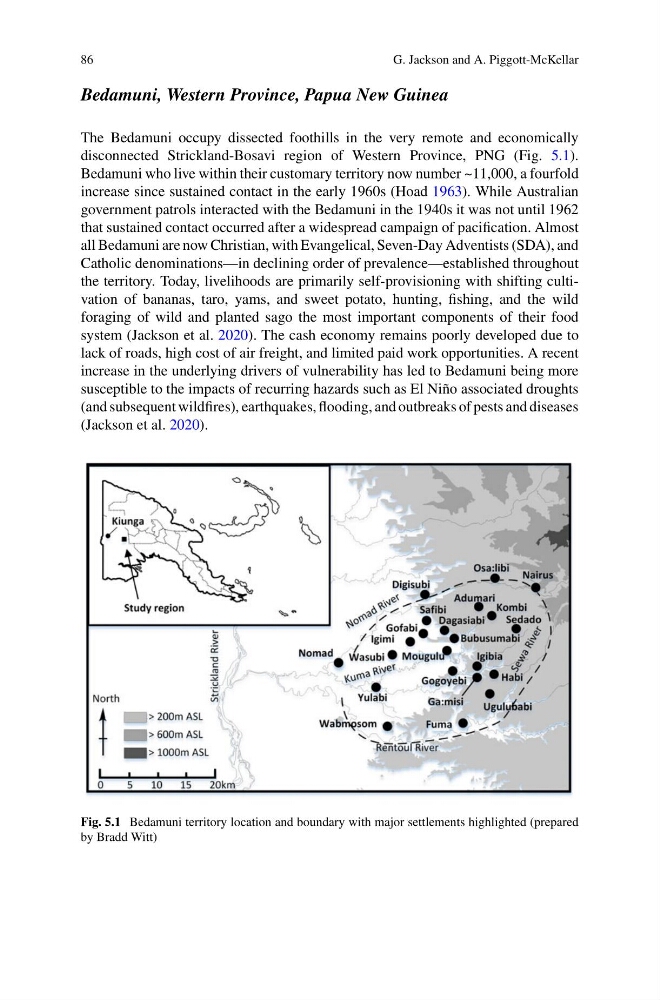
disconnected Strickland-Bosavi region of Western Province, PNG (Fig. 5.1).
Bedamuni who live within their customary territory now number ~11,000, a fourfold
increase since sustained contact in the early 1960s (Hoad 1963). While Australian
government patrols interacted with the Bedamuni in the 1940s it was not until 1962
that sustained contact occurred after a widespread campaign of pacification. Almost
all Bedamuni are now Christian, with Evangelical, Seven-Day Adventists (SDA), and
Catholic denominations—in declining order of prevalence—established throughout
the territory. Today, livelihoods are primarily self-provisioning with shifting cultivation of bananas, taro, yams, and sweet potato, hunting, fishing, and the wild
foraging of wild and planted sago the most important components of their food
system (Jackson et al. 2020). The cash economy remains poorly developed due to
lack of roads, high cost of air freight, and limited paid work opportunities. A recent
increase in the underlying drivers of vulnerability has led to Bedamuni being more
susceptible to the impacts of recurring hazards such as El Niño associated droughts
(and subsequent wildfires), earthquakes, flooding, and outbreaks of pests and diseases
(Jackson et al. 2020).
Fig. 5.1 Bedamuni territory location and boundary with major settlements highlighted (prepared
by Bradd Witt)
G. Jackson and A. Piggott-McKellar
Bedamuni, Western Province, Papua New Guinea
The Bedamuni occupy dissected foothills in the very remote and economically
disconnected Strickland-Bosavi region of Western Province, PNG (Fig. 5.1).
Bedamuni who live within their customary territory now number ~11,000, a fourfold
increase since sustained contact in the early 1960s (Hoad 1963). While Australian
government patrols interacted with the Bedamuni in the 1940s it was not until 1962
that sustained contact occurred after a widespread campaign of pacification. Almost
all Bedamuni are now Christian, with Evangelical, Seven-Day Adventists (SDA), and
Catholic denominations—in declining order of prevalence—established throughout
the territory. Today, livelihoods are primarily self-provisioning with shifting cultivation of bananas, taro, yams, and sweet potato, hunting, fishing, and the wild
foraging of wild and planted sago the most important components of their food
system (Jackson et al. 2020). The cash economy remains poorly developed due to
lack of roads, high cost of air freight, and limited paid work opportunities. A recent
increase in the underlying drivers of vulnerability has led to Bedamuni being more
susceptible to the impacts of recurring hazards such as El Niño associated droughts
(and subsequent wildfires), earthquakes, flooding, and outbreaks of pests and diseases
(Jackson et al. 2020).
Fig. 5.1 Bedamuni territory location and boundary with major settlements highlighted (prepared
by Bradd Witt)