

366
J. M. Luetz and R. G. Leo
most sceptical about the reality and severity of climate change (Poortinga et al. 2011,
p. 1017).
Human values and spirituality play an important role in human behaviour (Luetz
et al. 2020; Luetz and Nunn 2020). Given what the body of literature suggests about
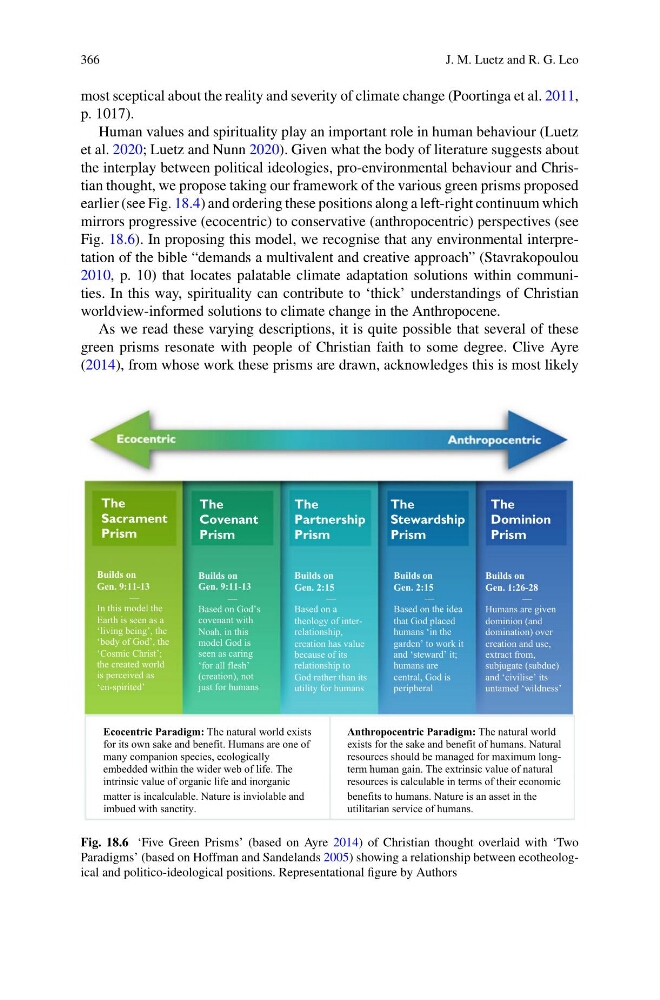
the interplay between political ideologies, pro-environmental behaviour and Christian thought, we propose taking our framework of the various green prisms proposed
earlier (see Fig. 18.4) and ordering these positions along a left-right continuum which
mirrors progressive (ecocentric) to conservative (anthropocentric) perspectives (see
Fig. 18.6). In proposing this model, we recognise that any environmental interpretation of the bible “demands a multivalent and creative approach” (Stavrakopoulou
2010, p. 10) that locates palatable climate adaptation solutions within communities. In this way, spirituality can contribute to ‘thick’ understandings of Christian
worldview-informed solutions to climate change in the Anthropocene.
As we read these varying descriptions, it is quite possible that several of these
green prisms resonate with people of Christian faith to some degree. Clive Ayre
(2014), from whose work these prisms are drawn, acknowledges this is most likely
Ecocentric Paradigm: The natural world exists
for its own sake and benefit. Humans are one of
many companion species, ecologically
embedded within the wider web of life. The
intrinsic value of organic life and inorganic
Anthropocentric Paradigm: The natural world
exists for the sake and benefit of humans. Natural
resources should be managed for maximum longterm human gain. The extrinsic value of natural
resources is calculable in terms of their economic
The
Sacrament
Prism
The
Covenant
Prism
The
Partnership
Prism
The
Stewardship
Prism
The
Dominion
Prism
Builds on
Gen. 9:11-13
—
In this model the
Earth is seen as a
‘living being’, the
‘body of God’, the
‘Cosmic Christ’;
the created world
is perceived as
‘en-spirited’
Builds on
Gen. 9:11-13
—
Based on God’s
covenant with
Noah, in this
model God is
seen as caring
‘for all flesh’
(creation), not
just for humans
Builds on
Gen. 2:15
—
Based on a
theology of interrelationship,
creation has value
because of its
relationship to
God rather than its
utility for humans
Builds on
Gen. 2:15
—
Based on the idea
that God placed
humans ‘in the
garden’ to work it
and ‘steward’ it;
humans are
central, God is
peripheral
Builds on
Gen. 1:26-28
—
Humans are given
dominion (and
domination) over
creation and use,
extract from,
subjugate (subdue)
and ‘civilise’ its
untamed ‘wildness’
matter is incalculable. Nature is inviolable and
imbued with sanctity.
benefits to humans. Nature is an asset in the
utilitarian service of humans.
Fig. 18.6 ‘Five Green Prisms’ (based on Ayre 2014) of Christian thought overlaid with ‘Two
Paradigms’ (based on Hoffman and Sandelands 2005) showing a relationship between ecotheological and politico-ideological positions. Representational figure by Authors
J. M. Luetz and R. G. Leo
most sceptical about the reality and severity of climate change (Poortinga et al. 2011,
p. 1017).
Human values and spirituality play an important role in human behaviour (Luetz
et al. 2020; Luetz and Nunn 2020). Given what the body of literature suggests about
the interplay between political ideologies, pro-environmental behaviour and Christian thought, we propose taking our framework of the various green prisms proposed
earlier (see Fig. 18.4) and ordering these positions along a left-right continuum which
mirrors progressive (ecocentric) to conservative (anthropocentric) perspectives (see
Fig. 18.6). In proposing this model, we recognise that any environmental interpretation of the bible “demands a multivalent and creative approach” (Stavrakopoulou
2010, p. 10) that locates palatable climate adaptation solutions within communities. In this way, spirituality can contribute to ‘thick’ understandings of Christian
worldview-informed solutions to climate change in the Anthropocene.
As we read these varying descriptions, it is quite possible that several of these
green prisms resonate with people of Christian faith to some degree. Clive Ayre
(2014), from whose work these prisms are drawn, acknowledges this is most likely
Ecocentric Paradigm: The natural world exists
for its own sake and benefit. Humans are one of
many companion species, ecologically
embedded within the wider web of life. The
intrinsic value of organic life and inorganic
Anthropocentric Paradigm: The natural world
exists for the sake and benefit of humans. Natural
resources should be managed for maximum longterm human gain. The extrinsic value of natural
resources is calculable in terms of their economic
The
Sacrament
Prism
The
Covenant
Prism
The
Partnership
Prism
The
Stewardship
Prism
The
Dominion
Prism
Builds on
Gen. 9:11-13
—
In this model the
Earth is seen as a
‘living being’, the
‘body of God’, the
‘Cosmic Christ’;
the created world
is perceived as
‘en-spirited’
Builds on
Gen. 9:11-13
—
Based on God’s
covenant with
Noah, in this
model God is
seen as caring
‘for all flesh’
(creation), not
just for humans
Builds on
Gen. 2:15
—
Based on a
theology of interrelationship,
creation has value
because of its
relationship to
God rather than its
utility for humans
Builds on
Gen. 2:15
—
Based on the idea
that God placed
humans ‘in the
garden’ to work it
and ‘steward’ it;
humans are
central, God is
peripheral
Builds on
Gen. 1:26-28
—
Humans are given
dominion (and
domination) over
creation and use,
extract from,
subjugate (subdue)
and ‘civilise’ its
untamed ‘wildness’
matter is incalculable. Nature is inviolable and
imbued with sanctity.
benefits to humans. Nature is an asset in the
utilitarian service of humans.
Fig. 18.6 ‘Five Green Prisms’ (based on Ayre 2014) of Christian thought overlaid with ‘Two
Paradigms’ (based on Hoffman and Sandelands 2005) showing a relationship between ecotheological and politico-ideological positions. Representational figure by Authors