

18 Christianity, Creation, and the Climate Crisis …
365
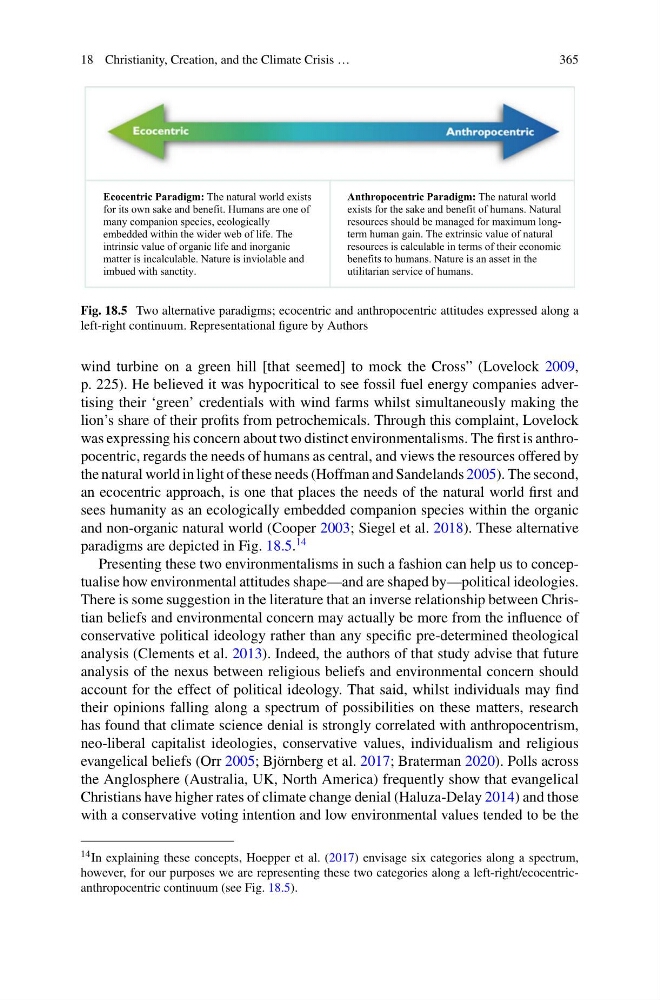
Ecocentric Paradigm: The natural world exists
for its own sake and benefit. Humans are one of
many companion species, ecologically
embedded within the wider web of life. The
intrinsic value of organic life and inorganic
matter is incalculable. Nature is inviolable and
imbued with sanctity.
Anthropocentric Paradigm: The natural world
exists for the sake and benefit of humans. Natural
resources should be managed for maximum longterm human gain. The extrinsic value of natural
resources is calculable in terms of their economic
benefits to humans. Nature is an asset in the
utilitarian service of humans.
Fig. 18.5 Two alternative paradigms; ecocentric and anthropocentric attitudes expressed along a
left-right continuum. Representational figure by Authors
wind turbine on a green hill [that seemed] to mock the Cross” (Lovelock 2009,
p. 225). He believed it was hypocritical to see fossil fuel energy companies advertising their ‘green’ credentials with wind farms whilst simultaneously making the
lion’s share of their profits from petrochemicals. Through this complaint, Lovelock
was expressing his concern about two distinct environmentalisms. The first is anthropocentric, regards the needs of humans as central, and views the resources offered by
the natural world in light of these needs (Hoffman and Sandelands 2005). The second,
an ecocentric approach, is one that places the needs of the natural world first and
sees humanity as an ecologically embedded companion species within the organic
and non-organic natural world (Cooper 2003; Siegel et al. 2018). These alternative
paradigms are depicted in Fig. 18.5.
14
Presenting these two environmentalisms in such a fashion can help us to conceptualise how environmental attitudes shape—and are shaped by—political ideologies.
There is some suggestion in the literature that an inverse relationship between Christian beliefs and environmental concern may actually be more from the influence of
conservative political ideology rather than any specific pre-determined theological
analysis (Clements et al. 2013). Indeed, the authors of that study advise that future
analysis of the nexus between religious beliefs and environmental concern should
account for the effect of political ideology. That said, whilst individuals may find
their opinions falling along a spectrum of possibilities on these matters, research
has found that climate science denial is strongly correlated with anthropocentrism,
neo-liberal capitalist ideologies, conservative values, individualism and religious
evangelical beliefs (Orr 2005; Björnberg et al. 2017; Braterman 2020). Polls across
the Anglosphere (Australia, UK, North America) frequently show that evangelical
Christians have higher rates of climate change denial (Haluza-Delay 2014) and those
with a conservative voting intention and low environmental values tended to be the
14 In explaining these concepts, Hoepper et al. (2017) envisage six categories along a spectrum,
however, for our purposes we are representing these two categories along a left-right/ecocentricanthropocentric continuum (see Fig. 18.5).
365
Ecocentric Paradigm: The natural world exists
for its own sake and benefit. Humans are one of
many companion species, ecologically
embedded within the wider web of life. The
intrinsic value of organic life and inorganic
matter is incalculable. Nature is inviolable and
imbued with sanctity.
Anthropocentric Paradigm: The natural world
exists for the sake and benefit of humans. Natural
resources should be managed for maximum longterm human gain. The extrinsic value of natural
resources is calculable in terms of their economic
benefits to humans. Nature is an asset in the
utilitarian service of humans.
Fig. 18.5 Two alternative paradigms; ecocentric and anthropocentric attitudes expressed along a
left-right continuum. Representational figure by Authors
wind turbine on a green hill [that seemed] to mock the Cross” (Lovelock 2009,
p. 225). He believed it was hypocritical to see fossil fuel energy companies advertising their ‘green’ credentials with wind farms whilst simultaneously making the
lion’s share of their profits from petrochemicals. Through this complaint, Lovelock
was expressing his concern about two distinct environmentalisms. The first is anthropocentric, regards the needs of humans as central, and views the resources offered by
the natural world in light of these needs (Hoffman and Sandelands 2005). The second,
an ecocentric approach, is one that places the needs of the natural world first and
sees humanity as an ecologically embedded companion species within the organic
and non-organic natural world (Cooper 2003; Siegel et al. 2018). These alternative
paradigms are depicted in Fig. 18.5.
14
Presenting these two environmentalisms in such a fashion can help us to conceptualise how environmental attitudes shape—and are shaped by—political ideologies.
There is some suggestion in the literature that an inverse relationship between Christian beliefs and environmental concern may actually be more from the influence of
conservative political ideology rather than any specific pre-determined theological
analysis (Clements et al. 2013). Indeed, the authors of that study advise that future
analysis of the nexus between religious beliefs and environmental concern should
account for the effect of political ideology. That said, whilst individuals may find
their opinions falling along a spectrum of possibilities on these matters, research
has found that climate science denial is strongly correlated with anthropocentrism,
neo-liberal capitalist ideologies, conservative values, individualism and religious
evangelical beliefs (Orr 2005; Björnberg et al. 2017; Braterman 2020). Polls across
the Anglosphere (Australia, UK, North America) frequently show that evangelical
Christians have higher rates of climate change denial (Haluza-Delay 2014) and those
with a conservative voting intention and low environmental values tended to be the
14 In explaining these concepts, Hoepper et al. (2017) envisage six categories along a spectrum,
however, for our purposes we are representing these two categories along a left-right/ecocentricanthropocentric continuum (see Fig. 18.5).