

12 Climate Change: Science, People, Religion—Cord of Three Strands
229
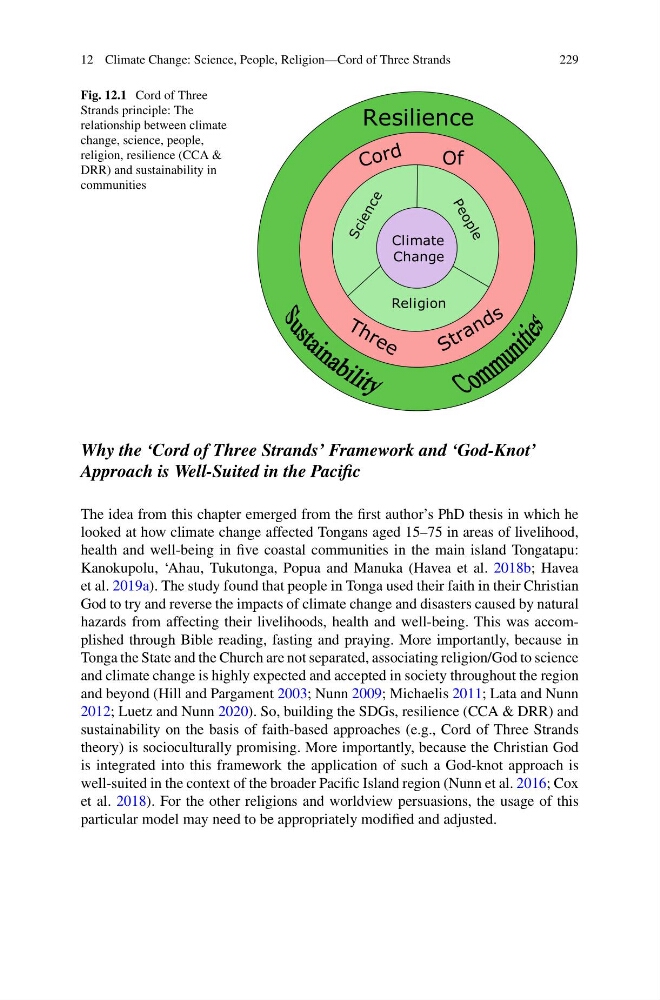
Fig. 12.1 Cord of Three
Strands principle: The
relationship between climate
change, science, people,
religion, resilience (CCA &
DRR) and sustainability in
communities
Why the ‘Cord of Three Strands’ Framework and ‘God-Knot’
Approach is Well-Suited in the Pacific
The idea from this chapter emerged from the first author’s PhD thesis in which he
looked at how climate change affected Tongans aged 15–75 in areas of livelihood,
health and well-being in five coastal communities in the main island Tongatapu:
Kanokupolu, ‘Ahau, Tukutonga, Popua and Manuka (Havea et al. 2018b; Havea
et al. 2019a). The study found that people in Tonga used their faith in their Christian
God to try and reverse the impacts of climate change and disasters caused by natural
hazards from affecting their livelihoods, health and well-being. This was accomplished through Bible reading, fasting and praying. More importantly, because in
Tonga the State and the Church are not separated, associating religion/God to science
and climate change is highly expected and accepted in society throughout the region
and beyond (Hill and Pargament 2003; Nunn 2009; Michaelis 2011; Lata and Nunn
2012; Luetz and Nunn 2020). So, building the SDGs, resilience (CCA & DRR) and
sustainability on the basis of faith-based approaches (e.g., Cord of Three Strands
theory) is socioculturally promising. More importantly, because the Christian God
is integrated into this framework the application of such a God-knot approach is
well-suited in the context of the broader Pacific Island region (Nunn et al. 2016; Cox
et al. 2018). For the other religions and worldview persuasions, the usage of this
particular model may need to be appropriately modified and adjusted.
229
Fig. 12.1 Cord of Three
Strands principle: The
relationship between climate
change, science, people,
religion, resilience (CCA &
DRR) and sustainability in
communities
Why the ‘Cord of Three Strands’ Framework and ‘God-Knot’
Approach is Well-Suited in the Pacific
The idea from this chapter emerged from the first author’s PhD thesis in which he
looked at how climate change affected Tongans aged 15–75 in areas of livelihood,
health and well-being in five coastal communities in the main island Tongatapu:
Kanokupolu, ‘Ahau, Tukutonga, Popua and Manuka (Havea et al. 2018b; Havea
et al. 2019a). The study found that people in Tonga used their faith in their Christian
God to try and reverse the impacts of climate change and disasters caused by natural
hazards from affecting their livelihoods, health and well-being. This was accomplished through Bible reading, fasting and praying. More importantly, because in
Tonga the State and the Church are not separated, associating religion/God to science
and climate change is highly expected and accepted in society throughout the region
and beyond (Hill and Pargament 2003; Nunn 2009; Michaelis 2011; Lata and Nunn
2012; Luetz and Nunn 2020). So, building the SDGs, resilience (CCA & DRR) and
sustainability on the basis of faith-based approaches (e.g., Cord of Three Strands
theory) is socioculturally promising. More importantly, because the Christian God
is integrated into this framework the application of such a God-knot approach is
well-suited in the context of the broader Pacific Island region (Nunn et al. 2016; Cox
et al. 2018). For the other religions and worldview persuasions, the usage of this
particular model may need to be appropriately modified and adjusted.