

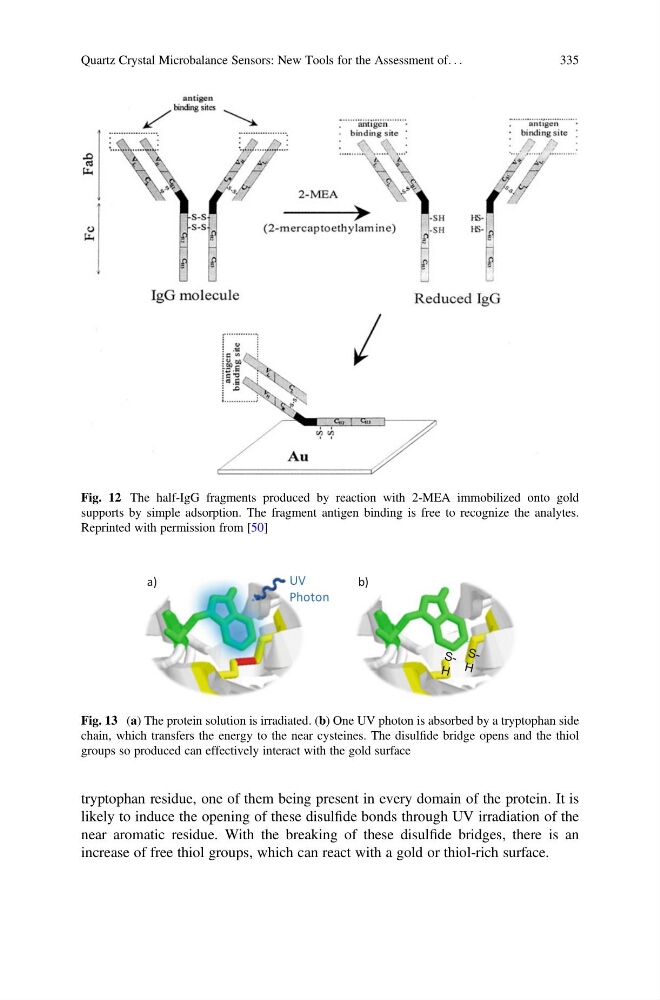
tryptophan residue, one of them being present in every domain of the protein. It is
likely to induce the opening of these disulfide bonds through UV irradiation of the
near aromatic residue. With the breaking of these disulfide bridges, there is an
increase of free thiol groups, which can react with a gold or thiol-rich surface.
Fig. 12 The half-IgG fragments produced by reaction with 2-MEA immobilized onto gold
supports by simple adsorption. The fragment antigen binding is free to recognize the analytes.
Reprinted with permission from [50]
UV
Photon
a)
b)
Fig. 13 (a) The protein solution is irradiated. (b) One UV photon is absorbed by a tryptophan side
chain, which transfers the energy to the near cysteines. The disulfide bridge opens and the thiol
groups so produced can effectively interact with the gold surface
Quartz Crystal Microbalance Sensors: New Tools for the Assessment of. . .
335
likely to induce the opening of these disulfide bonds through UV irradiation of the
near aromatic residue. With the breaking of these disulfide bridges, there is an
increase of free thiol groups, which can react with a gold or thiol-rich surface.
Fig. 12 The half-IgG fragments produced by reaction with 2-MEA immobilized onto gold
supports by simple adsorption. The fragment antigen binding is free to recognize the analytes.
Reprinted with permission from [50]
UV
Photon
a)
b)
Fig. 13 (a) The protein solution is irradiated. (b) One UV photon is absorbed by a tryptophan side
chain, which transfers the energy to the near cysteines. The disulfide bridge opens and the thiol
groups so produced can effectively interact with the gold surface
Quartz Crystal Microbalance Sensors: New Tools for the Assessment of. . .
335