

UV/Vis absorption spectroscopy uses the linear dependence between the absorption measured and the concentration of the analytes, called the Lambert-Beer
relationship, to determine parameter concentration values:
A ¼ ε  c  L
ð2Þ
A total λ
ð Þ ¼
X
i
ε i λ
ð Þc i L
ð3Þ
where A is the absorption value, ε (λ) is the molar extinction coefficient of the
molecule or ion at wavelength λ, c is its concentration and L is the distance the light
travels through the sample. The absorption at a particular wavelength A i of multiple
species i in a complex matrix can be linearly added to give a total absorption value
A total (λ). For the purpose of water quality monitoring, spectrometer devices use a
reference spectrum recorded in high-purity water which is subtracted from every
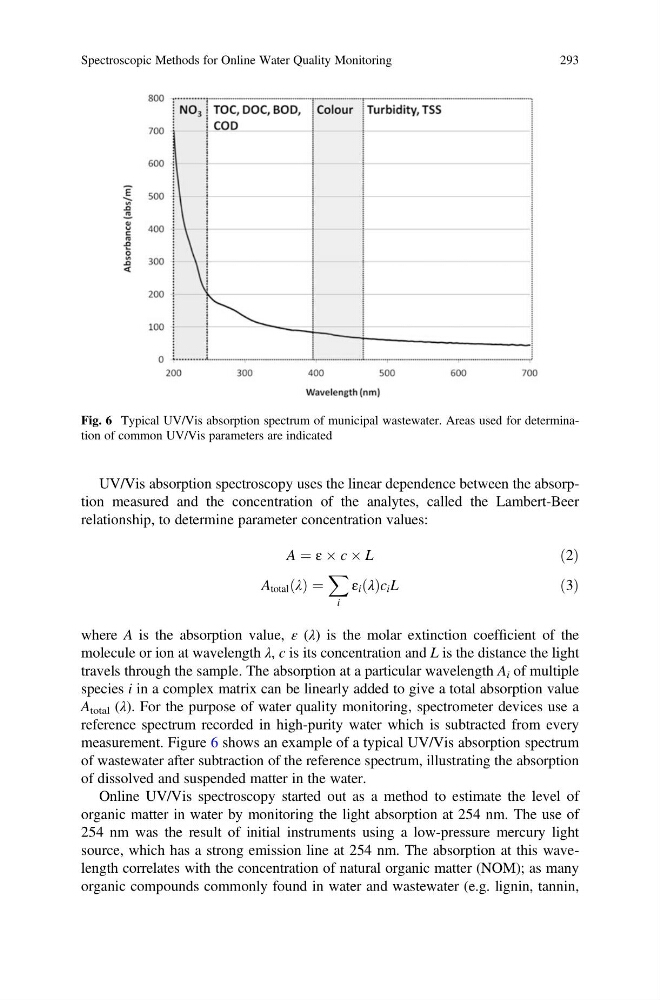
measurement. Figure 6 shows an example of a typical UV/Vis absorption spectrum
of wastewater after subtraction of the reference spectrum, illustrating the absorption
of dissolved and suspended matter in the water.
Online UV/Vis spectroscopy started out as a method to estimate the level of
organic matter in water by monitoring the light absorption at 254 nm. The use of
254 nm was the result of initial instruments using a low-pressure mercury light
source, which has a strong emission line at 254 nm. The absorption at this wavelength correlates with the concentration of natural organic matter (NOM); as many
organic compounds commonly found in water and wastewater (e.g. lignin, tannin,
Fig. 6 Typical UV/Vis absorption spectrum of municipal wastewater. Areas used for determination of common UV/Vis parameters are indicated
Spectroscopic Methods for Online Water Quality Monitoring
293
relationship, to determine parameter concentration values:
A ¼ ε  c  L
ð2Þ
A total λ
ð Þ ¼
X
i
ε i λ
ð Þc i L
ð3Þ
where A is the absorption value, ε (λ) is the molar extinction coefficient of the
molecule or ion at wavelength λ, c is its concentration and L is the distance the light
travels through the sample. The absorption at a particular wavelength A i of multiple
species i in a complex matrix can be linearly added to give a total absorption value
A total (λ). For the purpose of water quality monitoring, spectrometer devices use a
reference spectrum recorded in high-purity water which is subtracted from every
measurement. Figure 6 shows an example of a typical UV/Vis absorption spectrum
of wastewater after subtraction of the reference spectrum, illustrating the absorption
of dissolved and suspended matter in the water.
Online UV/Vis spectroscopy started out as a method to estimate the level of
organic matter in water by monitoring the light absorption at 254 nm. The use of
254 nm was the result of initial instruments using a low-pressure mercury light
source, which has a strong emission line at 254 nm. The absorption at this wavelength correlates with the concentration of natural organic matter (NOM); as many
organic compounds commonly found in water and wastewater (e.g. lignin, tannin,
Fig. 6 Typical UV/Vis absorption spectrum of municipal wastewater. Areas used for determination of common UV/Vis parameters are indicated
Spectroscopic Methods for Online Water Quality Monitoring
293