

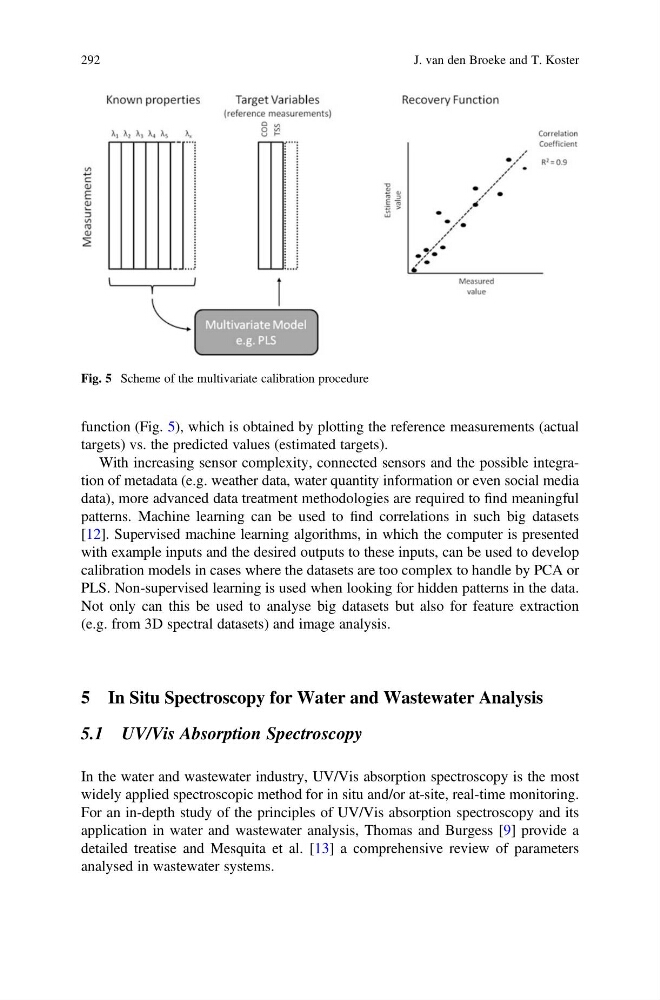
function (Fig. 5), which is obtained by plotting the reference measurements (actual
targets) vs. the predicted values (estimated targets).
With increasing sensor complexity, connected sensors and the possible integration of metadata (e.g. weather data, water quantity information or even social media
data), more advanced data treatment methodologies are required to find meaningful
patterns. Machine learning can be used to find correlations in such big datasets
[12]. Supervised machine learning algorithms, in which the computer is presented
with example inputs and the desired outputs to these inputs, can be used to develop
calibration models in cases where the datasets are too complex to handle by PCA or
PLS. Non-supervised learning is used when looking for hidden patterns in the data.
Not only can this be used to analyse big datasets but also for feature extraction
(e.g. from 3D spectral datasets) and image analysis.
5 In Situ Spectroscopy for Water and Wastewater Analysis
5.1 UV/Vis Absorption Spectroscopy
In the water and wastewater industry, UV/Vis absorption spectroscopy is the most
widely applied spectroscopic method for in situ and/or at-site, real-time monitoring.
For an in-depth study of the principles of UV/Vis absorption spectroscopy and its
application in water and wastewater analysis, Thomas and Burgess [9] provide a
detailed treatise and Mesquita et al. [13] a comprehensive review of parameters
analysed in wastewater systems.
Fig. 5 Scheme of the multivariate calibration procedure
292
J. van den Broeke and T. Koster
targets) vs. the predicted values (estimated targets).
With increasing sensor complexity, connected sensors and the possible integration of metadata (e.g. weather data, water quantity information or even social media
data), more advanced data treatment methodologies are required to find meaningful
patterns. Machine learning can be used to find correlations in such big datasets
[12]. Supervised machine learning algorithms, in which the computer is presented
with example inputs and the desired outputs to these inputs, can be used to develop
calibration models in cases where the datasets are too complex to handle by PCA or
PLS. Non-supervised learning is used when looking for hidden patterns in the data.
Not only can this be used to analyse big datasets but also for feature extraction
(e.g. from 3D spectral datasets) and image analysis.
5 In Situ Spectroscopy for Water and Wastewater Analysis
5.1 UV/Vis Absorption Spectroscopy
In the water and wastewater industry, UV/Vis absorption spectroscopy is the most
widely applied spectroscopic method for in situ and/or at-site, real-time monitoring.
For an in-depth study of the principles of UV/Vis absorption spectroscopy and its
application in water and wastewater analysis, Thomas and Burgess [9] provide a
detailed treatise and Mesquita et al. [13] a comprehensive review of parameters
analysed in wastewater systems.
Fig. 5 Scheme of the multivariate calibration procedure
292
J. van den Broeke and T. Koster