

4 SMOS Descending and Ascending Overpasses
SMOS makes both ascending and descending overpasses; however the performance
of those retrievals remains unclear [68, 91–93]. Based on the literature review,
previous studies mainly focused on the downscaling, assimilation and evaluation
of the SMOS ascending overpass in order to minimise the observation error caused
by the daytime soil-drying effect and the impact of vertical soil-vegetation temperature gradients [8, 20, 61, 68, 85]. It is expected that satellite soil moisture measurements are more accurate in the hours near dawn when the soil profile has the most
time to return to an equilibrium state from the previous day’s fluxes [94]. Hence,
based on this hypothesis, it is more likely to be true that ascending soil moisture
measurements would have better performance than their descending counterparts
[68]. In addition, based on evaporation demand, it is expected that soil would be
wetter at night and drier during the day; in other words, the ascending pass should
hold higher soil moisture values than the descending pass if there is no rainfall
during the day [83]. However it is found by [22] the SMOS descending orbit shows a
stronger potential for improved hydrological predictions in a medium-sized cropland
catchment. This outcome contradicts the previous hypothesis from other studies that
ascending soil moisture measurements should have better performance than their
descending counterparts. Additionally in [22], it is explored that SMOS retrievals
from the descending overpass are consistently wetter (about 11.7% by volume) than
the ascending retrievals (Fig. 5), which is again not expected. It is explained by the
authors that the results could be partly explained by the RFI from the North Warning
System radars across northern Canada (formerly called the Distant Early Warning
(DEW) Line) [83], which preferentially affects the ascending retrievals in the study
area because of the acquisition time and swath area [91]. The RFI increases the
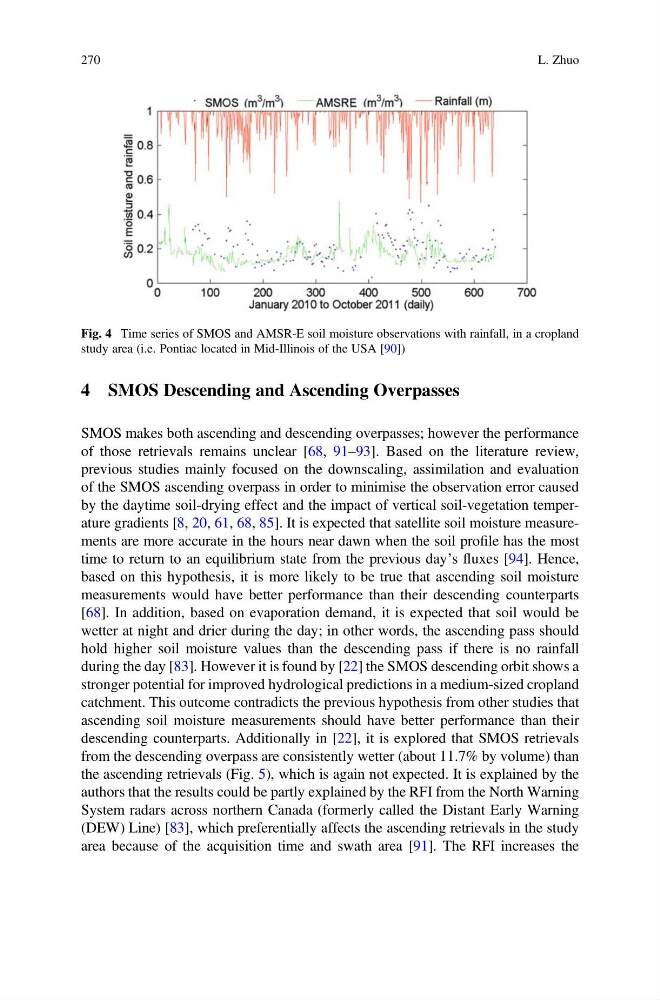
Fig. 4 Time series of SMOS and AMSR-E soil moisture observations with rainfall, in a cropland
study area (i.e. Pontiac located in Mid-Illinois of the USA [90])
270
L. Zhuo
SMOS makes both ascending and descending overpasses; however the performance
of those retrievals remains unclear [68, 91–93]. Based on the literature review,
previous studies mainly focused on the downscaling, assimilation and evaluation
of the SMOS ascending overpass in order to minimise the observation error caused
by the daytime soil-drying effect and the impact of vertical soil-vegetation temperature gradients [8, 20, 61, 68, 85]. It is expected that satellite soil moisture measurements are more accurate in the hours near dawn when the soil profile has the most
time to return to an equilibrium state from the previous day’s fluxes [94]. Hence,
based on this hypothesis, it is more likely to be true that ascending soil moisture
measurements would have better performance than their descending counterparts
[68]. In addition, based on evaporation demand, it is expected that soil would be
wetter at night and drier during the day; in other words, the ascending pass should
hold higher soil moisture values than the descending pass if there is no rainfall
during the day [83]. However it is found by [22] the SMOS descending orbit shows a
stronger potential for improved hydrological predictions in a medium-sized cropland
catchment. This outcome contradicts the previous hypothesis from other studies that
ascending soil moisture measurements should have better performance than their
descending counterparts. Additionally in [22], it is explored that SMOS retrievals
from the descending overpass are consistently wetter (about 11.7% by volume) than
the ascending retrievals (Fig. 5), which is again not expected. It is explained by the
authors that the results could be partly explained by the RFI from the North Warning
System radars across northern Canada (formerly called the Distant Early Warning
(DEW) Line) [83], which preferentially affects the ascending retrievals in the study
area because of the acquisition time and swath area [91]. The RFI increases the
Fig. 4 Time series of SMOS and AMSR-E soil moisture observations with rainfall, in a cropland
study area (i.e. Pontiac located in Mid-Illinois of the USA [90])
270
L. Zhuo