

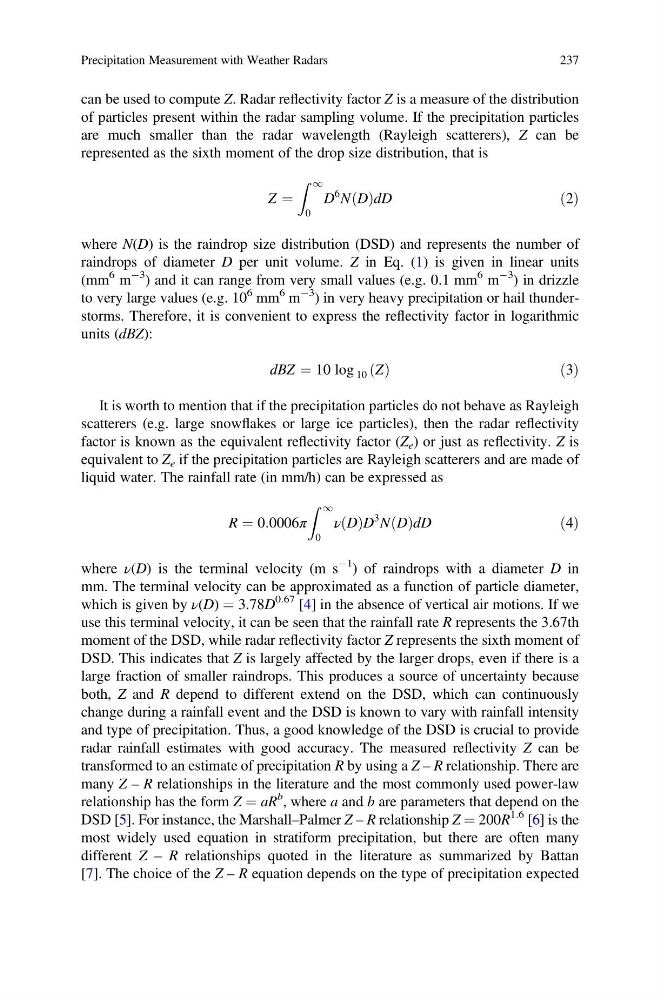
can be used to compute Z. Radar reflectivity factor Z is a measure of the distribution
of particles present within the radar sampling volume. If the precipitation particles
are much smaller than the radar wavelength (Rayleigh scatterers), Z can be
represented as the sixth moment of the drop size distribution, that is
Z ¼
Z 1
0
D
6 N D
ð ÞdD
ð2Þ
where N(D) is the raindrop size distribution (DSD) and represents the number of
raindrops of diameter D per unit volume. Z in Eq. (1) is given in linear units
(mm
6 m
À3 ) and it can range from very small values (e.g. 0.1 mm
6 m
À3
) in drizzle
to very large values (e.g. 10
6 mm
6 m
À3 ) in very heavy precipitation or hail thunderstorms. Therefore, it is convenient to express the reflectivity factor in logarithmic
units (dBZ):
dBZ ¼ 10 log 10 Z
ð Þ
ð3Þ
It is worth to mention that if the precipitation particles do not behave as Rayleigh
scatterers (e.g. large snowflakes or large ice particles), then the radar reflectivity
factor is known as the equivalent reflectivity factor (Z e ) or just as reflectivity. Z is
equivalent to Z e if the precipitation particles are Rayleigh scatterers and are made of
liquid water. The rainfall rate (in mm/h) can be expressed as
R ¼ 0:0006π
Z 1
0
ν D
ð ÞD
3 N D
ð ÞdD
ð4Þ
where ν(D) is the terminal velocity (m s
À1 ) of raindrops with a diameter D in
mm. The terminal velocity can be approximated as a function of particle diameter,
which is given by ν(D) ¼ 3.78D
0.67 [4] in the absence of vertical air motions. If we
use this terminal velocity, it can be seen that the rainfall rate R represents the 3.67th
moment of the DSD, while radar reflectivity factor Z represents the sixth moment of
DSD. This indicates that Z is largely affected by the larger drops, even if there is a
large fraction of smaller raindrops. This produces a source of uncertainty because
both, Z and R depend to different extend on the DSD, which can continuously
change during a rainfall event and the DSD is known to vary with rainfall intensity
and type of precipitation. Thus, a good knowledge of the DSD is crucial to provide
radar rainfall estimates with good accuracy. The measured reflectivity Z can be
transformed to an estimate of precipitation R by using a Z – R relationship. There are
many Z – R relationships in the literature and the most commonly used power-law
relationship has the form Z ¼ aR
b , where a and b are parameters that depend on the
DSD [5]. For instance, the Marshall–Palmer Z – R relationship Z ¼ 200R
1.6 [6] is the
most widely used equation in stratiform precipitation, but there are often many
different Z – R relationships quoted in the literature as summarized by Battan
[7]. The choice of the Z – R equation depends on the type of precipitation expected
Precipitation Measurement with Weather Radars
237
of particles present within the radar sampling volume. If the precipitation particles
are much smaller than the radar wavelength (Rayleigh scatterers), Z can be
represented as the sixth moment of the drop size distribution, that is
Z ¼
Z 1
0
D
6 N D
ð ÞdD
ð2Þ
where N(D) is the raindrop size distribution (DSD) and represents the number of
raindrops of diameter D per unit volume. Z in Eq. (1) is given in linear units
(mm
6 m
À3 ) and it can range from very small values (e.g. 0.1 mm
6 m
À3
) in drizzle
to very large values (e.g. 10
6 mm
6 m
À3 ) in very heavy precipitation or hail thunderstorms. Therefore, it is convenient to express the reflectivity factor in logarithmic
units (dBZ):
dBZ ¼ 10 log 10 Z
ð Þ
ð3Þ
It is worth to mention that if the precipitation particles do not behave as Rayleigh
scatterers (e.g. large snowflakes or large ice particles), then the radar reflectivity
factor is known as the equivalent reflectivity factor (Z e ) or just as reflectivity. Z is
equivalent to Z e if the precipitation particles are Rayleigh scatterers and are made of
liquid water. The rainfall rate (in mm/h) can be expressed as
R ¼ 0:0006π
Z 1
0
ν D
ð ÞD
3 N D
ð ÞdD
ð4Þ
where ν(D) is the terminal velocity (m s
À1 ) of raindrops with a diameter D in
mm. The terminal velocity can be approximated as a function of particle diameter,
which is given by ν(D) ¼ 3.78D
0.67 [4] in the absence of vertical air motions. If we
use this terminal velocity, it can be seen that the rainfall rate R represents the 3.67th
moment of the DSD, while radar reflectivity factor Z represents the sixth moment of
DSD. This indicates that Z is largely affected by the larger drops, even if there is a
large fraction of smaller raindrops. This produces a source of uncertainty because
both, Z and R depend to different extend on the DSD, which can continuously
change during a rainfall event and the DSD is known to vary with rainfall intensity
and type of precipitation. Thus, a good knowledge of the DSD is crucial to provide
radar rainfall estimates with good accuracy. The measured reflectivity Z can be
transformed to an estimate of precipitation R by using a Z – R relationship. There are
many Z – R relationships in the literature and the most commonly used power-law
relationship has the form Z ¼ aR
b , where a and b are parameters that depend on the
DSD [5]. For instance, the Marshall–Palmer Z – R relationship Z ¼ 200R
1.6 [6] is the
most widely used equation in stratiform precipitation, but there are often many
different Z – R relationships quoted in the literature as summarized by Battan
[7]. The choice of the Z – R equation depends on the type of precipitation expected
Precipitation Measurement with Weather Radars
237