

67
Target
Instrumentation & needs
Notes
References
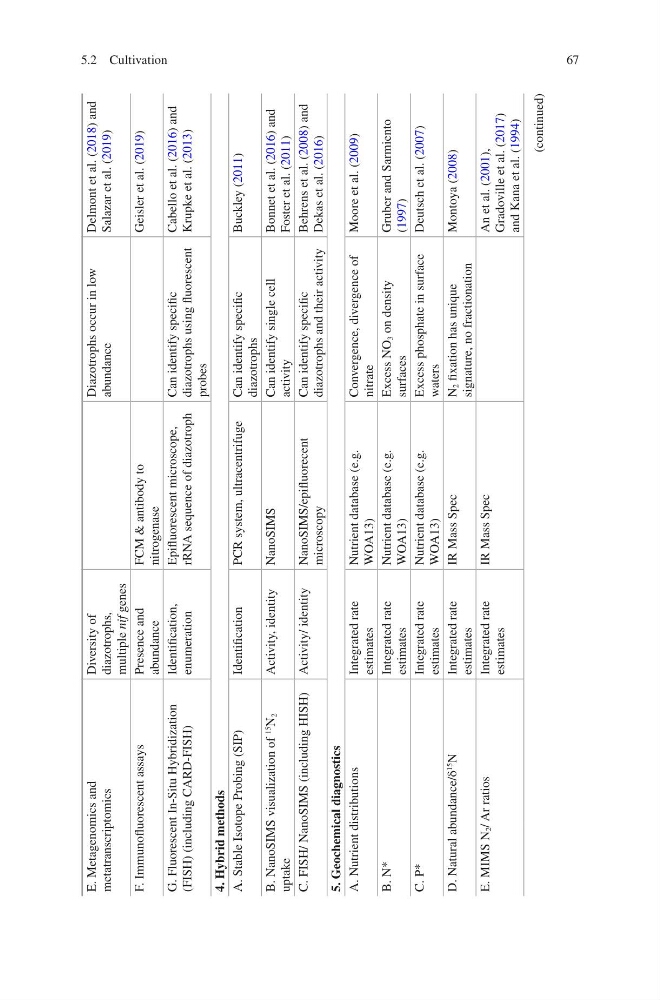
E. Metagenomics and
metatranscriptomics
Diversity of
diazotrophs,
multiple nif
genes
Diazotrophs occur in low
abundance
Delmont et al. (2018) and
Salazar et al. (2019)
F. Immunofluorescent assays
Presence and
abundance
FCM & antibody to
nitrogenase
Geisler et al. (2019)
G. Fluorescent In-Situ Hybridization
(FISH) (including CARD-FISH)
Identification,
enumeration
Epifluorescent microscope,
rRNA sequence of diazotroph
Can identify specific
diazotrophs using fluorescent
probes
Cabello et al. (2016) and
Krupke et al. (2013)
4. Hybrid methods
A. Stable Isotope Probing (SIP)
Identification
PCR system, ultracentrifuge
Can identify specific
diazotrophs
Buckley (2011)
B. NanoSIMS visualization of
15
N
2
uptake
Activity, identity
NanoSIMS
Can identify single cell
activity
Bonnet et al. (2016) and
Foster et al. (2011)
C. FISH/ NanoSIMS (including HISH) Activity/ identity
NanoSIMS/epifluorecent
microscopy
Can identify specific
diazotrophs and their activity
Behrens et al. (2008) and
Dekas et al. (2016)
5. Geochemical diagnostics
A. Nutrient distributions
Integrated rate
estimates
Nutrient database (e.g.
WOA13)
Convergence, divergence of
nitrate
Moore et al. (2009)
B. N*
Integrated rate
estimates
Nutrient database (e.g.
WOA13)
Excess NO
3 on density
surfaces
Gruber and Sarmiento
(1997)
C. P*
Integrated rate
estimates
Nutrient database (e.g.
WOA13)
Excess phosphate in surface
waters
Deutsch et al. (2007)
D. Natural abundance/δ
15
N
Integrated rate
estimates
IR Mass Spec
N
2 fixation has unique
signature, no fractionation
Montoya (2008)
E. MIMS N
2 / Ar ratios
Integrated rate
estimates
IR Mass Spec
An et al. (2001),
Gradoville et al. (2017)
and Kana et al. (1994)
(continued)
5.2 Cultivation
Target
Instrumentation & needs
Notes
References
E. Metagenomics and
metatranscriptomics
Diversity of
diazotrophs,
multiple nif
genes
Diazotrophs occur in low
abundance
Delmont et al. (2018) and
Salazar et al. (2019)
F. Immunofluorescent assays
Presence and
abundance
FCM & antibody to
nitrogenase
Geisler et al. (2019)
G. Fluorescent In-Situ Hybridization
(FISH) (including CARD-FISH)
Identification,
enumeration
Epifluorescent microscope,
rRNA sequence of diazotroph
Can identify specific
diazotrophs using fluorescent
probes
Cabello et al. (2016) and
Krupke et al. (2013)
4. Hybrid methods
A. Stable Isotope Probing (SIP)
Identification
PCR system, ultracentrifuge
Can identify specific
diazotrophs
Buckley (2011)
B. NanoSIMS visualization of
15
N
2
uptake
Activity, identity
NanoSIMS
Can identify single cell
activity
Bonnet et al. (2016) and
Foster et al. (2011)
C. FISH/ NanoSIMS (including HISH) Activity/ identity
NanoSIMS/epifluorecent
microscopy
Can identify specific
diazotrophs and their activity
Behrens et al. (2008) and
Dekas et al. (2016)
5. Geochemical diagnostics
A. Nutrient distributions
Integrated rate
estimates
Nutrient database (e.g.
WOA13)
Convergence, divergence of
nitrate
Moore et al. (2009)
B. N*
Integrated rate
estimates
Nutrient database (e.g.
WOA13)
Excess NO
3 on density
surfaces
Gruber and Sarmiento
(1997)
C. P*
Integrated rate
estimates
Nutrient database (e.g.
WOA13)
Excess phosphate in surface
waters
Deutsch et al. (2007)
D. Natural abundance/δ
15
N
Integrated rate
estimates
IR Mass Spec
N
2 fixation has unique
signature, no fractionation
Montoya (2008)
E. MIMS N
2 / Ar ratios
Integrated rate
estimates
IR Mass Spec
An et al. (2001),
Gradoville et al. (2017)
and Kana et al. (1994)
(continued)
5.2 Cultivation