

46
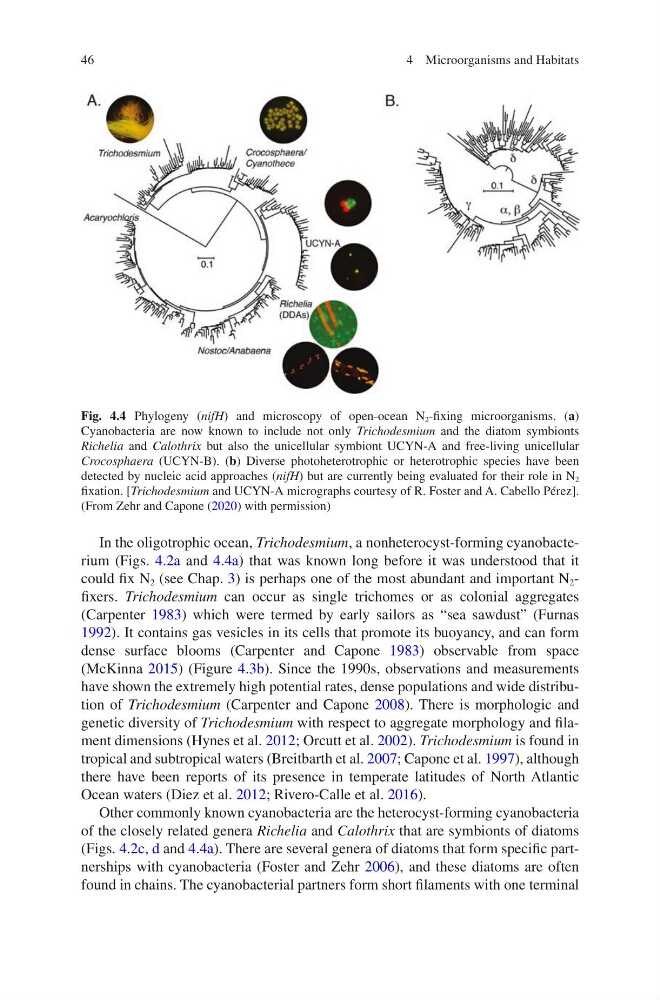
In the oligotrophic ocean, Trichodesmium, a nonheterocyst-forming cyanobacterium (Figs. 4.2a and 4.4a) that was known long before it was understood that it
could fix N 2 (see Chap. 3) is perhaps one of the most abundant and important N 2 -
fixers. Trichodesmium can occur as single trichomes or as colonial aggregates
(Carpenter 1983) which were termed by early sailors as “sea sawdust” (Furnas
1992). It contains gas vesicles in its cells that promote its buoyancy, and can form
dense surface blooms (Carpenter and Capone 1983) observable from space
(McKinna 2015) (Figure 4.3b). Since the 1990s, observations and measurements
have shown the extremely high potential rates, dense populations and wide distribution of Trichodesmium (Carpenter and Capone 2008). There is morphologic and
genetic diversity of Trichodesmium with respect to aggregate morphology and filament dimensions (Hynes et al. 2012; Orcutt et al. 2002). Trichodesmium is found in
tropical and subtropical waters (Breitbarth et al. 2007; Capone et al. 1997), although
there have been reports of its presence in temperate latitudes of North Atlantic
Ocean waters (Diez et al. 2012; Rivero-Calle et al. 2016).
Other commonly known cyanobacteria are the heterocyst-forming cyanobacteria
of the closely related genera Richelia and Calothrix that are symbionts of diatoms
(Figs. 4.2c, d and 4.4a). There are several genera of diatoms that form specific partnerships with cyanobacteria (Foster and Zehr 2006), and these diatoms are often
found in chains. The cyanobacterial partners form short filaments with one terminal
Fig. 4.4 Phylogeny (nifH) and microscopy of open-ocean N 2 -fixing microorganisms. (a)
Cyanobacteria are now known to include not only Trichodesmium and the diatom symbionts
Richelia and Calothrix but also the unicellular symbiont UCYN-A and free-living unicellular
Crocosphaera (UCYN-B). (b) Diverse photoheterotrophic or heterotrophic species have been
detected by nucleic acid approaches (nifH) but are currently being evaluated for their role in N 2
fixation. [Trichodesmium and UCYN-A micrographs courtesy of R. Foster and A. Cabello Pérez].
(From Zehr and Capone (2020) with permission)
4 Microorganisms and Habitats
In the oligotrophic ocean, Trichodesmium, a nonheterocyst-forming cyanobacterium (Figs. 4.2a and 4.4a) that was known long before it was understood that it
could fix N 2 (see Chap. 3) is perhaps one of the most abundant and important N 2 -
fixers. Trichodesmium can occur as single trichomes or as colonial aggregates
(Carpenter 1983) which were termed by early sailors as “sea sawdust” (Furnas
1992). It contains gas vesicles in its cells that promote its buoyancy, and can form
dense surface blooms (Carpenter and Capone 1983) observable from space
(McKinna 2015) (Figure 4.3b). Since the 1990s, observations and measurements
have shown the extremely high potential rates, dense populations and wide distribution of Trichodesmium (Carpenter and Capone 2008). There is morphologic and
genetic diversity of Trichodesmium with respect to aggregate morphology and filament dimensions (Hynes et al. 2012; Orcutt et al. 2002). Trichodesmium is found in
tropical and subtropical waters (Breitbarth et al. 2007; Capone et al. 1997), although
there have been reports of its presence in temperate latitudes of North Atlantic
Ocean waters (Diez et al. 2012; Rivero-Calle et al. 2016).
Other commonly known cyanobacteria are the heterocyst-forming cyanobacteria
of the closely related genera Richelia and Calothrix that are symbionts of diatoms
(Figs. 4.2c, d and 4.4a). There are several genera of diatoms that form specific partnerships with cyanobacteria (Foster and Zehr 2006), and these diatoms are often
found in chains. The cyanobacterial partners form short filaments with one terminal
Fig. 4.4 Phylogeny (nifH) and microscopy of open-ocean N 2 -fixing microorganisms. (a)
Cyanobacteria are now known to include not only Trichodesmium and the diatom symbionts
Richelia and Calothrix but also the unicellular symbiont UCYN-A and free-living unicellular
Crocosphaera (UCYN-B). (b) Diverse photoheterotrophic or heterotrophic species have been
detected by nucleic acid approaches (nifH) but are currently being evaluated for their role in N 2
fixation. [Trichodesmium and UCYN-A micrographs courtesy of R. Foster and A. Cabello Pérez].
(From Zehr and Capone (2020) with permission)
4 Microorganisms and Habitats