

12
inhibition by molecular O 2 (Robson and Postgate 1980) which has important implications for N 2 -fixing organisms and the environments they inhabit (Fay 1992).
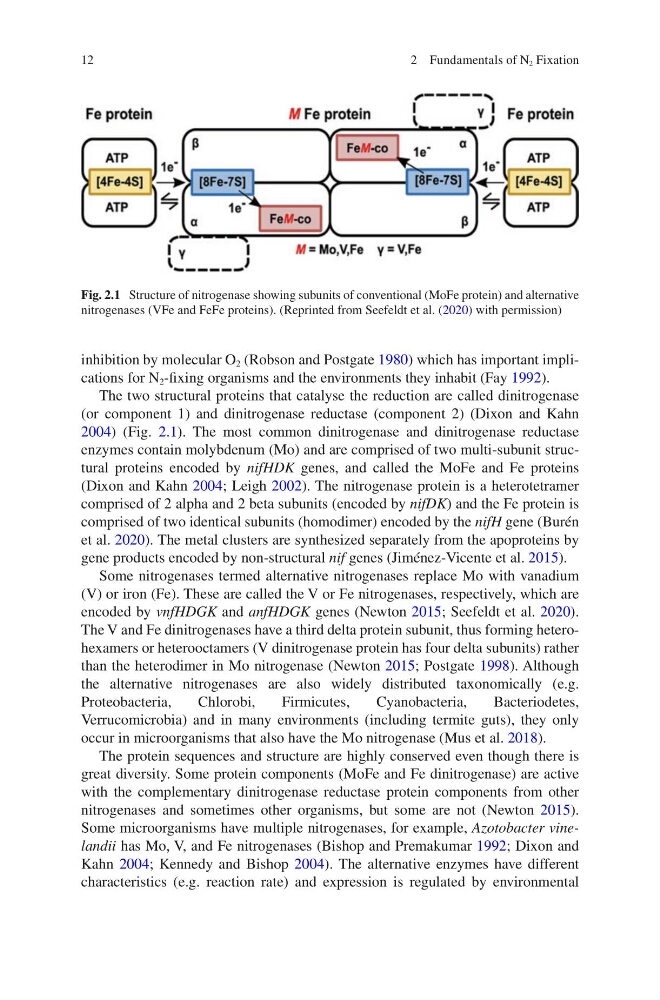
The two structural proteins that catalyse the reduction are called dinitrogenase
(or component 1) and dinitrogenase reductase (component 2) (Dixon and Kahn
2004) (Fig. 2.1). The most common dinitrogenase and dinitrogenase reductase
enzymes contain molybdenum (Mo) and are comprised of two multi-subunit structural proteins encoded by nifHDK genes, and called the MoFe and Fe proteins
(Dixon and Kahn 2004; Leigh 2002). The nitrogenase protein is a heterotetramer
comprised of 2 alpha and 2 beta subunits (encoded by nifDK) and the Fe protein is
comprised of two identical subunits (homodimer) encoded by the nifH gene (Burén
et al. 2020). The metal clusters are synthesized separately from the apoproteins by
gene products encoded by non-structural nif genes (Jiménez-Vicente et al. 2015).
Some nitrogenases termed alternative nitrogenases replace Mo with vanadium
(V) or iron (Fe). These are called the V or Fe nitrogenases, respectively, which are
encoded by vnfHDGK and anfHDGK genes (Newton 2015; Seefeldt et al. 2020).
The V and Fe dinitrogenases have a third delta protein subunit, thus forming heterohexamers or heterooctamers (V dinitrogenase protein has four delta subunits) rather
than the heterodimer in Mo nitrogenase (Newton 2015; Postgate 1998). Although
the alternative nitrogenases are also widely distributed taxonomically (e.g.
Proteobacteria,
Chlorobi,
Firmicutes,
Cyanobacteria,
Bacteriodetes,
Verrucomicrobia) and in many environments (including termite guts), they only
occur in microorganisms that also have the Mo nitrogenase (Mus et al. 2018).
The protein sequences and structure are highly conserved even though there is
great diversity. Some protein components (MoFe and Fe dinitrogenase) are active
with the complementary dinitrogenase reductase protein components from other
nitrogenases and sometimes other organisms, but some are not (Newton 2015).
Some microorganisms have multiple nitrogenases, for example, Azotobacter vinelandii has Mo, V, and Fe nitrogenases (Bishop and Premakumar 1992; Dixon and
Kahn 2004; Kennedy and Bishop 2004). The alternative enzymes have different
characteristics (e.g. reaction rate) and expression is regulated by environmental
Fig. 2.1 Structure of nitrogenase showing subunits of conventional (MoFe protein) and alternative
nitrogenases (VFe and FeFe proteins). (Reprinted from Seefeldt et al. (2020) with permission)
2 Fundamentals of N 2 Fixation
inhibition by molecular O 2 (Robson and Postgate 1980) which has important implications for N 2 -fixing organisms and the environments they inhabit (Fay 1992).
The two structural proteins that catalyse the reduction are called dinitrogenase
(or component 1) and dinitrogenase reductase (component 2) (Dixon and Kahn
2004) (Fig. 2.1). The most common dinitrogenase and dinitrogenase reductase
enzymes contain molybdenum (Mo) and are comprised of two multi-subunit structural proteins encoded by nifHDK genes, and called the MoFe and Fe proteins
(Dixon and Kahn 2004; Leigh 2002). The nitrogenase protein is a heterotetramer
comprised of 2 alpha and 2 beta subunits (encoded by nifDK) and the Fe protein is
comprised of two identical subunits (homodimer) encoded by the nifH gene (Burén
et al. 2020). The metal clusters are synthesized separately from the apoproteins by
gene products encoded by non-structural nif genes (Jiménez-Vicente et al. 2015).
Some nitrogenases termed alternative nitrogenases replace Mo with vanadium
(V) or iron (Fe). These are called the V or Fe nitrogenases, respectively, which are
encoded by vnfHDGK and anfHDGK genes (Newton 2015; Seefeldt et al. 2020).
The V and Fe dinitrogenases have a third delta protein subunit, thus forming heterohexamers or heterooctamers (V dinitrogenase protein has four delta subunits) rather
than the heterodimer in Mo nitrogenase (Newton 2015; Postgate 1998). Although
the alternative nitrogenases are also widely distributed taxonomically (e.g.
Proteobacteria,
Chlorobi,
Firmicutes,
Cyanobacteria,
Bacteriodetes,
Verrucomicrobia) and in many environments (including termite guts), they only
occur in microorganisms that also have the Mo nitrogenase (Mus et al. 2018).
The protein sequences and structure are highly conserved even though there is
great diversity. Some protein components (MoFe and Fe dinitrogenase) are active
with the complementary dinitrogenase reductase protein components from other
nitrogenases and sometimes other organisms, but some are not (Newton 2015).
Some microorganisms have multiple nitrogenases, for example, Azotobacter vinelandii has Mo, V, and Fe nitrogenases (Bishop and Premakumar 1992; Dixon and
Kahn 2004; Kennedy and Bishop 2004). The alternative enzymes have different
characteristics (e.g. reaction rate) and expression is regulated by environmental
Fig. 2.1 Structure of nitrogenase showing subunits of conventional (MoFe protein) and alternative
nitrogenases (VFe and FeFe proteins). (Reprinted from Seefeldt et al. (2020) with permission)
2 Fundamentals of N 2 Fixation