

11
also a wide variety of other plants, including rice, maize, and grasses (e.g. Kallar
grass) (Elmerich 2007). Genera include Rhizobium, Herbaspirillum,
Gluconacetobacter and Azoarcus. Cyanobacteria like Dolichospermum (Anabaena)
and Nostoc form associations with lichens, liverworts, cycads and aquatic water
ferns such as Azolla (Rai 2003).
N 2 -fixing microorganisms are found with a wide variety of animals including
humans (Igai et al. 2016), particularly in guts. Although not a lot is known about
their activity, it is unlikely in most cases that they contribute substantially to the
animal’s nutrition (Fisher and Newton 2002). However, there are cases where the
diet of the animal is very high in C but low in N (Fisher and Newton 2002), including leaf-cutter ants, termites (Bar-Shmuel et al. 2019), shipworms (Carpenter and
Culliney 1975; Distel et al. 1991; Horak and Montoya 2014) and corals (Benavides
et al. 2017), and in these cases N 2 -fixing bacteria are important in providing fixed N.
2.2 Nitrogen Fixation Reaction and Nitrogenases
N 2 fixation occurs naturally by chemical reactions in the atmosphere catalysed by
lightning (Fowler et al. 2015), industrially with the energy-intensive Haber-Bosch
process (Galloway et al. 2008) or by organisms through biological N 2 fixation
(BNF). The product of BNF and the industrial chemical Haber-Bosch process is
ammonia (NH 3 ), which becomes ammonium at typical environmental and physiological pH. Because of the needs for N compounds for fertilizers, explosives and
other products there has long been interest in chemically fixing N 2 (Knox 1904)
which was solved by the Haber-Bosch process around the time of World War I
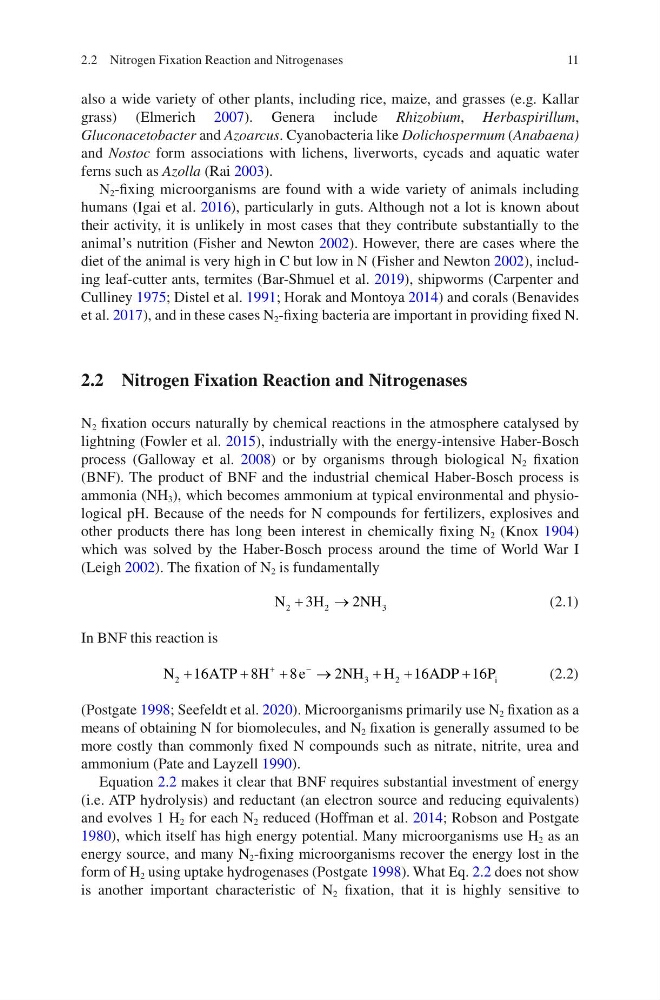
(Leigh 2002). The fixation of N 2 is fundamentally
N 3H
2NH
2
2
3
+
®
(2.1)
In BNF this reaction is
N
ATP 8H
e
2NH H
ADP
P i
2
3
2
16
8
1 6
16
+
+
+
+
+
+
®
+
-
(2.2)
(Postgate 1998; Seefeldt et al. 2020). Microorganisms primarily use N 2 fixation as a
means of obtaining N for biomolecules, and N 2 fixation is generally assumed to be
more costly than commonly fixed N compounds such as nitrate, nitrite, urea and
ammonium (Pate and Layzell 1990).
Equation 2.2 makes it clear that BNF requires substantial investment of energy
(i.e. ATP hydrolysis) and reductant (an electron source and reducing equivalents)
and evolves 1 H 2 for each N 2 reduced (Hoffman et al. 2014; Robson and Postgate
1980), which itself has high energy potential. Many microorganisms use H 2 as an
energy source, and many N 2 -fixing microorganisms recover the energy lost in the
form of H 2 using uptake hydrogenases (Postgate 1998). What Eq. 2.2 does not show
is another important characteristic of N 2 fixation, that it is highly sensitive to
2.2 Nitrogen Fixation Reaction and Nitrogenases
also a wide variety of other plants, including rice, maize, and grasses (e.g. Kallar
grass) (Elmerich 2007). Genera include Rhizobium, Herbaspirillum,
Gluconacetobacter and Azoarcus. Cyanobacteria like Dolichospermum (Anabaena)
and Nostoc form associations with lichens, liverworts, cycads and aquatic water
ferns such as Azolla (Rai 2003).
N 2 -fixing microorganisms are found with a wide variety of animals including
humans (Igai et al. 2016), particularly in guts. Although not a lot is known about
their activity, it is unlikely in most cases that they contribute substantially to the
animal’s nutrition (Fisher and Newton 2002). However, there are cases where the
diet of the animal is very high in C but low in N (Fisher and Newton 2002), including leaf-cutter ants, termites (Bar-Shmuel et al. 2019), shipworms (Carpenter and
Culliney 1975; Distel et al. 1991; Horak and Montoya 2014) and corals (Benavides
et al. 2017), and in these cases N 2 -fixing bacteria are important in providing fixed N.
2.2 Nitrogen Fixation Reaction and Nitrogenases
N 2 fixation occurs naturally by chemical reactions in the atmosphere catalysed by
lightning (Fowler et al. 2015), industrially with the energy-intensive Haber-Bosch
process (Galloway et al. 2008) or by organisms through biological N 2 fixation
(BNF). The product of BNF and the industrial chemical Haber-Bosch process is
ammonia (NH 3 ), which becomes ammonium at typical environmental and physiological pH. Because of the needs for N compounds for fertilizers, explosives and
other products there has long been interest in chemically fixing N 2 (Knox 1904)
which was solved by the Haber-Bosch process around the time of World War I
(Leigh 2002). The fixation of N 2 is fundamentally
N 3H
2NH
2
2
3
+
®
(2.1)
In BNF this reaction is
N
ATP 8H
e
2NH H
ADP
P i
2
3
2
16
8
1 6
16
+
+
+
+
+
+
®
+
-
(2.2)
(Postgate 1998; Seefeldt et al. 2020). Microorganisms primarily use N 2 fixation as a
means of obtaining N for biomolecules, and N 2 fixation is generally assumed to be
more costly than commonly fixed N compounds such as nitrate, nitrite, urea and
ammonium (Pate and Layzell 1990).
Equation 2.2 makes it clear that BNF requires substantial investment of energy
(i.e. ATP hydrolysis) and reductant (an electron source and reducing equivalents)
and evolves 1 H 2 for each N 2 reduced (Hoffman et al. 2014; Robson and Postgate
1980), which itself has high energy potential. Many microorganisms use H 2 as an
energy source, and many N 2 -fixing microorganisms recover the energy lost in the
form of H 2 using uptake hydrogenases (Postgate 1998). What Eq. 2.2 does not show
is another important characteristic of N 2 fixation, that it is highly sensitive to
2.2 Nitrogen Fixation Reaction and Nitrogenases