

129
7.7 Low O 2 Waters
In addition to open ocean oligotrophic oceans, low O 2 waters including ODZs are
potential habitats for N 2 fixation because of their low O 2 concentrations as well as
reduced nitrate and ammonium concentrations within the ODZ that might facilitate
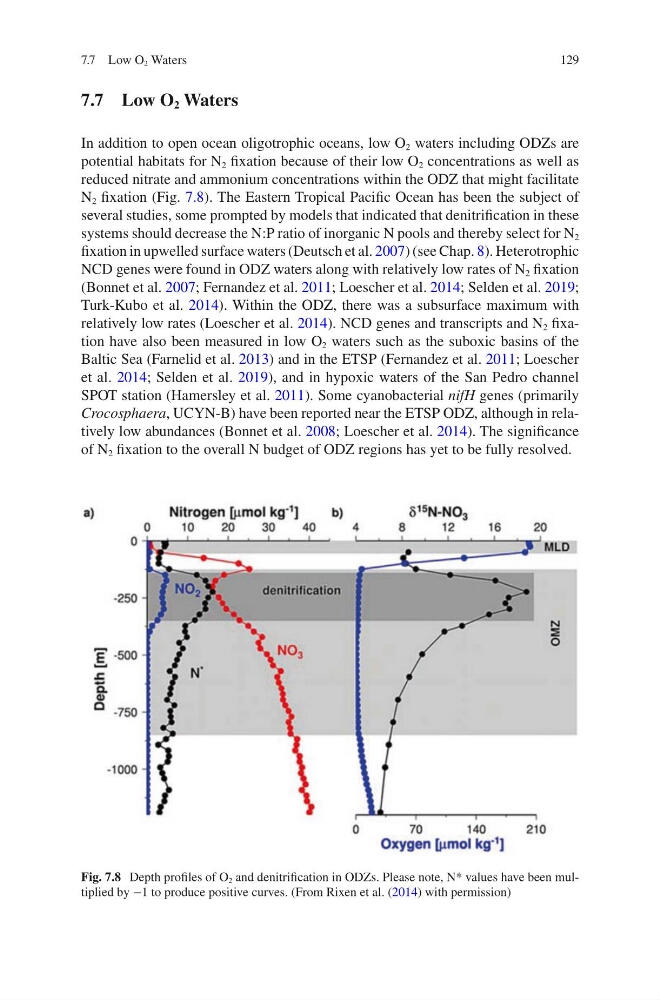
N 2 fixation (Fig. 7.8). The Eastern Tropical Pacific Ocean has been the subject of
several studies, some prompted by models that indicated that denitrification in these
systems should decrease the N:P ratio of inorganic N pools and thereby select for N 2
fixation in upwelled surface waters (Deutsch et al. 2007) (see Chap. 8). Heterotrophic
NCD genes were found in ODZ waters along with relatively low rates of N 2 fixation
(Bonnet et al. 2007; Fernandez et al. 2011; Loescher et al. 2014; Selden et al. 2019;
Turk-Kubo et al. 2014). Within the ODZ, there was a subsurface maximum with
relatively low rates (Loescher et al. 2014). NCD genes and transcripts and N 2 fixation have also been measured in low O 2 waters such as the suboxic basins of the
Baltic Sea (Farnelid et al. 2013) and in the ETSP (Fernandez et al. 2011; Loescher
et al. 2014; Selden et al. 2019), and in hypoxic waters of the San Pedro channel
SPOT station (Hamersley et al. 2011). Some cyanobacterial nifH genes (primarily
Crocosphaera, UCYN-B) have been reported near the ETSP ODZ, although in relatively low abundances (Bonnet et al. 2008; Loescher et al. 2014). The significance
of N 2 fixation to the overall N budget of ODZ regions has yet to be fully resolved.
Fig. 7.8 Depth profiles of O 2 and denitrification in ODZs. Please note, N* values have been multiplied by −1 to produce positive curves. (From Rixen et al. (2014) with permission)
7.7 Low O 2 Waters
7.7 Low O 2 Waters
In addition to open ocean oligotrophic oceans, low O 2 waters including ODZs are
potential habitats for N 2 fixation because of their low O 2 concentrations as well as
reduced nitrate and ammonium concentrations within the ODZ that might facilitate
N 2 fixation (Fig. 7.8). The Eastern Tropical Pacific Ocean has been the subject of
several studies, some prompted by models that indicated that denitrification in these
systems should decrease the N:P ratio of inorganic N pools and thereby select for N 2
fixation in upwelled surface waters (Deutsch et al. 2007) (see Chap. 8). Heterotrophic
NCD genes were found in ODZ waters along with relatively low rates of N 2 fixation
(Bonnet et al. 2007; Fernandez et al. 2011; Loescher et al. 2014; Selden et al. 2019;
Turk-Kubo et al. 2014). Within the ODZ, there was a subsurface maximum with
relatively low rates (Loescher et al. 2014). NCD genes and transcripts and N 2 fixation have also been measured in low O 2 waters such as the suboxic basins of the
Baltic Sea (Farnelid et al. 2013) and in the ETSP (Fernandez et al. 2011; Loescher
et al. 2014; Selden et al. 2019), and in hypoxic waters of the San Pedro channel
SPOT station (Hamersley et al. 2011). Some cyanobacterial nifH genes (primarily
Crocosphaera, UCYN-B) have been reported near the ETSP ODZ, although in relatively low abundances (Bonnet et al. 2008; Loescher et al. 2014). The significance
of N 2 fixation to the overall N budget of ODZ regions has yet to be fully resolved.
Fig. 7.8 Depth profiles of O 2 and denitrification in ODZs. Please note, N* values have been multiplied by −1 to produce positive curves. (From Rixen et al. (2014) with permission)
7.7 Low O 2 Waters