

128
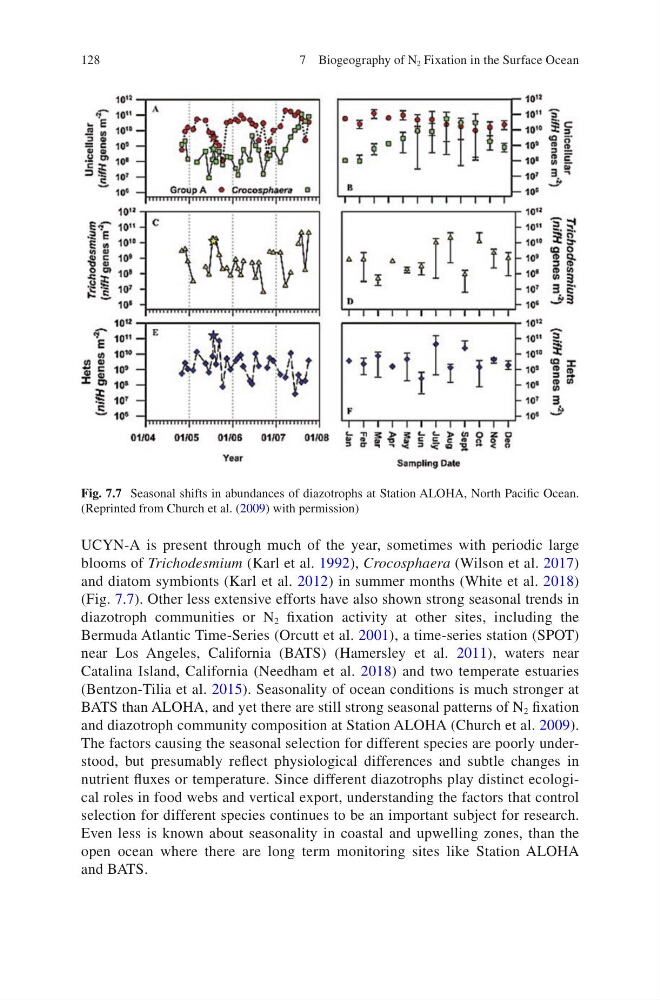
UCYN-A is present through much of the year, sometimes with periodic large
blooms of Trichodesmium (Karl et al. 1992), Crocosphaera (Wilson et al. 2017)
and diatom symbionts (Karl et al. 2012) in summer months (White et al. 2018)
(Fig. 7.7). Other less extensive efforts have also shown strong seasonal trends in
diazotroph communities or N 2 fixation activity at other sites, including the
Bermuda Atlantic Time-Series (Orcutt et al. 2001), a time-series station (SPOT)
near Los Angeles, California (BATS) (Hamersley et al. 2011), waters near
Catalina Island, California (Needham et al. 2018) and two temperate estuaries
(Bentzon-Tilia et al. 2015). Seasonality of ocean conditions is much stronger at
BATS than ALOHA, and yet there are still strong seasonal patterns of N 2 fixation
and diazotroph community composition at Station ALOHA (Church et al. 2009).
The factors causing the seasonal selection for different species are poorly understood, but presumably reflect physiological differences and subtle changes in
nutrient fluxes or temperature. Since different diazotrophs play distinct ecological roles in food webs and vertical export, understanding the factors that control
selection for different species continues to be an important subject for research.
Even less is known about seasonality in coastal and upwelling zones, than the
open ocean where there are long term monitoring sites like Station ALOHA
and BATS.
Fig. 7.7 Seasonal shifts in abundances of diazotrophs at Station ALOHA, North Pacific Ocean.
(Reprinted from Church et al. (2009) with permission)
7 Biogeography of N 2 Fixation in the Surface Ocean
UCYN-A is present through much of the year, sometimes with periodic large
blooms of Trichodesmium (Karl et al. 1992), Crocosphaera (Wilson et al. 2017)
and diatom symbionts (Karl et al. 2012) in summer months (White et al. 2018)
(Fig. 7.7). Other less extensive efforts have also shown strong seasonal trends in
diazotroph communities or N 2 fixation activity at other sites, including the
Bermuda Atlantic Time-Series (Orcutt et al. 2001), a time-series station (SPOT)
near Los Angeles, California (BATS) (Hamersley et al. 2011), waters near
Catalina Island, California (Needham et al. 2018) and two temperate estuaries
(Bentzon-Tilia et al. 2015). Seasonality of ocean conditions is much stronger at
BATS than ALOHA, and yet there are still strong seasonal patterns of N 2 fixation
and diazotroph community composition at Station ALOHA (Church et al. 2009).
The factors causing the seasonal selection for different species are poorly understood, but presumably reflect physiological differences and subtle changes in
nutrient fluxes or temperature. Since different diazotrophs play distinct ecological roles in food webs and vertical export, understanding the factors that control
selection for different species continues to be an important subject for research.
Even less is known about seasonality in coastal and upwelling zones, than the
open ocean where there are long term monitoring sites like Station ALOHA
and BATS.
Fig. 7.7 Seasonal shifts in abundances of diazotrophs at Station ALOHA, North Pacific Ocean.
(Reprinted from Church et al. (2009) with permission)
7 Biogeography of N 2 Fixation in the Surface Ocean