

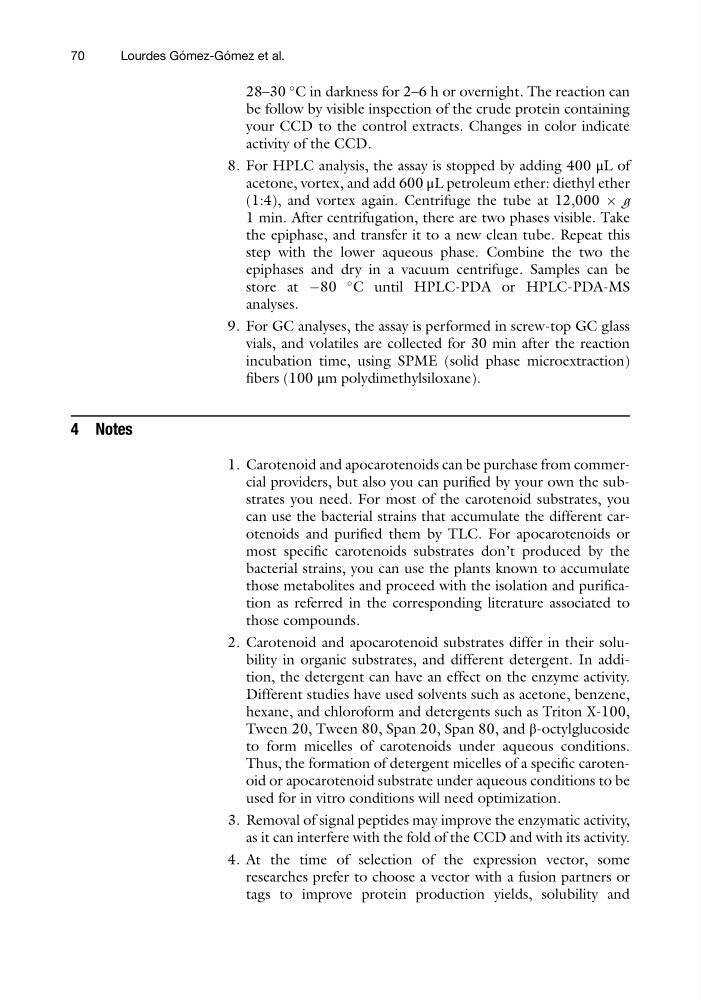
28–30
C in darkness for 2–6 h or overnight. The reaction can
be follow by visible inspection of the crude protein containing
your CCD to the control extracts. Changes in color indicate
activity of the CCD.
8. For HPLC analysis, the assay is stopped by adding 400 μL of
acetone, vortex, and add 600 μL petroleum ether: diethyl ether
(1:4), and vortex again. Centrifuge the tube at 12,000 Â g
1 min. After centrifugation, there are two phases visible. Take
the epiphase, and transfer it to a new clean tube. Repeat this
step with the lower aqueous phase. Combine the two the
epiphases and dry in a vacuum centrifuge. Samples can be
store at À80
C until HPLC-PDA or HPLC-PDA-MS
analyses.
9. For GC analyses, the assay is performed in screw-top GC glass
vials, and volatiles are collected for 30 min after the reaction
incubation time, using SPME (solid phase microextraction)
fibers (100 μm polydimethylsiloxane).
4 Notes
1. Carotenoid and apocarotenoids can be purchase from commercial providers, but also you can purified by your own the substrates you need. For most of the carotenoid substrates, you
can use the bacterial strains that accumulate the different carotenoids and purified them by TLC. For apocarotenoids or
most specific carotenoids substrates don’t produced by the
bacterial strains, you can use the plants known to accumulate
those metabolites and proceed with the isolation and purification as referred in the corresponding literature associated to
those compounds.
2. Carotenoid and apocarotenoid substrates differ in their solubility in organic substrates, and different detergent. In addition, the detergent can have an effect on the enzyme activity.
Different studies have used solvents such as acetone, benzene,
hexane, and chloroform and detergents such as Triton X-100,
Tween 20, Tween 80, Span 20, Span 80, and β-octylglucoside
to form micelles of carotenoids under aqueous conditions.
Thus, the formation of detergent micelles of a specific carotenoid or apocarotenoid substrate under aqueous conditions to be
used for in vitro conditions will need optimization.
3. Removal of signal peptides may improve the enzymatic activity,
as it can interfere with the fold of the CCD and with its activity.
4. At the time of selection of the expression vector, some
researches prefer to choose a vector with a fusion partners or
tags to improve protein production yields, solubility and
70
Lourdes Go ´ mez-Go ´ mez et al.
C in darkness for 2–6 h or overnight. The reaction can
be follow by visible inspection of the crude protein containing
your CCD to the control extracts. Changes in color indicate
activity of the CCD.
8. For HPLC analysis, the assay is stopped by adding 400 μL of
acetone, vortex, and add 600 μL petroleum ether: diethyl ether
(1:4), and vortex again. Centrifuge the tube at 12,000 Â g
1 min. After centrifugation, there are two phases visible. Take
the epiphase, and transfer it to a new clean tube. Repeat this
step with the lower aqueous phase. Combine the two the
epiphases and dry in a vacuum centrifuge. Samples can be
store at À80
C until HPLC-PDA or HPLC-PDA-MS
analyses.
9. For GC analyses, the assay is performed in screw-top GC glass
vials, and volatiles are collected for 30 min after the reaction
incubation time, using SPME (solid phase microextraction)
fibers (100 μm polydimethylsiloxane).
4 Notes
1. Carotenoid and apocarotenoids can be purchase from commercial providers, but also you can purified by your own the substrates you need. For most of the carotenoid substrates, you
can use the bacterial strains that accumulate the different carotenoids and purified them by TLC. For apocarotenoids or
most specific carotenoids substrates don’t produced by the
bacterial strains, you can use the plants known to accumulate
those metabolites and proceed with the isolation and purification as referred in the corresponding literature associated to
those compounds.
2. Carotenoid and apocarotenoid substrates differ in their solubility in organic substrates, and different detergent. In addition, the detergent can have an effect on the enzyme activity.
Different studies have used solvents such as acetone, benzene,
hexane, and chloroform and detergents such as Triton X-100,
Tween 20, Tween 80, Span 20, Span 80, and β-octylglucoside
to form micelles of carotenoids under aqueous conditions.
Thus, the formation of detergent micelles of a specific carotenoid or apocarotenoid substrate under aqueous conditions to be
used for in vitro conditions will need optimization.
3. Removal of signal peptides may improve the enzymatic activity,
as it can interfere with the fold of the CCD and with its activity.
4. At the time of selection of the expression vector, some
researches prefer to choose a vector with a fusion partners or
tags to improve protein production yields, solubility and
70
Lourdes Go ´ mez-Go ´ mez et al.