

contain novel even round vesicles, instead of the characteristics
plastoglobuli of the ordinary oranges (Fig. 1d). Mature fruit of
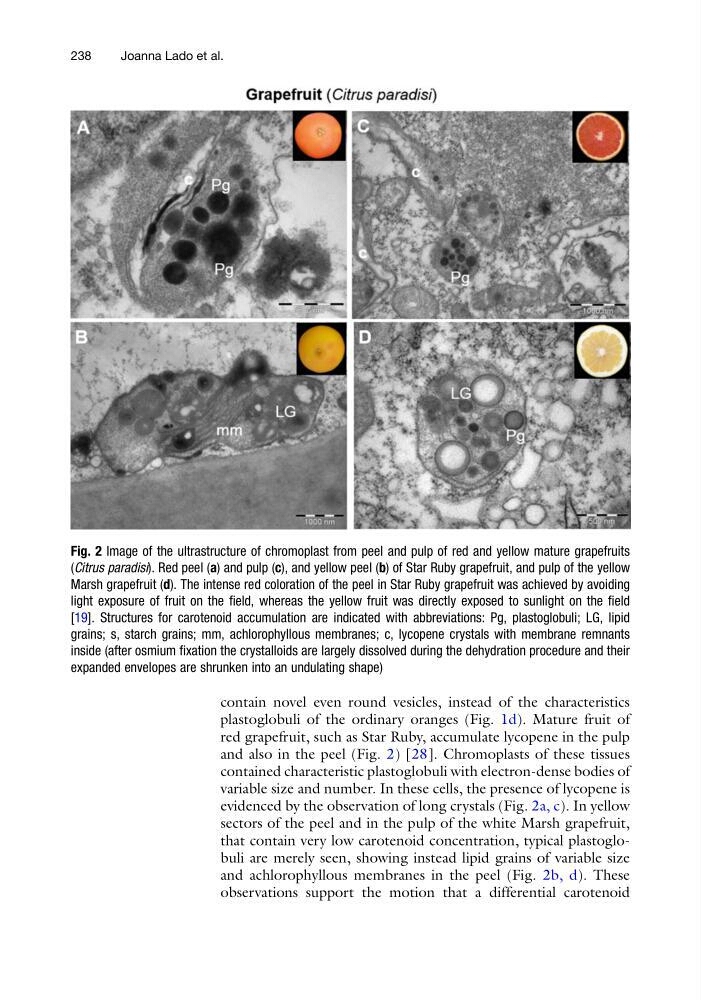
red grapefruit, such as Star Ruby, accumulate lycopene in the pulp
and also in the peel (Fig. 2) [28]. Chromoplasts of these tissues
contained characteristic plastoglobuli with electron-dense bodies of
variable size and number. In these cells, the presence of lycopene is
evidenced by the observation of long crystals (Fig. 2a, c). In yellow
sectors of the peel and in the pulp of the white Marsh grapefruit,
that contain very low carotenoid concentration, typical plastoglobuli are merely seen, showing instead lipid grains of variable size
and achlorophyllous membranes in the peel (Fig. 2b, d). These
observations support the motion that a differential carotenoid
Fig. 2 Image of the ultrastructure of chromoplast from peel and pulp of red and yellow mature grapefruits
(Citrus paradisi). Red peel (a) and pulp (c), and yellow peel (b) of Star Ruby grapefruit, and pulp of the yellow
Marsh grapefruit (d). The intense red coloration of the peel in Star Ruby grapefruit was achieved by avoiding
light exposure of fruit on the field, whereas the yellow fruit was directly exposed to sunlight on the field
[19]. Structures for carotenoid accumulation are indicated with abbreviations: Pg, plastoglobuli; LG, lipid
grains; s, starch grains; mm, achlorophyllous membranes; c, lycopene crystals with membrane remnants
inside (after osmium fixation the crystalloids are largely dissolved during the dehydration procedure and their
expanded envelopes are shrunken into an undulating shape)
238
Joanna Lado et al.
plastoglobuli of the ordinary oranges (Fig. 1d). Mature fruit of
red grapefruit, such as Star Ruby, accumulate lycopene in the pulp
and also in the peel (Fig. 2) [28]. Chromoplasts of these tissues
contained characteristic plastoglobuli with electron-dense bodies of
variable size and number. In these cells, the presence of lycopene is
evidenced by the observation of long crystals (Fig. 2a, c). In yellow
sectors of the peel and in the pulp of the white Marsh grapefruit,
that contain very low carotenoid concentration, typical plastoglobuli are merely seen, showing instead lipid grains of variable size
and achlorophyllous membranes in the peel (Fig. 2b, d). These
observations support the motion that a differential carotenoid
Fig. 2 Image of the ultrastructure of chromoplast from peel and pulp of red and yellow mature grapefruits
(Citrus paradisi). Red peel (a) and pulp (c), and yellow peel (b) of Star Ruby grapefruit, and pulp of the yellow
Marsh grapefruit (d). The intense red coloration of the peel in Star Ruby grapefruit was achieved by avoiding
light exposure of fruit on the field, whereas the yellow fruit was directly exposed to sunlight on the field
[19]. Structures for carotenoid accumulation are indicated with abbreviations: Pg, plastoglobuli; LG, lipid
grains; s, starch grains; mm, achlorophyllous membranes; c, lycopene crystals with membrane remnants
inside (after osmium fixation the crystalloids are largely dissolved during the dehydration procedure and their
expanded envelopes are shrunken into an undulating shape)
238
Joanna Lado et al.