

complement [25–27]. Citrus plastids have an extraordinary plasticity to rearrange carotenoids inside different compartments to allow
massive pigment accumulation, probably as a mechanism to avoid
potential harmful effects [28]. Transmission electron microscopy
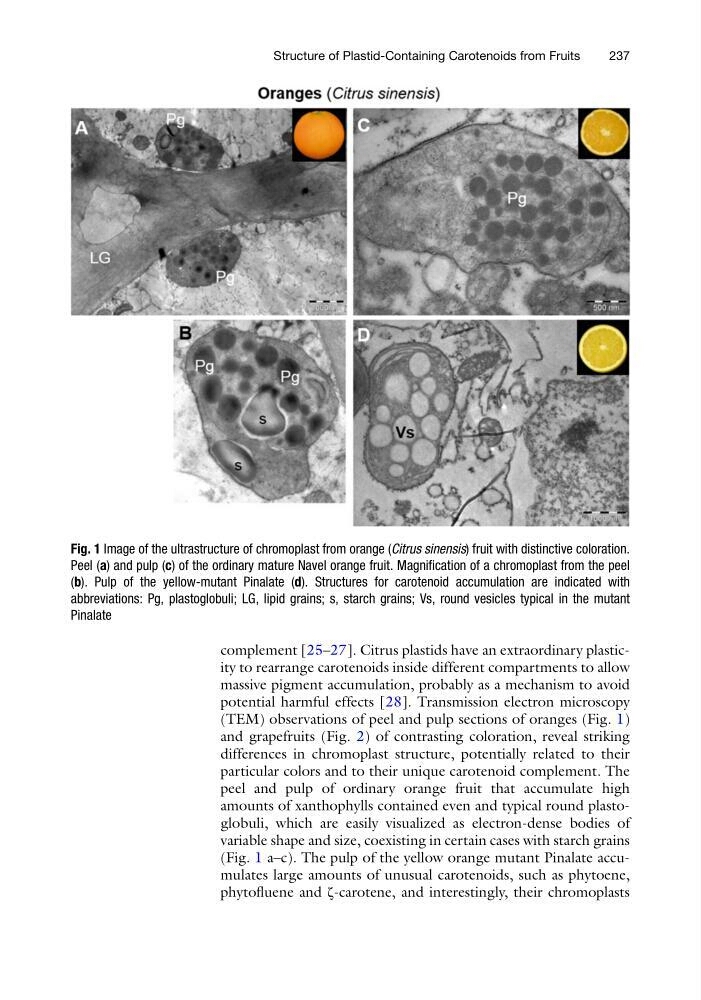
(TEM) observations of peel and pulp sections of oranges (Fig. 1)
and grapefruits (Fig. 2) of contrasting coloration, reveal striking
differences in chromoplast structure, potentially related to their
particular colors and to their unique carotenoid complement. The
peel and pulp of ordinary orange fruit that accumulate high
amounts of xanthophylls contained even and typical round plastoglobuli, which are easily visualized as electron-dense bodies of
variable shape and size, coexisting in certain cases with starch grains
(Fig. 1 a–c). The pulp of the yellow orange mutant Pinalate accumulates large amounts of unusual carotenoids, such as phytoene,
phytofluene and ζ-carotene, and interestingly, their chromoplasts
Fig. 1 Image of the ultrastructure of chromoplast from orange (Citrus sinensis) fruit with distinctive coloration.
Peel (a) and pulp (c) of the ordinary mature Navel orange fruit. Magnification of a chromoplast from the peel
(b). Pulp of the yellow-mutant Pinalate (d). Structures for carotenoid accumulation are indicated with
abbreviations: Pg, plastoglobuli; LG, lipid grains; s, starch grains; Vs, round vesicles typical in the mutant
Pinalate
Structure of Plastid-Containing Carotenoids from Fruits
237
massive pigment accumulation, probably as a mechanism to avoid
potential harmful effects [28]. Transmission electron microscopy
(TEM) observations of peel and pulp sections of oranges (Fig. 1)
and grapefruits (Fig. 2) of contrasting coloration, reveal striking
differences in chromoplast structure, potentially related to their
particular colors and to their unique carotenoid complement. The
peel and pulp of ordinary orange fruit that accumulate high
amounts of xanthophylls contained even and typical round plastoglobuli, which are easily visualized as electron-dense bodies of
variable shape and size, coexisting in certain cases with starch grains
(Fig. 1 a–c). The pulp of the yellow orange mutant Pinalate accumulates large amounts of unusual carotenoids, such as phytoene,
phytofluene and ζ-carotene, and interestingly, their chromoplasts
Fig. 1 Image of the ultrastructure of chromoplast from orange (Citrus sinensis) fruit with distinctive coloration.
Peel (a) and pulp (c) of the ordinary mature Navel orange fruit. Magnification of a chromoplast from the peel
(b). Pulp of the yellow-mutant Pinalate (d). Structures for carotenoid accumulation are indicated with
abbreviations: Pg, plastoglobuli; LG, lipid grains; s, starch grains; Vs, round vesicles typical in the mutant
Pinalate
Structure of Plastid-Containing Carotenoids from Fruits
237