

7. After the 2–3 h incubation period, remove the flask from the
rotator platform to a lab bench. Shake vigorously by hand for
3–5 min in a circular motion to completely release protoplasts
from their cell walls and plant tissues. Collect the released
protoplasts into a 50 mL plastic tube by pouring through a
60 μm nylon filter folded twice, then centrifuge at 80 Â g for
10 min at 20
C, discard the supernatant (be careful not to
disturb the protoplast pellet, it is very fragile), gently resuspend
the protoplasts in 50 mL of Buffer A (Basic protoplast buffer),
centrifuge at 80 Â g, discard the supernatant and repeat the
washing procedure again using 50 mL of Buffer A. Never
vortex protoplasts, only gently mix!
CYP97A::nYFP +
CYP97C::cYFP
HYD4::nYFP +
HYD4::cYFP
ChrD::nYFP +
ChrD::cYFP
CYP97A::nYFP +
HYD4::cYFP
A
B
C
D
TesƟng carotenoid enzyme interacƟons in plant cells
YES
YES
YES
NO
BiFC
Chlorophyll Merged
Bright field
InteracƟon?
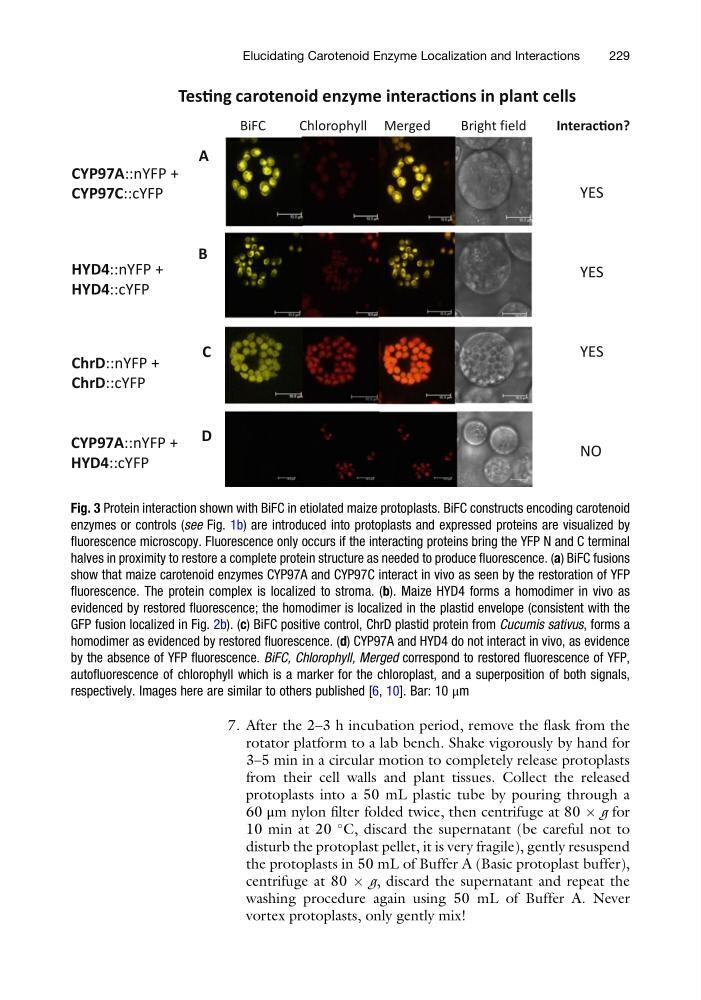
Fig. 3 Protein interaction shown with BiFC in etiolated maize protoplasts. BiFC constructs encoding carotenoid
enzymes or controls (see Fig. 1b) are introduced into protoplasts and expressed proteins are visualized by
fluorescence microscopy. Fluorescence only occurs if the interacting proteins bring the YFP N and C terminal
halves in proximity to restore a complete protein structure as needed to produce fluorescence. (a) BiFC fusions
show that maize carotenoid enzymes CYP97A and CYP97C interact in vivo as seen by the restoration of YFP
fluorescence. The protein complex is localized to stroma. (b). Maize HYD4 forms a homodimer in vivo as
evidenced by restored fluorescence; the homodimer is localized in the plastid envelope (consistent with the
GFP fusion localized in Fig. 2b). (c) BiFC positive control, ChrD plastid protein from Cucumis sativus, forms a
homodimer as evidenced by restored fluorescence. (d) CYP97A and HYD4 do not interact in vivo, as evidence
by the absence of YFP fluorescence. BiFC, Chlorophyll, Merged correspond to restored fluorescence of YFP,
autofluorescence of chlorophyll which is a marker for the chloroplast, and a superposition of both signals,
respectively. Images here are similar to others published [6, 10]. Bar: 10 μm
Elucidating Carotenoid Enzyme Localization and Interactions
229
rotator platform to a lab bench. Shake vigorously by hand for
3–5 min in a circular motion to completely release protoplasts
from their cell walls and plant tissues. Collect the released
protoplasts into a 50 mL plastic tube by pouring through a
60 μm nylon filter folded twice, then centrifuge at 80 Â g for
10 min at 20
C, discard the supernatant (be careful not to
disturb the protoplast pellet, it is very fragile), gently resuspend
the protoplasts in 50 mL of Buffer A (Basic protoplast buffer),
centrifuge at 80 Â g, discard the supernatant and repeat the
washing procedure again using 50 mL of Buffer A. Never
vortex protoplasts, only gently mix!
CYP97A::nYFP +
CYP97C::cYFP
HYD4::nYFP +
HYD4::cYFP
ChrD::nYFP +
ChrD::cYFP
CYP97A::nYFP +
HYD4::cYFP
A
B
C
D
TesƟng carotenoid enzyme interacƟons in plant cells
YES
YES
YES
NO
BiFC
Chlorophyll Merged
Bright field
InteracƟon?
Fig. 3 Protein interaction shown with BiFC in etiolated maize protoplasts. BiFC constructs encoding carotenoid
enzymes or controls (see Fig. 1b) are introduced into protoplasts and expressed proteins are visualized by
fluorescence microscopy. Fluorescence only occurs if the interacting proteins bring the YFP N and C terminal
halves in proximity to restore a complete protein structure as needed to produce fluorescence. (a) BiFC fusions
show that maize carotenoid enzymes CYP97A and CYP97C interact in vivo as seen by the restoration of YFP
fluorescence. The protein complex is localized to stroma. (b). Maize HYD4 forms a homodimer in vivo as
evidenced by restored fluorescence; the homodimer is localized in the plastid envelope (consistent with the
GFP fusion localized in Fig. 2b). (c) BiFC positive control, ChrD plastid protein from Cucumis sativus, forms a
homodimer as evidenced by restored fluorescence. (d) CYP97A and HYD4 do not interact in vivo, as evidence
by the absence of YFP fluorescence. BiFC, Chlorophyll, Merged correspond to restored fluorescence of YFP,
autofluorescence of chlorophyll which is a marker for the chloroplast, and a superposition of both signals,
respectively. Images here are similar to others published [6, 10]. Bar: 10 μm
Elucidating Carotenoid Enzyme Localization and Interactions
229