

3 Methods
3.1 Guidelines for
Creating Test Plasmids
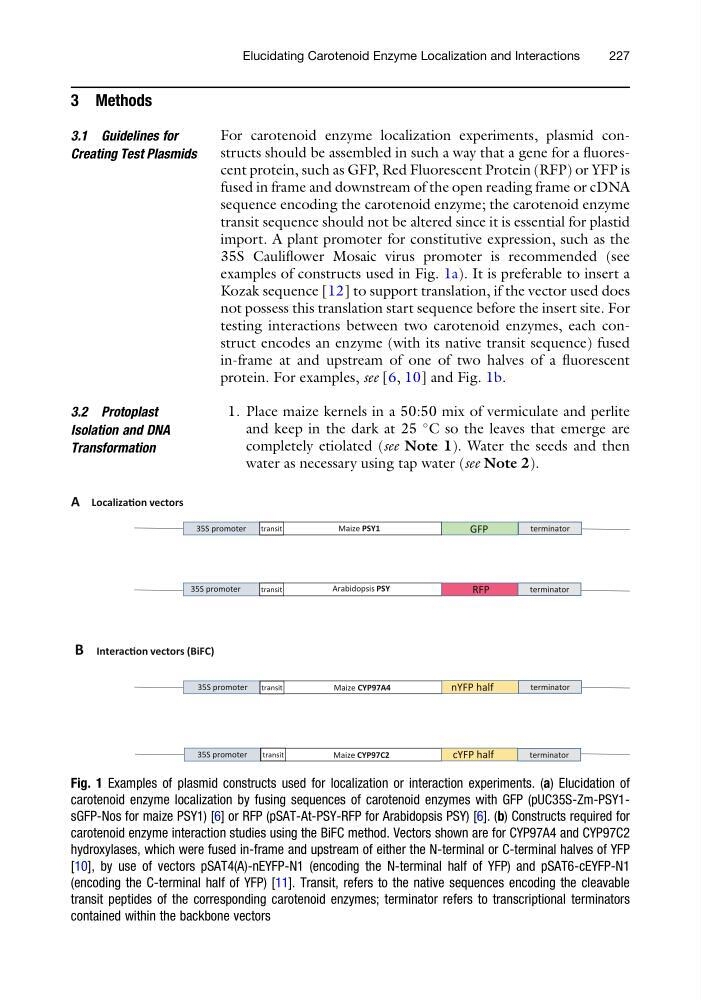
For carotenoid enzyme localization experiments, plasmid constructs should be assembled in such a way that a gene for a fluorescent protein, such as GFP, Red Fluorescent Protein (RFP) or YFP is
fused in frame and downstream of the open reading frame or cDNA
sequence encoding the carotenoid enzyme; the carotenoid enzyme
transit sequence should not be altered since it is essential for plastid
import. A plant promoter for constitutive expression, such as the
35S Cauliflower Mosaic virus promoter is recommended (see
examples of constructs used in Fig. 1a). It is preferable to insert a
Kozak sequence [12] to support translation, if the vector used does
not possess this translation start sequence before the insert site. For
testing interactions between two carotenoid enzymes, each construct encodes an enzyme (with its native transit sequence) fused
in-frame at and upstream of one of two halves of a fluorescent
protein. For examples, see [6, 10] and Fig. 1b.
3.2 Protoplast
Isolation and DNA
Transformation
1. Place maize kernels in a 50:50 mix of vermiculate and perlite
and keep in the dark at 25
C so the leaves that emerge are
completely etiolated (see Note 1). Water the seeds and then
water as necessary using tap water (see Note 2).
35S promoter
nYFP half
Maize CYP97A4
A
B InteracƟon vectors (BiFC)
35S promoter
GFP
Maize PSY1
RFP
Arabidopsis PSY
35S promoter
cYFP half
Maize CYP97C2
35S promoter
LocalizaƟon vectors
transit
transit
transit
transit
terminator
terminator
terminator
terminator
Fig. 1 Examples of plasmid constructs used for localization or interaction experiments. (a) Elucidation of
carotenoid enzyme localization by fusing sequences of carotenoid enzymes with GFP (pUC35S-Zm-PSY1sGFP-Nos for maize PSY1) [6] or RFP (pSAT-At-PSY-RFP for Arabidopsis PSY) [6]. (b) Constructs required for
carotenoid enzyme interaction studies using the BiFC method. Vectors shown are for CYP97A4 and CYP97C2
hydroxylases, which were fused in-frame and upstream of either the N-terminal or C-terminal halves of YFP
[10], by use of vectors pSAT4(A)-nEYFP-N1 (encoding the N-terminal half of YFP) and pSAT6-cEYFP-N1
(encoding the C-terminal half of YFP) [11]. Transit, refers to the native sequences encoding the cleavable
transit peptides of the corresponding carotenoid enzymes; terminator refers to transcriptional terminators
contained within the backbone vectors
Elucidating Carotenoid Enzyme Localization and Interactions
227
3.1 Guidelines for
Creating Test Plasmids
For carotenoid enzyme localization experiments, plasmid constructs should be assembled in such a way that a gene for a fluorescent protein, such as GFP, Red Fluorescent Protein (RFP) or YFP is
fused in frame and downstream of the open reading frame or cDNA
sequence encoding the carotenoid enzyme; the carotenoid enzyme
transit sequence should not be altered since it is essential for plastid
import. A plant promoter for constitutive expression, such as the
35S Cauliflower Mosaic virus promoter is recommended (see
examples of constructs used in Fig. 1a). It is preferable to insert a
Kozak sequence [12] to support translation, if the vector used does
not possess this translation start sequence before the insert site. For
testing interactions between two carotenoid enzymes, each construct encodes an enzyme (with its native transit sequence) fused
in-frame at and upstream of one of two halves of a fluorescent
protein. For examples, see [6, 10] and Fig. 1b.
3.2 Protoplast
Isolation and DNA
Transformation
1. Place maize kernels in a 50:50 mix of vermiculate and perlite
and keep in the dark at 25
C so the leaves that emerge are
completely etiolated (see Note 1). Water the seeds and then
water as necessary using tap water (see Note 2).
35S promoter
nYFP half
Maize CYP97A4
A
B InteracƟon vectors (BiFC)
35S promoter
GFP
Maize PSY1
RFP
Arabidopsis PSY
35S promoter
cYFP half
Maize CYP97C2
35S promoter
LocalizaƟon vectors
transit
transit
transit
transit
terminator
terminator
terminator
terminator
Fig. 1 Examples of plasmid constructs used for localization or interaction experiments. (a) Elucidation of
carotenoid enzyme localization by fusing sequences of carotenoid enzymes with GFP (pUC35S-Zm-PSY1sGFP-Nos for maize PSY1) [6] or RFP (pSAT-At-PSY-RFP for Arabidopsis PSY) [6]. (b) Constructs required for
carotenoid enzyme interaction studies using the BiFC method. Vectors shown are for CYP97A4 and CYP97C2
hydroxylases, which were fused in-frame and upstream of either the N-terminal or C-terminal halves of YFP
[10], by use of vectors pSAT4(A)-nEYFP-N1 (encoding the N-terminal half of YFP) and pSAT6-cEYFP-N1
(encoding the C-terminal half of YFP) [11]. Transit, refers to the native sequences encoding the cleavable
transit peptides of the corresponding carotenoid enzymes; terminator refers to transcriptional terminators
contained within the backbone vectors
Elucidating Carotenoid Enzyme Localization and Interactions
227