

3.4 Conclusions
The occurrence of apocarotenoids in food and in biological matrices should be much further investigated and the here reported
methodology provides a tool for a fast and reliable determination
of these bioactive metabolites in various matrices. Detection of
oxidative or cleavage products of carotenoids requires highly sensitive techniques without laborious preparation steps, therefore the
hyphenated here described automated online SFE-SFC-QqQ/MS
technique will provide a useful tool for their identification. The
online nature of the system, compared to offline approaches, drastically reduces the extraction time (compared to the traditional
solid/liquid extraction, which may require a few hours), reduces
the analysis run time, reduces the risks of sample contamination and
the possible occurrence of operator errors, improves run-to-run
precision, and enables the setting of batch-type applications.
4 Notes
1. By using the SFE-SFC instrument the main goal of the “manual” sample preparation is to achieve an accurate homogenization of the sample and sampling in order to achieve accurate
and reproducible results.
2. During this step it is very important to completely fill the
extraction vessel in order to reach the same pressure of the
back pressure regulator (BPR). The split ratio of the mobile
phase between the analytical column and the extraction vessel
depends on the analytical conditions, but can be calculated
Apo-8’Zeaxanthin
Apo-Zeaxanthinals
1
2
3
4
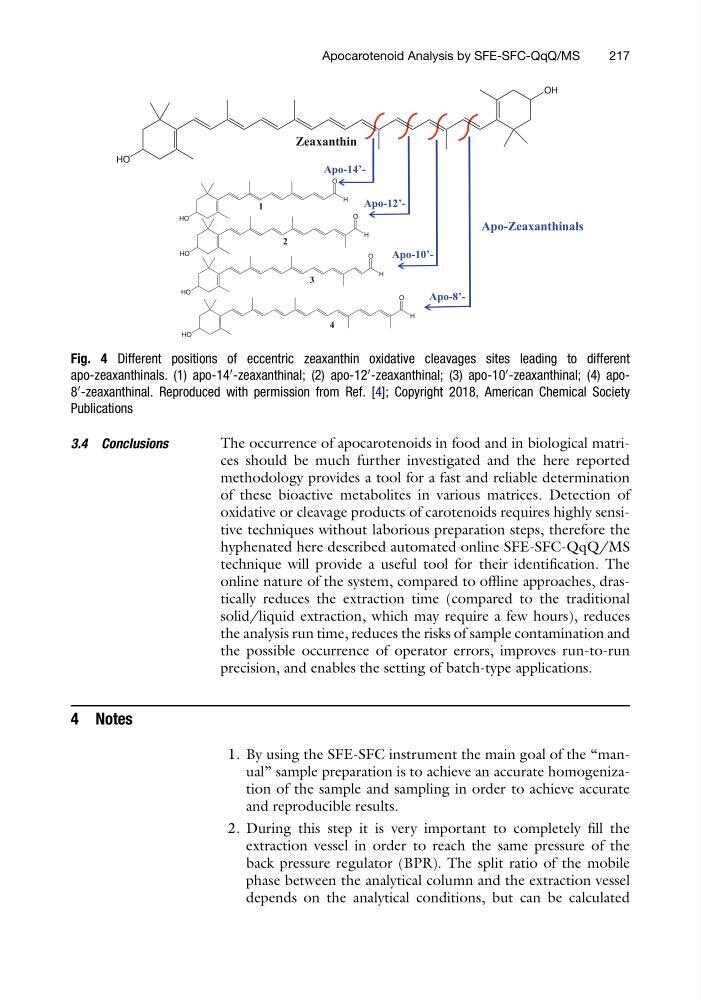
Fig. 4 Different positions of eccentric zeaxanthin oxidative cleavages sites leading to different
apo-zeaxanthinals. (1) apo-14
0 -zeaxanthinal; (2) apo-12
0 -zeaxanthinal; (3) apo-10
0 -zeaxanthinal; (4) apo8
0 -zeaxanthinal. Reproduced with permission from Ref. [4]; Copyright 2018, American Chemical Society
Publications
Apocarotenoid Analysis by SFE-SFC-QqQ/MS
217
The occurrence of apocarotenoids in food and in biological matrices should be much further investigated and the here reported
methodology provides a tool for a fast and reliable determination
of these bioactive metabolites in various matrices. Detection of
oxidative or cleavage products of carotenoids requires highly sensitive techniques without laborious preparation steps, therefore the
hyphenated here described automated online SFE-SFC-QqQ/MS
technique will provide a useful tool for their identification. The
online nature of the system, compared to offline approaches, drastically reduces the extraction time (compared to the traditional
solid/liquid extraction, which may require a few hours), reduces
the analysis run time, reduces the risks of sample contamination and
the possible occurrence of operator errors, improves run-to-run
precision, and enables the setting of batch-type applications.
4 Notes
1. By using the SFE-SFC instrument the main goal of the “manual” sample preparation is to achieve an accurate homogenization of the sample and sampling in order to achieve accurate
and reproducible results.
2. During this step it is very important to completely fill the
extraction vessel in order to reach the same pressure of the
back pressure regulator (BPR). The split ratio of the mobile
phase between the analytical column and the extraction vessel
depends on the analytical conditions, but can be calculated
Apo-8’Zeaxanthin
Apo-Zeaxanthinals
1
2
3
4
Fig. 4 Different positions of eccentric zeaxanthin oxidative cleavages sites leading to different
apo-zeaxanthinals. (1) apo-14
0 -zeaxanthinal; (2) apo-12
0 -zeaxanthinal; (3) apo-10
0 -zeaxanthinal; (4) apo8
0 -zeaxanthinal. Reproduced with permission from Ref. [4]; Copyright 2018, American Chemical Society
Publications
Apocarotenoid Analysis by SFE-SFC-QqQ/MS
217