

species such as strawberry or grape [6], thus suggesting their participation in different roles along fruit development. Given the role
of plant apocarotenoids in inter- and intraorganism communication, determining their levels is a prerequisite to understand their
functions.
Here we describe first a method for the analysis of apocarotenoid volatile compounds which is based on a general method for
volatiles which includes extraction by means of HS-SPME and
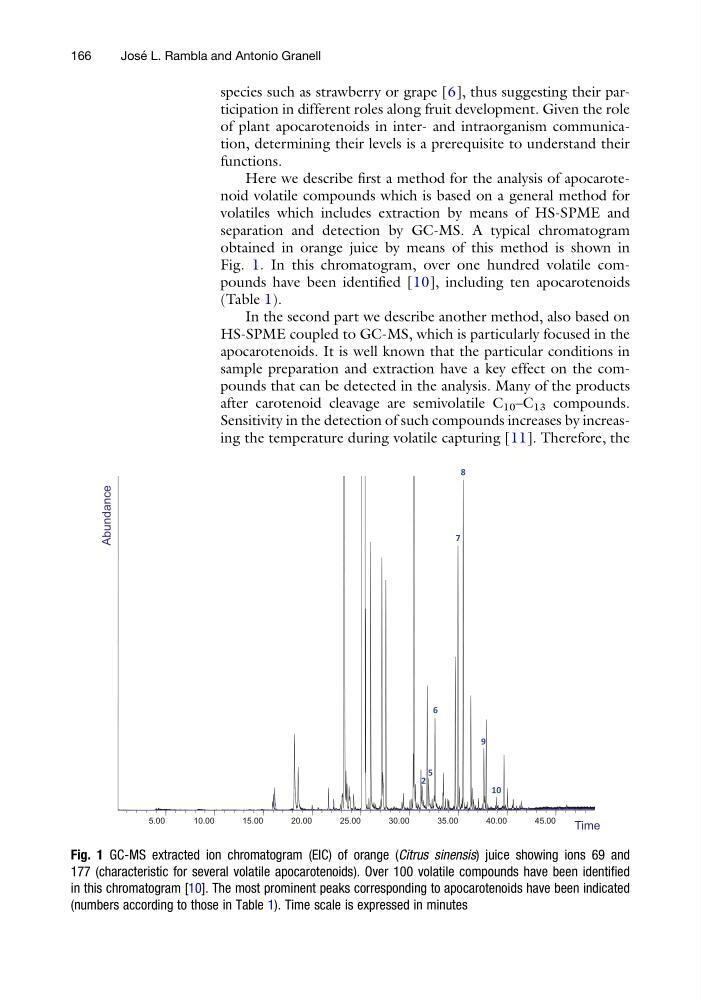
separation and detection by GC-MS. A typical chromatogram
obtained in orange juice by means of this method is shown in
Fig. 1. In this chromatogram, over one hundred volatile compounds have been identified [10], including ten apocarotenoids
(Table 1).
In the second part we describe another method, also based on
HS-SPME coupled to GC-MS, which is particularly focused in the
apocarotenoids. It is well known that the particular conditions in
sample preparation and extraction have a key effect on the compounds that can be detected in the analysis. Many of the products
after carotenoid cleavage are semivolatile C 10 –C 13 compounds.
Sensitivity in the detection of such compounds increases by increasing the temperature during volatile capturing [11]. Therefore, the
e
c
n
a
d
n
u
b
A
5.00
10.00
15.00
20.00
25.00
30.00
35.00
40.00
45.00
Time
7
8
9
5
2
6
10
Fig. 1 GC-MS extracted ion chromatogram (EIC) of orange (Citrus sinensis) juice showing ions 69 and
177 (characteristic for several volatile apocarotenoids). Over 100 volatile compounds have been identified
in this chromatogram [10]. The most prominent peaks corresponding to apocarotenoids have been indicated
(numbers according to those in Table 1). Time scale is expressed in minutes
166
Jose ´ L. Rambla and Antonio Granell
of plant apocarotenoids in inter- and intraorganism communication, determining their levels is a prerequisite to understand their
functions.
Here we describe first a method for the analysis of apocarotenoid volatile compounds which is based on a general method for
volatiles which includes extraction by means of HS-SPME and
separation and detection by GC-MS. A typical chromatogram
obtained in orange juice by means of this method is shown in
Fig. 1. In this chromatogram, over one hundred volatile compounds have been identified [10], including ten apocarotenoids
(Table 1).
In the second part we describe another method, also based on
HS-SPME coupled to GC-MS, which is particularly focused in the
apocarotenoids. It is well known that the particular conditions in
sample preparation and extraction have a key effect on the compounds that can be detected in the analysis. Many of the products
after carotenoid cleavage are semivolatile C 10 –C 13 compounds.
Sensitivity in the detection of such compounds increases by increasing the temperature during volatile capturing [11]. Therefore, the
e
c
n
a
d
n
u
b
A
5.00
10.00
15.00
20.00
25.00
30.00
35.00
40.00
45.00
Time
7
8
9
5
2
6
10
Fig. 1 GC-MS extracted ion chromatogram (EIC) of orange (Citrus sinensis) juice showing ions 69 and
177 (characteristic for several volatile apocarotenoids). Over 100 volatile compounds have been identified
in this chromatogram [10]. The most prominent peaks corresponding to apocarotenoids have been indicated
(numbers according to those in Table 1). Time scale is expressed in minutes
166
Jose ´ L. Rambla and Antonio Granell