

14. Evaporate the organic solvent using nitrogen gas.
15. Prepare a set of standards by dissolving the pure carotenoid
standards in 100% EtOAc and serially diluting (usually 1/2 or
1/5 by volume) to cover an appropriate concentration range
relevant to the tissue samples being analyzed.
Carotenoids identieid in light and/or
dark-grown WT &
crtiso leaf and cotyledon itssues
328
414
438 468
9c-Vio
414
438
468
Vio
412
436
464
Neo
468
Chl-b
446
424
474
Lut
432
Chl-a
338
422
446
474
βc-c1
474
βc-1
422
446
426
452
480
βc
βc-2
422
447
474
Ant
420
445 473
tc-ζc
296
378
400 424
296
378
396 420
ζc-1
380
401 426 dc-ζc
388
410 432
462
P-Neu
438
P-Lyc
334
410
434 462
Neu-3
418
438
470
Neu-6
420
446 470
tc-Lyc
Neu
418
442
470
7,9dc-Lyc
422
446 474
7c-Lyc1
&2
298
442
466
494
9c-Lyc1
&2
298
442
466 498
298
442
470
498
7,7dc-Lyc
5,5dc-Lyc
294
446
470
502
294
446
474 502
5c-Lyc
Lyc
294
446
474 502
Phf
isoforms
332
348
367-68
Phy
isoforms
286
9c-ζc
380
402
426
ζc
380
402
426
Carotenoids identified in dark--grown
crtiso &
ziso cotyledon tissues
416
466
Zea
430
450 480
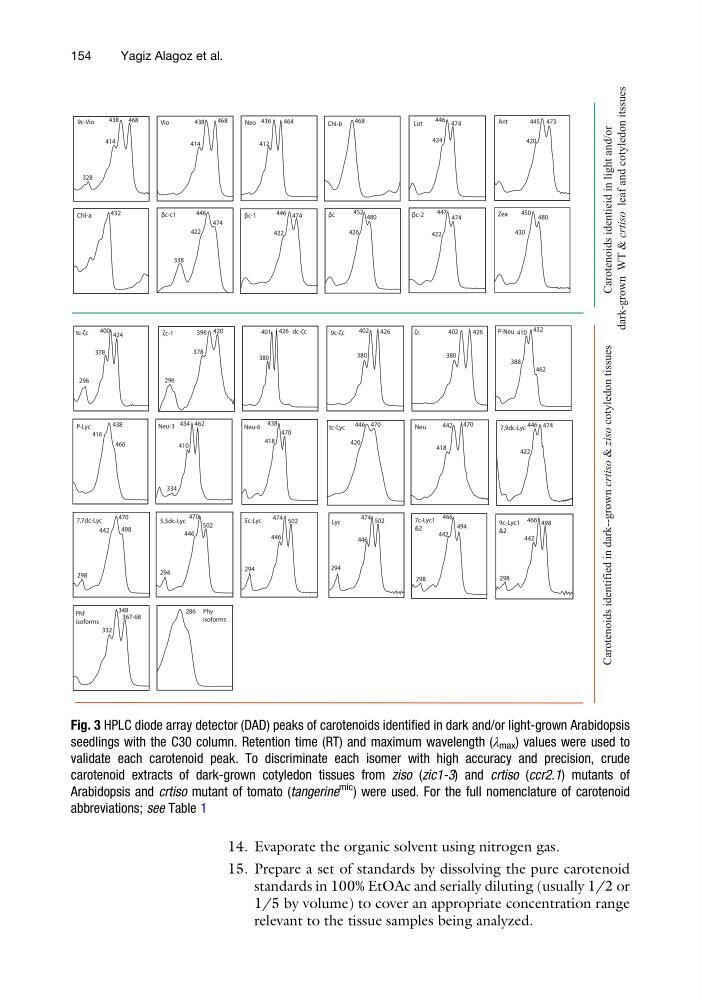
Fig. 3 HPLC diode array detector (DAD) peaks of carotenoids identified in dark and/or light-grown Arabidopsis
seedlings with the C30 column. Retention time (RT) and maximum wavelength (λ max ) values were used to
validate each carotenoid peak. To discriminate each isomer with high accuracy and precision, crude
carotenoid extracts of dark-grown cotyledon tissues from ziso (zic1-3) and crtiso (ccr2.1) mutants of
Arabidopsis and crtiso mutant of tomato (tangerine
mic ) were used. For the full nomenclature of carotenoid
abbreviations; see Table 1
154
Yagiz Alagoz et al.
15. Prepare a set of standards by dissolving the pure carotenoid
standards in 100% EtOAc and serially diluting (usually 1/2 or
1/5 by volume) to cover an appropriate concentration range
relevant to the tissue samples being analyzed.
Carotenoids identieid in light and/or
dark-grown WT &
crtiso leaf and cotyledon itssues
328
414
438 468
9c-Vio
414
438
468
Vio
412
436
464
Neo
468
Chl-b
446
424
474
Lut
432
Chl-a
338
422
446
474
βc-c1
474
βc-1
422
446
426
452
480
βc
βc-2
422
447
474
Ant
420
445 473
tc-ζc
296
378
400 424
296
378
396 420
ζc-1
380
401 426 dc-ζc
388
410 432
462
P-Neu
438
P-Lyc
334
410
434 462
Neu-3
418
438
470
Neu-6
420
446 470
tc-Lyc
Neu
418
442
470
7,9dc-Lyc
422
446 474
7c-Lyc1
&2
298
442
466
494
9c-Lyc1
&2
298
442
466 498
298
442
470
498
7,7dc-Lyc
5,5dc-Lyc
294
446
470
502
294
446
474 502
5c-Lyc
Lyc
294
446
474 502
Phf
isoforms
332
348
367-68
Phy
isoforms
286
9c-ζc
380
402
426
ζc
380
402
426
Carotenoids identified in dark--grown
crtiso &
ziso cotyledon tissues
416
466
Zea
430
450 480
Fig. 3 HPLC diode array detector (DAD) peaks of carotenoids identified in dark and/or light-grown Arabidopsis
seedlings with the C30 column. Retention time (RT) and maximum wavelength (λ max ) values were used to
validate each carotenoid peak. To discriminate each isomer with high accuracy and precision, crude
carotenoid extracts of dark-grown cotyledon tissues from ziso (zic1-3) and crtiso (ccr2.1) mutants of
Arabidopsis and crtiso mutant of tomato (tangerine
mic ) were used. For the full nomenclature of carotenoid
abbreviations; see Table 1
154
Yagiz Alagoz et al.