

and the final compilation of chromatographic data, UV-visible
spectra and MS information. The aim at this point of the data
processing is to confirm that specific product ions arise from the
protonated molecular ions, so that the experimental fingerprint is
correlated with the common fragmentation reactions observed for
carotenoids [12]. This step is critical for the identification of unanticipated carotenoid structures.
1. Draw the structure of the carotenoid (see Note 9).
2. Apply the software for the in silico generation of product ions
(see Note 10).
3. Compare the list of the in silico product ions with the list of
experimental product ions for the selected carotenoid
structure.
4. Review the structures proposed for each product ion and select
the correct one. The common fragmentation rules of carotenoids should be followed.
5. Review the proposed mechanisms for each product ion. The
software also suggests different mechanisms to generate the
same fragment ion structure. Revise and select the most appropriate mechanism proposed for each fragment ion. The mechanism should be consistent with the chemical behavior of
carotenoids. In principle, the simplest should be the most
probable [10].
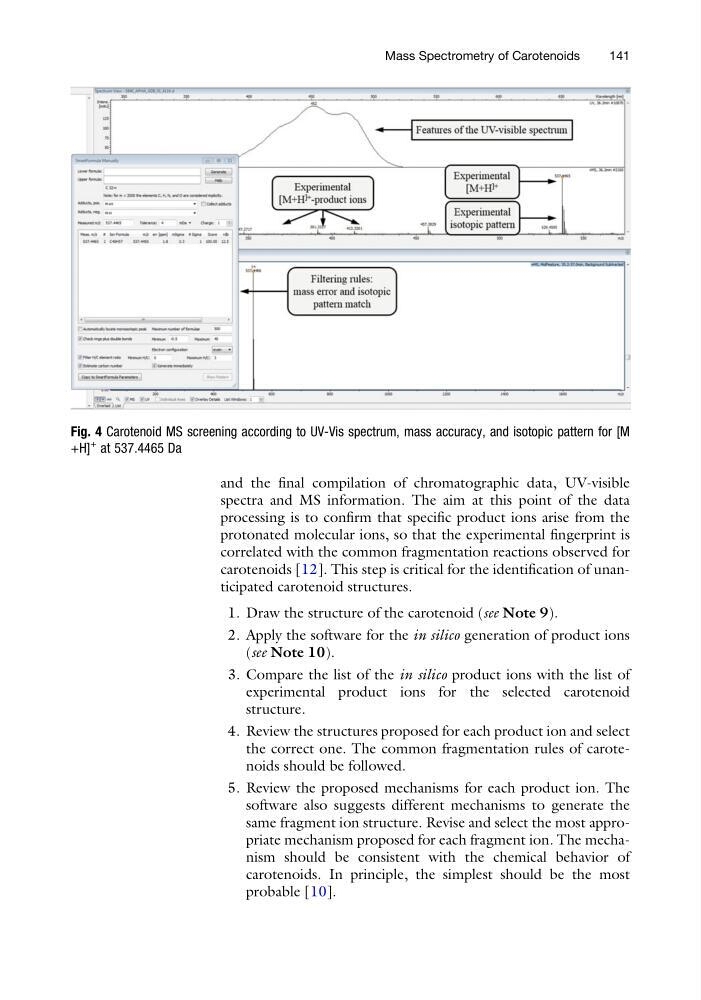
Fig. 4 Carotenoid MS screening according to UV-Vis spectrum, mass accuracy, and isotopic pattern for [M
+H]
+ at 537.4465 Da
Mass Spectrometry of Carotenoids
141
spectra and MS information. The aim at this point of the data
processing is to confirm that specific product ions arise from the
protonated molecular ions, so that the experimental fingerprint is
correlated with the common fragmentation reactions observed for
carotenoids [12]. This step is critical for the identification of unanticipated carotenoid structures.
1. Draw the structure of the carotenoid (see Note 9).
2. Apply the software for the in silico generation of product ions
(see Note 10).
3. Compare the list of the in silico product ions with the list of
experimental product ions for the selected carotenoid
structure.
4. Review the structures proposed for each product ion and select
the correct one. The common fragmentation rules of carotenoids should be followed.
5. Review the proposed mechanisms for each product ion. The
software also suggests different mechanisms to generate the
same fragment ion structure. Revise and select the most appropriate mechanism proposed for each fragment ion. The mechanism should be consistent with the chemical behavior of
carotenoids. In principle, the simplest should be the most
probable [10].
Fig. 4 Carotenoid MS screening according to UV-Vis spectrum, mass accuracy, and isotopic pattern for [M
+H]
+ at 537.4465 Da
Mass Spectrometry of Carotenoids
141