

1. The user should collect in an in-house database the calculated
m/z values and the elemental composition of the predicted
carotenoids in the analyzed extract (targeted strategy) or to
compile the comprehensive information regarding the current
knowledge of carotenoids and the anticipated structures the
user proposes (untargeted strategy). Additionally, the calculated m/z values and the elemental composition of the product
ions should be included (see Fig. 3 and Note 7).
2. Perform the mass screening with the software to all the raw
data (FS) in a batch mode. To increase the accuracy of the
screening, the software allows the user to include filtering
rules (see Note 8). Commonly, the mass filtering is the first
rule applied for the protonated molecular ions, setting a mass
error value for MS peak match between the experimental and
the theoretical values. The lower the mass error value (5 ppm,
3 ppm, 1 ppm. . .) the higher the accuracy of the predicted
match. Additionally, modern MS software includes a filtering
rule for the isotopic pattern value of the calculated and experimental MS data. This filtering rule is managed by the software
with the application of an algorithm that yields a numerical
value. The lower the deviation between the calculated and
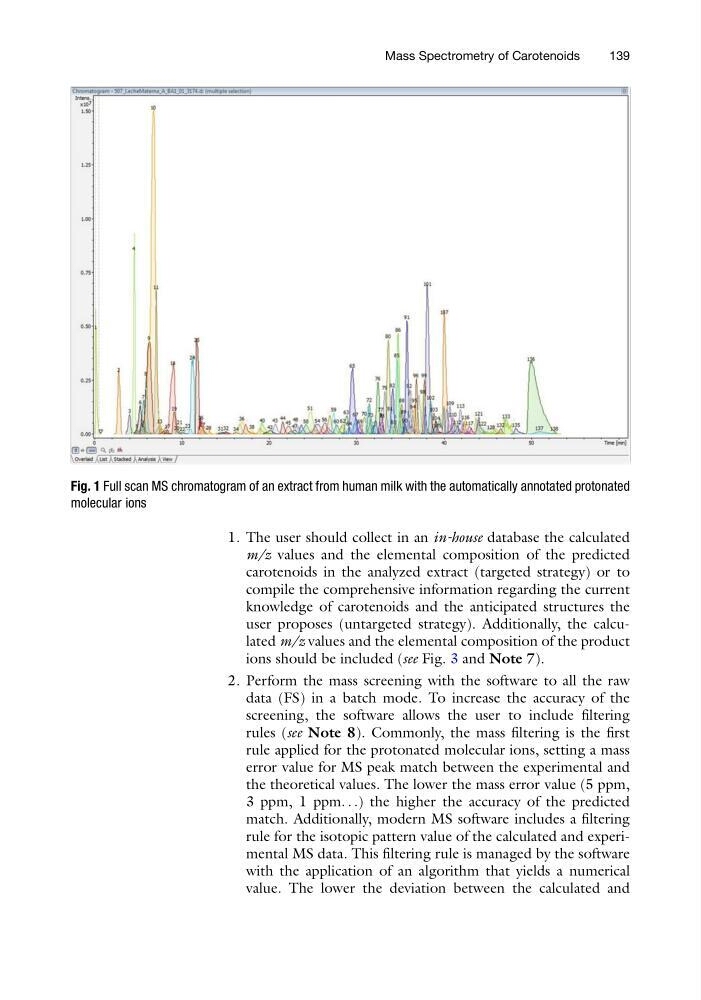
Fig. 1 Full scan MS chromatogram of an extract from human milk with the automatically annotated protonated
molecular ions
Mass Spectrometry of Carotenoids
139
m/z values and the elemental composition of the predicted
carotenoids in the analyzed extract (targeted strategy) or to
compile the comprehensive information regarding the current
knowledge of carotenoids and the anticipated structures the
user proposes (untargeted strategy). Additionally, the calculated m/z values and the elemental composition of the product
ions should be included (see Fig. 3 and Note 7).
2. Perform the mass screening with the software to all the raw
data (FS) in a batch mode. To increase the accuracy of the
screening, the software allows the user to include filtering
rules (see Note 8). Commonly, the mass filtering is the first
rule applied for the protonated molecular ions, setting a mass
error value for MS peak match between the experimental and
the theoretical values. The lower the mass error value (5 ppm,
3 ppm, 1 ppm. . .) the higher the accuracy of the predicted
match. Additionally, modern MS software includes a filtering
rule for the isotopic pattern value of the calculated and experimental MS data. This filtering rule is managed by the software
with the application of an algorithm that yields a numerical
value. The lower the deviation between the calculated and
Fig. 1 Full scan MS chromatogram of an extract from human milk with the automatically annotated protonated
molecular ions
Mass Spectrometry of Carotenoids
139