

8. Plot peak area versus concentration (μg/mL) to calculate the
calibration curve expression by the “linear least-squares”
method (see Note 27). Calibration curve is given as follows:
Peak area ¼ Response factor  C μg=mL
ð
ÞþIntercept
4 Notes
1. Lyophilization, also known freeze-drying, is the preferred
method for dehydrating or drying biological materials as it
preserves intact most of chemical constituents.
2. Avoid the increase of temperature by using short milling times.
3. Commercial diethyl ether is usually supplied with added butylated hydroxytoluene (BHT), an antioxidant which reduces the
formation of peroxides.
4. If possible, amber glass vials should be used in order to prevent
the photodegradation of pigments.
5. As minimum requirements, the HPLC equipment should
deliver binary solvent gradients, control constant column
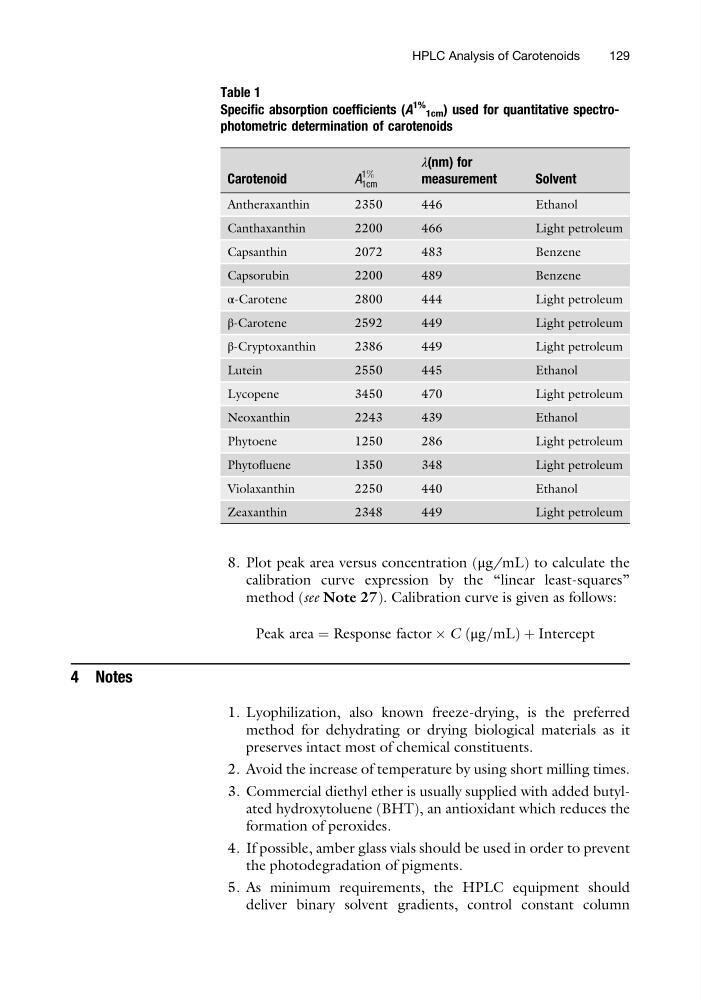
Table 1
Specific absorption coefficients (A
1%
1cm ) used for quantitative spectrophotometric determination of carotenoids
Carotenoid
A
1%
1cm
λ(nm) for
measurement
Solvent
Antheraxanthin
2350
446
Ethanol
Canthaxanthin
2200
466
Light petroleum
Capsanthin
2072
483
Benzene
Capsorubin
2200
489
Benzene
α-Carotene
2800
444
Light petroleum
β-Carotene
2592
449
Light petroleum
β-Cryptoxanthin
2386
449
Light petroleum
Lutein
2550
445
Ethanol
Lycopene
3450
470
Light petroleum
Neoxanthin
2243
439
Ethanol
Phytoene
1250
286
Light petroleum
Phytofluene
1350
348
Light petroleum
Violaxanthin
2250
440
Ethanol
Zeaxanthin
2348
449
Light petroleum
HPLC Analysis of Carotenoids
129
calibration curve expression by the “linear least-squares”
method (see Note 27). Calibration curve is given as follows:
Peak area ¼ Response factor  C μg=mL
ð
ÞþIntercept
4 Notes
1. Lyophilization, also known freeze-drying, is the preferred
method for dehydrating or drying biological materials as it
preserves intact most of chemical constituents.
2. Avoid the increase of temperature by using short milling times.
3. Commercial diethyl ether is usually supplied with added butylated hydroxytoluene (BHT), an antioxidant which reduces the
formation of peroxides.
4. If possible, amber glass vials should be used in order to prevent
the photodegradation of pigments.
5. As minimum requirements, the HPLC equipment should
deliver binary solvent gradients, control constant column
Table 1
Specific absorption coefficients (A
1%
1cm ) used for quantitative spectrophotometric determination of carotenoids
Carotenoid
A
1%
1cm
λ(nm) for
measurement
Solvent
Antheraxanthin
2350
446
Ethanol
Canthaxanthin
2200
466
Light petroleum
Capsanthin
2072
483
Benzene
Capsorubin
2200
489
Benzene
α-Carotene
2800
444
Light petroleum
β-Carotene
2592
449
Light petroleum
β-Cryptoxanthin
2386
449
Light petroleum
Lutein
2550
445
Ethanol
Lycopene
3450
470
Light petroleum
Neoxanthin
2243
439
Ethanol
Phytoene
1250
286
Light petroleum
Phytofluene
1350
348
Light petroleum
Violaxanthin
2250
440
Ethanol
Zeaxanthin
2348
449
Light petroleum
HPLC Analysis of Carotenoids
129