

58
T. B. Asafa et al.
(b)
(a)
(d)
2
3
4
5
6
7
8
9
10
11
12
Weight Loss (g)
Weight Loss
0
0.15 0.175
0.2
0.35
400
800
1200
1600
2000
No of cycles to scratch 9.31g of paint
No of cycles to scratch 9.31g of paint
Concentration of AgNPs (wt%)
(c)
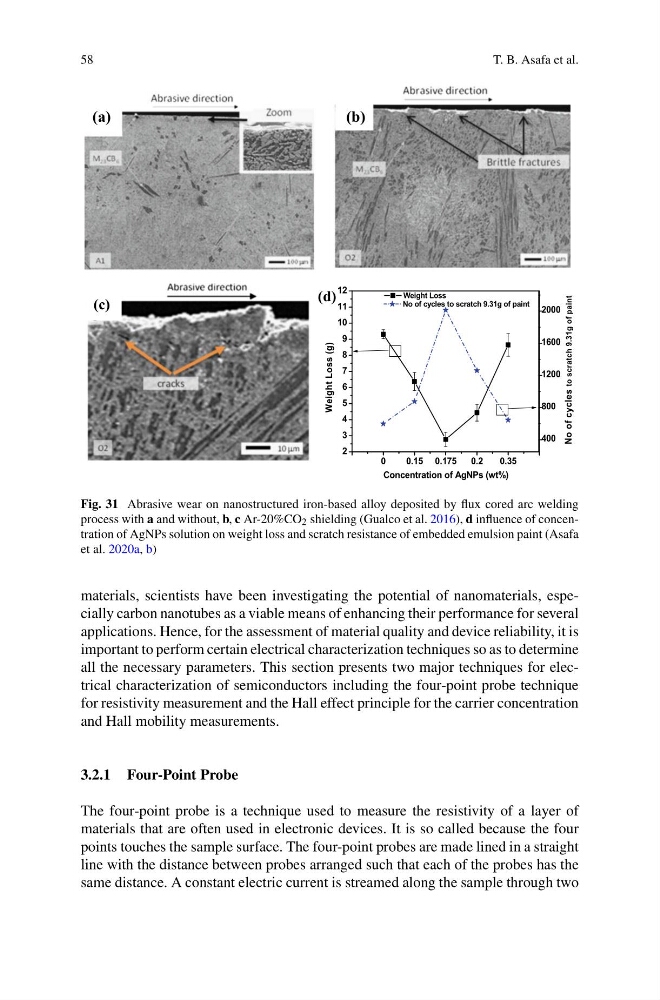
Fig. 31 Abrasive wear on nanostructured iron-based alloy deposited by flux cored arc welding
process with a and without, b, c Ar-20%CO 2 shielding (Gualco et al. 2016), d influence of concentration of AgNPs solution on weight loss and scratch resistance of embedded emulsion paint (Asafa
et al. 2020a, b)
materials, scientists have been investigating the potential of nanomaterials, especially carbon nanotubes as a viable means of enhancing their performance for several
applications. Hence, for the assessment of material quality and device reliability, it is
important to perform certain electrical characterization techniques so as to determine
all the necessary parameters. This section presents two major techniques for electrical characterization of semiconductors including the four-point probe technique
for resistivity measurement and the Hall effect principle for the carrier concentration
and Hall mobility measurements.
3.2.1 Four-Point Probe
The four-point probe is a technique used to measure the resistivity of a layer of
materials that are often used in electronic devices. It is so called because the four
points touches the sample surface. The four-point probes are made lined in a straight
line with the distance between probes arranged such that each of the probes has the
same distance. A constant electric current is streamed along the sample through two
T. B. Asafa et al.
(b)
(a)
(d)
2
3
4
5
6
7
8
9
10
11
12
Weight Loss (g)
Weight Loss
0
0.15 0.175
0.2
0.35
400
800
1200
1600
2000
No of cycles to scratch 9.31g of paint
No of cycles to scratch 9.31g of paint
Concentration of AgNPs (wt%)
(c)
Fig. 31 Abrasive wear on nanostructured iron-based alloy deposited by flux cored arc welding
process with a and without, b, c Ar-20%CO 2 shielding (Gualco et al. 2016), d influence of concentration of AgNPs solution on weight loss and scratch resistance of embedded emulsion paint (Asafa
et al. 2020a, b)
materials, scientists have been investigating the potential of nanomaterials, especially carbon nanotubes as a viable means of enhancing their performance for several
applications. Hence, for the assessment of material quality and device reliability, it is
important to perform certain electrical characterization techniques so as to determine
all the necessary parameters. This section presents two major techniques for electrical characterization of semiconductors including the four-point probe technique
for resistivity measurement and the Hall effect principle for the carrier concentration
and Hall mobility measurements.
3.2.1 Four-Point Probe
The four-point probe is a technique used to measure the resistivity of a layer of
materials that are often used in electronic devices. It is so called because the four
points touches the sample surface. The four-point probes are made lined in a straight
line with the distance between probes arranged such that each of the probes has the
same distance. A constant electric current is streamed along the sample through two