

46
T. B. Asafa et al.
and essential tool for the characterization of nanostructured materials. Further information can be extracted from the high-resolution investigations, including peculiar
insights into the controlling effect of structural discontinuities on a range of physical
and chemical processes such as phase transformations, oxidation reactions, epitaxial
growth, and catalysis.
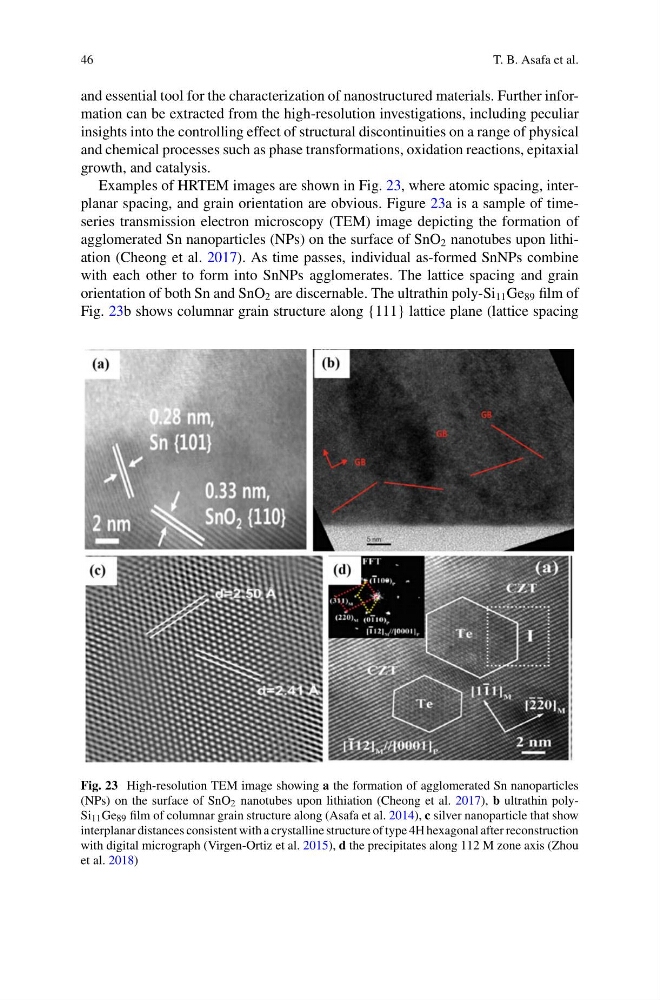
Examples of HRTEM images are shown in Fig. 23, where atomic spacing, interplanar spacing, and grain orientation are obvious. Figure 23a is a sample of timeseries transmission electron microscopy (TEM) image depicting the formation of
agglomerated Sn nanoparticles (NPs) on the surface of SnO 2 nanotubes upon lithiation (Cheong et al. 2017). As time passes, individual as-formed SnNPs combine
with each other to form into SnNPs agglomerates. The lattice spacing and grain
orientation of both Sn and SnO 2 are discernable. The ultrathin poly-Si 11 Ge 89 film of
Fig. 23b shows columnar grain structure along {111} lattice plane (lattice spacing
Fig. 23 High-resolution TEM image showing a the formation of agglomerated Sn nanoparticles
(NPs) on the surface of SnO 2 nanotubes upon lithiation (Cheong et al. 2017), b ultrathin polySi 11 Ge 89 film of columnar grain structure along (Asafa et al. 2014), c silver nanoparticle that show
interplanar distances consistent with a crystalline structure of type 4H hexagonal after reconstruction
with digital micrograph (Virgen-Ortiz et al. 2015), d the precipitates along 112 M zone axis (Zhou
et al. 2018)
T. B. Asafa et al.
and essential tool for the characterization of nanostructured materials. Further information can be extracted from the high-resolution investigations, including peculiar
insights into the controlling effect of structural discontinuities on a range of physical
and chemical processes such as phase transformations, oxidation reactions, epitaxial
growth, and catalysis.
Examples of HRTEM images are shown in Fig. 23, where atomic spacing, interplanar spacing, and grain orientation are obvious. Figure 23a is a sample of timeseries transmission electron microscopy (TEM) image depicting the formation of
agglomerated Sn nanoparticles (NPs) on the surface of SnO 2 nanotubes upon lithiation (Cheong et al. 2017). As time passes, individual as-formed SnNPs combine
with each other to form into SnNPs agglomerates. The lattice spacing and grain
orientation of both Sn and SnO 2 are discernable. The ultrathin poly-Si 11 Ge 89 film of
Fig. 23b shows columnar grain structure along {111} lattice plane (lattice spacing
Fig. 23 High-resolution TEM image showing a the formation of agglomerated Sn nanoparticles
(NPs) on the surface of SnO 2 nanotubes upon lithiation (Cheong et al. 2017), b ultrathin polySi 11 Ge 89 film of columnar grain structure along (Asafa et al. 2014), c silver nanoparticle that show
interplanar distances consistent with a crystalline structure of type 4H hexagonal after reconstruction
with digital micrograph (Virgen-Ortiz et al. 2015), d the precipitates along 112 M zone axis (Zhou
et al. 2018)